Disclosure: We’re reader supported. When you buy through links on our site, we may earn a commission: Full Disclosure.
I almost shared the headline.
A trade site ran a story about slashing Salmonella from microgreens seeds. It landed in the same weeks a single broccoli seed lot was tied to 32 illnesses in six states (FDA, 2026). Microgreens get eaten raw, so a germ that rides in on the seed has no cooking step waiting for it.
So I read the USDA paper down to its charts, crop by crop. Two plant-based washes cut Salmonella on the seed. No tray came out clean, and the headline left out where the rest of it went.
Key Takeaway
Two plant-based seed washes cut Salmonella on brassica microgreen seed by up to 2.15 log in a USDA lab study (Bhattarai et al., 2026). That is a lower load, not a clean tray. At harvest, kale and red cabbage still carried about 2 log, broccoli and daikon barely moved, and the soil held 3 to 6 log.
Below: what the washes did to seed and germination, what was left on five crops at harvest, what stayed in the soil, and where a wash fits in your plan.
Comprehensive Food Safety for Microgreens
Is it really possible for a one-person microgreens farm to have every seed step written down, from the bag to the tray, before the next seed order arrives?
A seed wash is one step. The guide is the rest of the system this post does not give you: the guide itself, eight templates, the Seed Sourcing SOP Module and the Seed Lot Record app on your phone. Written for a grower who hates paperwork.
You know which lot went into which tray, and you can show it.
$97 · One payment, instant access · Educational only. Not compliance or legal advice.
Can you wash Salmonella off microgreen seeds?
The Sprout Safety Alliance and the FDA made this video to show the seed treatment step sprout growers must follow under the Produce Safety Rule. Microgreens growers are not held to that step, so most of us decide on our own whether to wash seed at all.
A team from the University of Maryland and the USDA lab in Beltsville tested two washes on five brassicas: daikon radish, broccoli, mustard, red cabbage and red Russian kale (Bhattarai et al., 2026). One was BIT, a compound brassicas make on their own, mixed into tiny droplets. The other was Sporan, a plant-oil fungicide sold for organic growing. The seed got a coat of four Salmonella strains first, then a 15-minute stirred soak and 5 minutes of standing time.
On the seed, the washes worked. BIT took mustard seed from 3.28 to 1.13 log CFU/g, a cut of 2.15 log. In English, that is about 99% fewer bacteria. Sporan’s best was 1.74 log.
Here is the catch. The paper’s own chart shows a plain water rinse knocked Salmonella down on mustard and kale seed too, so against water most cuts fall under 1 log. Daikon barely moved. The seed supplier post covers what other seed soaks have managed on alfalfa and other crops.
Does a seed wash hurt germination or yield?
It can, and the damage depends on the crop. In a dish test, kale seed treated with BIT sprouted at about 7%, against 80% for water-rinsed seed. Sporan dropped daikon to about 32%, against 99% for water. Broccoli held up best, at 88% after Sporan.
The trays told a gentler story. Fresh yield at day 14 barely changed for four of the five microgreens. Broccoli came in between about 228 and 240 grams per tray, washed or not. Daikon was the exception: BIT trays yielded 97 grams, against 202 grams for water-rinsed seed.
Why the gap? The dish test soaked seed in more liquid and set it on wet paper, with no soil to soak up what was left on it. The trays used drained, dried seed in organic potting soil, sprouted in the dark at 29°C (84.2°F) and grown at 24°C (75.2°F) under LEDs.
Read the dish numbers as a warning, not a forecast. A wash that cuts Salmonella and costs you a third of your stand is a trade worth testing on one tray before you bet a week of orders on it.
How much Salmonella was left on the microgreens at harvest?
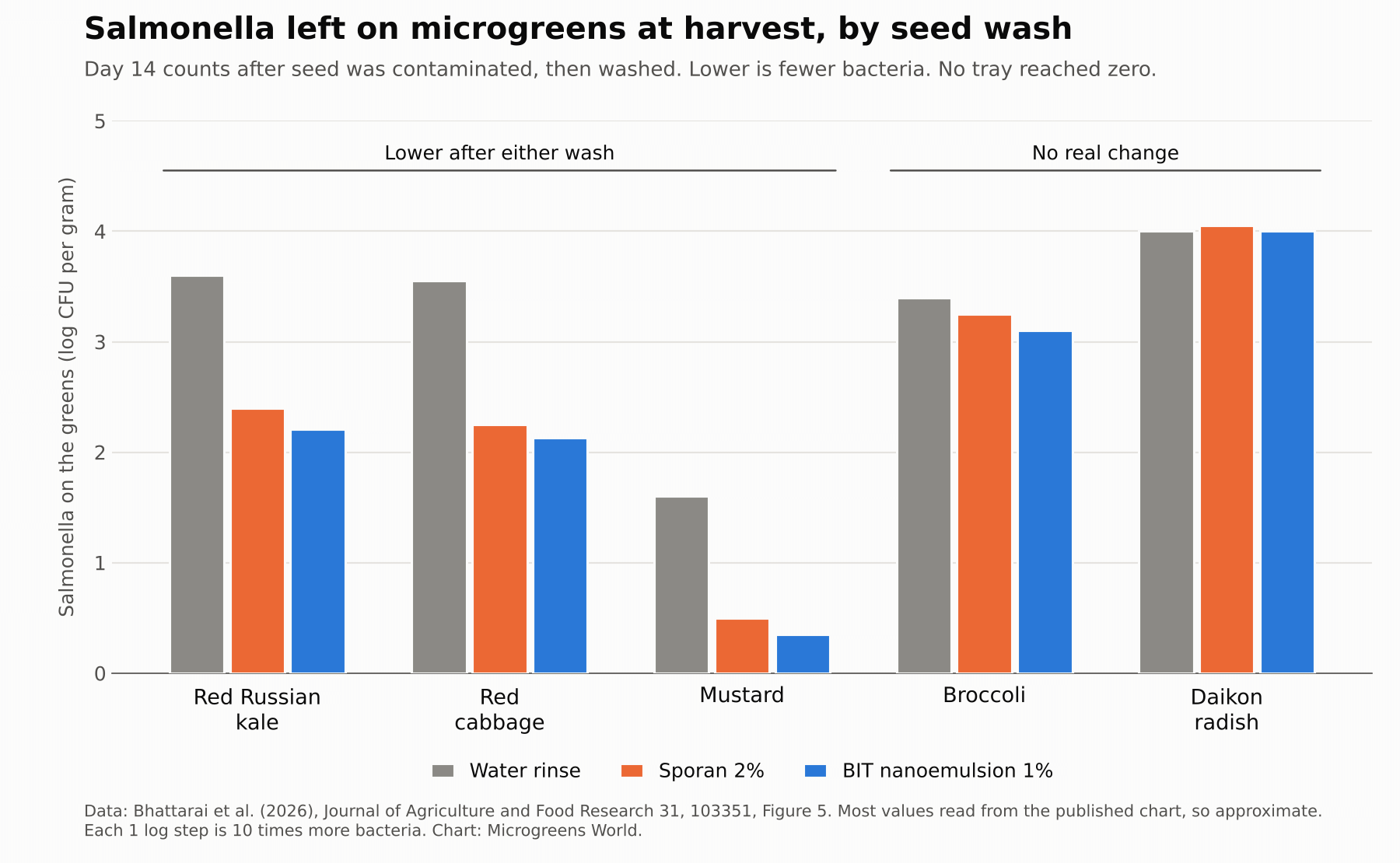
Some, on every tray. At day 14, microgreens grown from water-rinsed seed carried between about 1.6 and 4 log CFU/g of Salmonella, depending on the crop.
Three crops responded to a wash. Red Russian kale fell from about 3.6 log to 2.2 after BIT. Red cabbage dropped from about 3.6 to 2.1. Mustard went from about 1.6 to under half a log. Sporan landed close to BIT on all three, a result the abstract plays down.
Two crops did not respond. Broccoli stayed near 3 log under every treatment, and daikon held at about 4 log no matter what touched the seed.
You may read that the wash cut Salmonella on kale by 1.78 log. That number is the BIT trays dropping between day 7 and day 14, not BIT against untreated trays. Against water at harvest, the gap is closer to 1.4.
The same lab has seen pathogens from contaminated seed hold on to harvest in daikon, mustard, broccoli and red cabbage before (Rao et al., 2025). Eat microgreens rather than grow them? The recall tracker shows what is active right now.
What happens to Salmonella in the soil after a seed wash?
It stays, and in several trays it grew. The potting soil under the microgreens held 3.2 to 5.9 log CFU/g of Salmonella across crops and sampling days. No wash changed that number, and counts climbed from day 7 to day 14 in several trays.
The washes act on the seed and the seedling. Once Salmonella rides into the tray, the growing medium keeps a supply of its own. The authors point to BIT binding to soil and plant oils breaking down in a moist, rich mix.
This study grew everything in soil. In an earlier USDA trial, daikon grown on fiber pads from contaminated seed carried about 6.5 log Salmonella at day 14. On composted manure and soil, it carried about 4.7 (Chen et al., 2023). Grow on mats or pads? Don’t assume the soil numbers carry over to your setup.
The medium is part of the hazard, so don’t reuse media from a tray sown with a suspect seed lot. Growing adds to the count too. In radish grown from E. coli-contaminated seed, the counts climbed on the microgreens as they grew, less than on sprouts and still up (Xiao et al., 2014).
Should microgreen growers use a seed wash at all?
Maybe, as one layer. A wash is not a kill step, and it does not replace the rest of a plan for Salmonella in microgreens.
Conventional treatments do comparable work on paper. A hydrogen peroxide and peracetic acid soak, followed by dry heat at 60°C (140°F), cut Listeria by about 2.4 log on borage seed and 3.3 log on carrot seed (Ayilaran et al., 2026). Germination held up. Different germ, different seed, so read it as a range rather than a match.
Two cautions before anyone reaches for a bottle. BIT nanoemulsion is a lab mix, not a product you can buy. Sporan is sold as a fungicide, and nothing in the paper shows a label for treating seed against Salmonella. Anything that touches your seed needs a label for that use, and it belongs in your written food safety plan.
The layers that carry more weight start before the wash. The FDA’s broccoli investigation came down to one supplier lot, W4105, and three seed recalls so far (FDA, 2026). Buy by lot, ask for test results, and log every lot against the trays you sow from it. The supplier post lists what to ask a seed supplier before you buy.
Wrap-up: Salmonella in microgreens and the seed wash
Two plant-based washes made a real dent in Salmonella on brassica seed and a smaller dent on the microgreens at harvest. Kale, red cabbage and mustard came out lower, broccoli and daikon did not budge, and the soil kept its Salmonella the whole time.
So the answer to the headline is a qualified one. A wash lowers the load. It does not hand you a clean tray, and it says nothing about the lot you bought.
A seed wash is one piece of a larger picture. The food safety hub for growers puts it next to the seed records, the water and the buyer questions that make up the rest.
Comprehensive Food Safety for Microgreens
Is it really possible for a one-person microgreens farm to have every seed step written down, from the bag to the tray, before the next seed order arrives?
A seed wash is one step. The guide is the rest of the system this post does not give you: the guide itself, eight templates, the Seed Sourcing SOP Module and the Seed Lot Record app on your phone. Written for a grower who hates paperwork.
You know which lot went into which tray, and you can show it.
$97 · One payment, instant access · Educational only. Not compliance or legal advice.
Microgreens salmonella: frequently asked questions
What is benzyl isothiocyanate?
Benzyl isothiocyanate, or BIT, is a compound brassica plants release from their glucosinolates. In this study it was a lab-made seed wash, spread in droplets 12 to 34 nanometers across. Its only job here was killing Salmonella on seed. The paper makes no claim about eating it in microgreens.
Is Sporan approved for treating microgreen seeds?
Not that this paper shows. Sporan is a plant-oil fungicide from KeyPlex, sold for organic growing, and the study tested it at 2%. The product label governs every use. If a treatment isn’t labeled for seed, leave it out of your food safety plan until your regulator or extension agent says otherwise.
What does a 2-log reduction mean?
It means 99% fewer bacteria. Each log is a factor of 10, so 1 log is 90% fewer and 3 log is 99.9% fewer. Start with 10,000 Salmonella cells per gram and a 2-log cut leaves about 100. A seed wash lowers the risk on microgreens without ending it.
Why did the researchers contaminate the seeds on purpose?
To measure a wash, you need a known starting dose. Scientists call it a challenge study. The team soaked seed in liquid carrying about 10,000 Salmonella cells per milliliter, a heavy dose by design. Seed contaminated in the field can carry more or less, so real results could land on either side.
Does rinsing microgreens after harvest remove Salmonella?
Not reliably. The authors note washing harvested microgreens with sanitizer is not preferred, given how soft and delicate the leaves are. A rinse can’t undo bacteria carried up from the seed into the plant. Heat kills Salmonella, and most microgreens are eaten raw.
Is there a food-grade sanitizer for microgreen seeds?
Plenty of products call themselves food-grade, and the phrase alone doesn’t settle it. The label decides: the product has to be approved for treating seed, at the dose and contact time printed on it. Write that product into your food safety plan and log every batch you treat.
References
Ayilaran, E., McHugh, O., & Jung, Y. (2026). Microgreen seed decontamination: Efficacy of hydrogen peroxide, hydrogen peroxide-peroxyacetic acid, and dry heat against Listeria monocytogenes. Journal of Agriculture and Food Research, 27, 102882. https://doi.org/10.1016/j.jafr.2026.102882
Bhattarai, S., Subedi, U., Pradhan, A. K., & Patel, J. (2026). Preharvest seed treatment with natural antimicrobial formulations to control Salmonella enterica in microgreens. Journal of Agriculture and Food Research, 31, 103351. https://doi.org/10.1016/j.jafr.2026.103351
Chen, C. H., Yin, H. B., & Patel, J. (2023). Influence of contamination source and cultivation matrix on survival of Escherichia coli O157:H7 and Salmonella enterica on daikon microgreens. LWT, 185, 115165. https://doi.org/10.1016/j.lwt.2023.115165
Rao, A. P., Pradhan, A. K., & Patel, J. (2025). Transfer of Salmonella enterica, Escherichia coli O157:H7 and Listeria monocytogenes to microgreens and soil from contaminated seeds. Journal of Agriculture and Food Research, 21, 101761. https://doi.org/10.1016/j.jafr.2025.101761
U.S. Food and Drug Administration. (2026). Outbreak investigation of Salmonella: Sprouts (September 2026) [Investigation notice, updated October 9, 2026]. https://www.fda.gov/food/outbreaks-foodborne-illness/outbreak-investigation-salmonella-sprouts-september-2026
Xiao, Z., Nou, X., Luo, Y., & Wang, Q. (2014). Comparison of the growth of Escherichia coli O157:H7 and O104:H4 during sprouting and microgreen production from contaminated radish seeds. Food Microbiology, 44, 60–63. https://doi.org/10.1016/j.fm.2014.05.015