Disclosure: We’re reader supported. When you buy through links on our site, we may earn a commission: Full Disclosure.
The line that stopped me in the CDC’s outbreak report was a short one. One patient had named a microgreen mix.
It isn’t the cause. The outbreak is tied to broccoli sprouts from Evergreen Fresh Sprouts: 32 people sick in six states, three of them hospitalized, and no seed source named so far (CDC, 2026). But it sent me looking for what a seed bag has to tell you, and what safe microgreens seeds would look like on paper.
I’ve grown from seed bought at Ace Hardware and never had a problem. That says something about my luck. It says nothing about the seed. So here is what regulators actually ask buyers to check.
Key Takeaway
Microgreen seed is ordinary crop seed sold under a use label, and no standard defines it. So the label proves nothing. Ontario asks for a pathogen test certificate for every lot, the US sprout rule asks for inspection and treatment, and treating alfalfa seed cut Salmonella by only 1.3 to 3.9 log (Liao, 2009).
Five questions follow on what makes safe microgreens seeds, from whether microgreen seed is a real category to where the FDA sprout rule stops applying.
Microgreens Food Safety
Would your own paperwork hold up if a buyer asked for it?
The Gap Assessment is a five-minute anonymous questionnaire. It walks 40 checkpoints across 19 FSMA areas and stores nothing, so you see where your records have holes before a buyer or an inspector does.
Educational only. This is not compliance or legal advice.
Are microgreen seeds different from regular seeds?
Grower Curtis Stone explains the agronomic difference in three minutes. It’s one grower’s view on selection and price, and it says nothing about safety.
His point is that the difference sits in how seed gets selected. Microgreen seed is chosen and priced for how a seedling performs in a tray, and he says vegetable seed will most likely work for microgreens, though not the other way round (Stone, 2022). That is an agronomy claim, and a fair one.
Safety is another matter. Researchers who bought 102 seed samples from online vendors, covering 14 species, noted there is no established standard for decontaminating microgreen seed (Ocho Bernal et al., 2023). The FDA’s 2023 sprout guidance does name them, and says microgreens are not sprouts (FDA, 2023).
The legal line doesn’t depend on the seed either. The FDA says it has historically told sprouts from microgreens by the growth stage of the leaves, and notes that microgreens are typically grown in soil or substrate and harvested above it (FDA, 2023). In other words, the rules follow how a crop is grown and cut, not what the bag says.
So a bag marked for microgreens is a sales label, and it can’t tell you how clean the seed is. Our microgreen seed guide covers varieties and sourcing. The safety questions come next.
Can microgreen seeds carry Salmonella or E. coli?
Yes, and contaminated seed is the usual starting point. Ontario’s agriculture ministry says pathogens on sprouted seeds and on microgreens, such as broccoli and pea shoots, have caused numerous recalls and outbreaks in Canada, and that the contamination most often originated from Salmonella or E. coli on the seeds (OMAFRA, 2026).
Sprouts are the better-studied cousin. The FDA counted 52 outbreaks of foodborne illness tied to sprouts in the US between 1996 and 2020 (FDA, 2023). Those are sprouts, not microgreens, and I didn’t find a comparable count for microgreens.
The seed doesn’t have to look bad. In a 2024 experiment with contaminated seed, pathogens carried over to the grown microgreens at 1.6 to 7.7 log CFU/g, and carryover fell as seed size and weight rose (Işık et al., 2024).
It happens in real supply chains. On May 6, 2026, the CFIA announced a Class 1 recall of Germina “Brocoli Calabrese” seed, lot BRR18, for possible pathogenic E. coli. A recall in another country triggered it, and no illnesses were reported (CFIA, 2026).
The picture isn’t all alarming. In the 102-sample survey, no E. coli turned up, and one onion sample screened positive for Salmonella by PCR without a single viable cell (Ocho Bernal et al., 2023). That is a small survey, not a safety rating. Our food safety guide for small growers covers what happens after the seed arrives.
What should I ask a seed supplier before I buy?
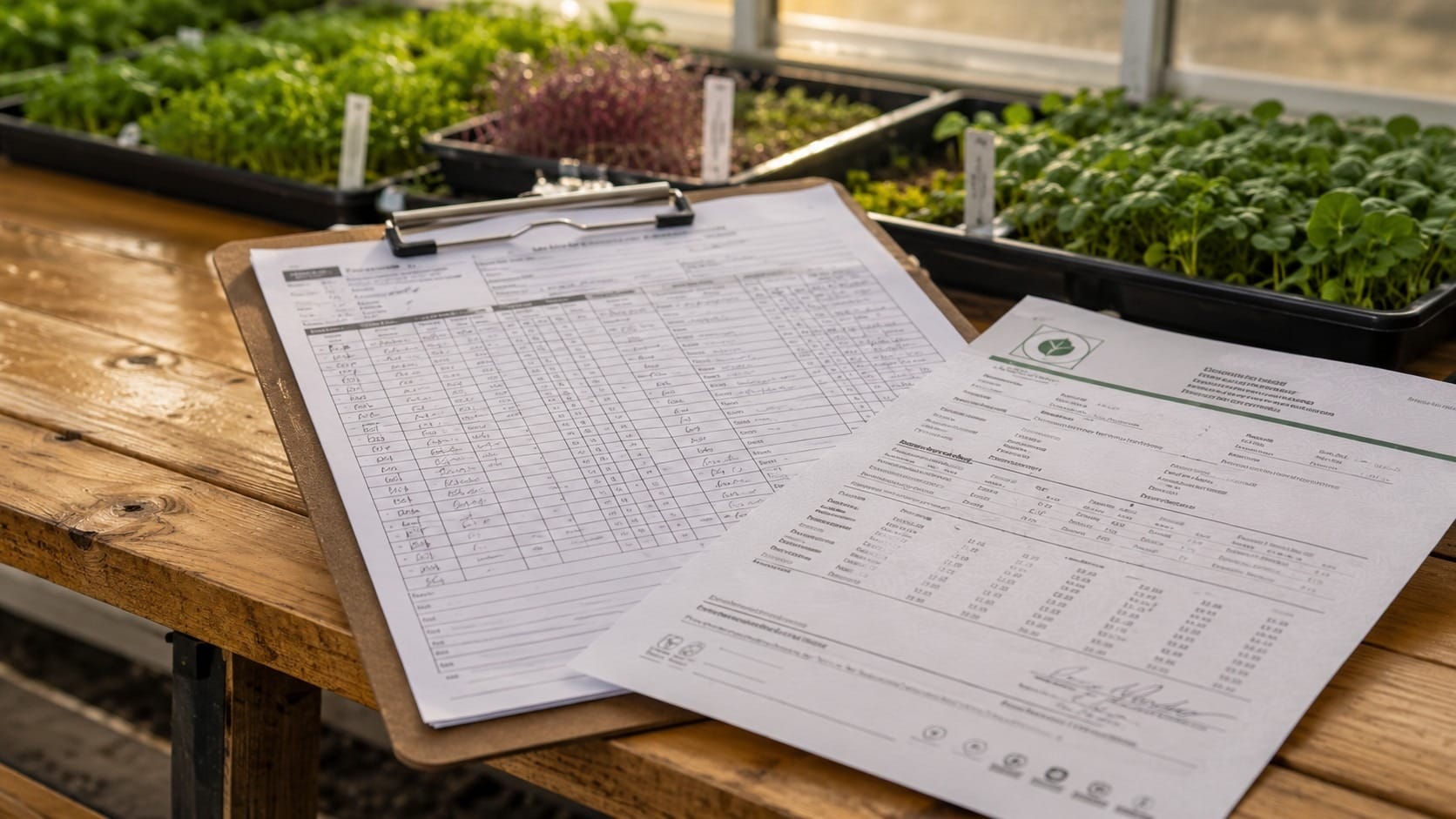
Safe microgreens seeds start with paperwork tied to the exact lot. Canada’s food inspection agency tells sprout producers to get a certificate of analysis for each incoming lot and to check that the bag names its producer or distributor and carries a lot number. Country of origin should be there too (CFIA, 2018). Ontario’s guidance asks for a lot certificate as well (OMAFRA, 2026). Neither is a seed rule written for microgreens. Ontario’s list is advice (“should”), and the CFIA page was written for sprouts, so microgreen growers are borrowing it.
Check the bag when it arrives. The CFIA tells producers to examine incoming bags and keep trace-back records (CFIA, 2018), and the US sprout rule says to visually examine seed and its packaging for signs of contamination (21 C.F.R. § 112.142). Then tie the lot number on the bag to every tray you sow from it. If a recall like Germina’s lands, that link tells you which trays are affected.
Ask what treatment the seed received, in writing. US sprout growers who rely on a supplier’s treatment must hold documentation of it, such as a Certificate of Conformance (21 C.F.R. § 112.142).
Then read the paper with some doubt. The CFIA says a negative test doesn’t guarantee pathogen-free seed, and neither does any treatment (CFIA, 2018). One seller’s checklist video, from Modern Grower, treats testing as the proof. That is a pitch. A certificate is a sample result for one lot. Our seed selection post covers the growing side.
Does soaking or sanitizing seed make it safe?
Not on the evidence I found. The FDA’s seed guidance says treatments may reduce pathogens but not eliminate them (FDA, 2022).
The best-known numbers come from alfalfa. Liao (2009) soaked seed carrying about 15 million Salmonella cells per gram in acidified sodium chlorite. At 800 ppm for 45 minutes, counts fell 3.9 log, which by my arithmetic still leaves roughly 2,000 cells per gram. Weaker doses cut 1.3 to 2.2 log.
Ontario’s guidance asks for a 3-log reduction (OMAFRA, 2026). Clearing that bar took a single pathogen on a single seed type in one lab. A peroxide soak with heat, the sort of method growers pass around online, cut counts 1.46 to 2.83 log on three seed types at 60°C (140°F) for 20 hours, with no germination loss (Ocho Bernal et al., 2023).
Time and place matter too. In Liao’s work, Salmonella on freshly inoculated seed was easier to kill than on seed stored four weeks or longer (Liao, 2009), and a real lot has usually sat in a warehouse. Seed treatment is also only one barrier. Ontario’s list adds rinsing before and after treatment and pasteurizing the growing medium (OMAFRA, 2026), and the 2024 study found pathogens moved to microgreens from contaminated substrate as well as from seed (Işık et al., 2024).
I’m not printing a soak recipe here. Doses that work vary by seed, and a heavy one costs germination: Liao saw a 20 per cent drop with 20,000 ppm calcium hypochlorite. Soaking alone doesn’t give you safe microgreens seeds.
Do microgreen growers have to follow the FDA sprout rule?
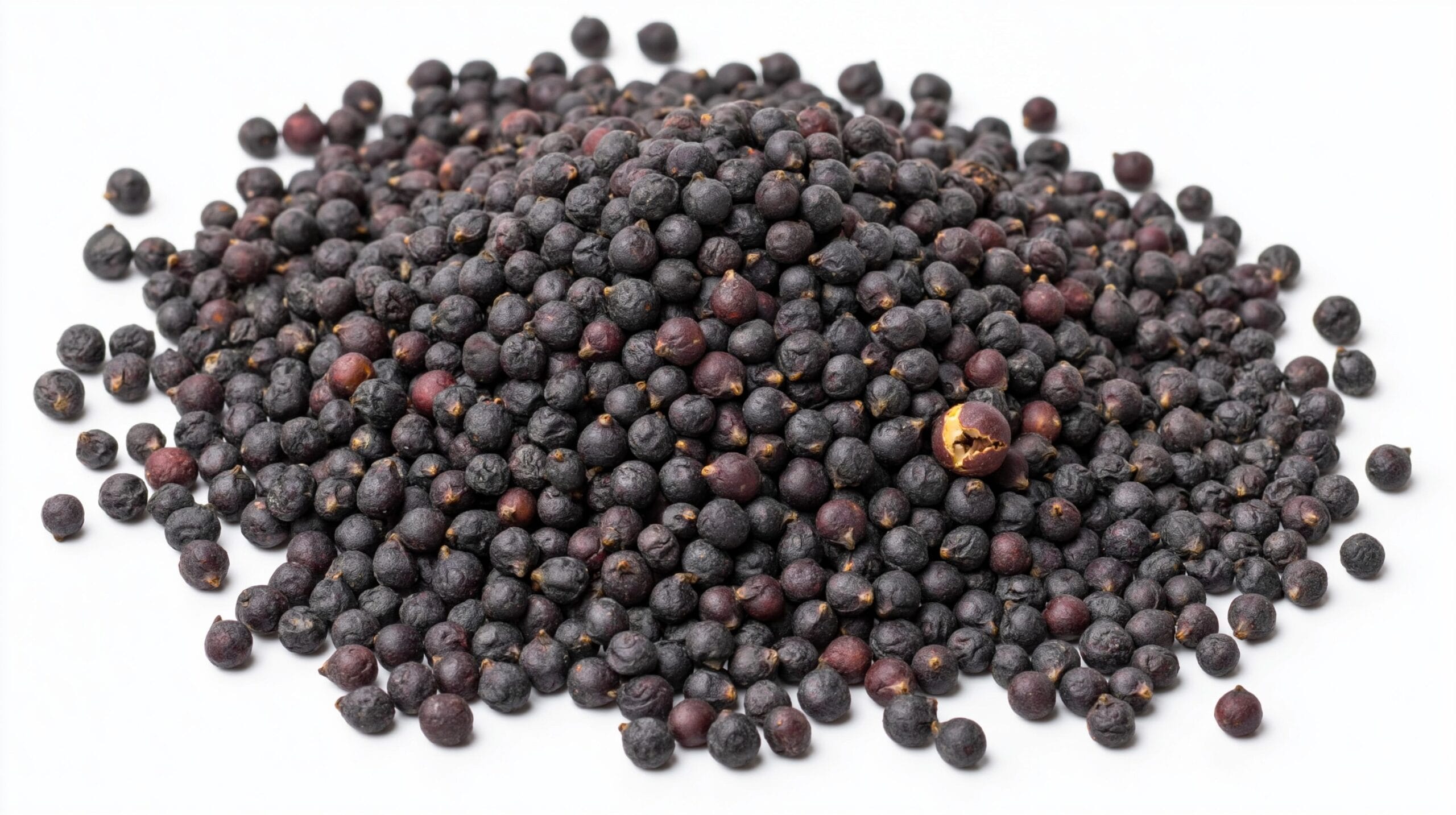
Not the sprout rule itself, but that isn’t the end of it. The FDA’s 2023 sprout guidance says that because microgreens are not sprouts, they are not subject to Subpart M, the sprout section (FDA, 2023). Subpart M is where the seed treatment and seed lot requirements sit (21 C.F.R. §§ 112.141–112.142).
The same guidance adds that microgreens are covered produce under the rest of the Produce Safety Rule, unless a farm is exempt or excluded (FDA, 2023). Which parts reach you depends on your size and your sales, so check with your state regulator. This is not legal advice.
A newer rule is coming. The FDA’s Food Traceability Rule has a compliance date of July 20, 2028. Its food list covers sprouts, among other produce, and doesn’t name microgreens. Farms with $25,000 or less in sales and direct-to-consumer sellers have exemptions (FDA, n.d.).
One edge case deserves a call to your regulator. The guidance says soil-grown sprouts sold in the tray with roots and substrate intact, wheatgrass being its example, are ordinarily subject to Subpart M (FDA, 2023). That passage is about sprouts, and I didn’t find it addressing microgreens sold as living trays. If you sell that way, ask.
Where you sell matters as well. In Ontario, Regulation 119/11 binds anyone who packs or sells produce, microgreens included, unless they are federally licensed (OMAFRA, 2026).
The labeling side is moving too. We covered a petition that could change how sprouts are labeled in the October 2 digest.
Wrap-up: safe microgreens seeds
A bag marked for microgreens tells you how the seller wants it used. It doesn’t tell you what is on the seed. As far as regulators describe them, safe microgreens seeds come with a paper trail for the exact lot, and with a buyer who knows what a test result can’t promise.
Nothing here makes seed risk-free, and nothing I found says the rules are settled. Watch the outbreak page, because the seed source may still be named. If you keep one habit from this post, keep the lot number tied to the tray.
Seed is also a cost line, and the paperwork sits next to price and margin in a business that has to add up. The microgreens business hub is where I keep those numbers together.
Microgreens Food Safety
Would your own paperwork hold up if a buyer asked for it?
The Gap Assessment is a five-minute anonymous questionnaire. It walks 40 checkpoints across 19 FSMA areas and stores nothing, so you see where your records have holes before a buyer or an inspector does.
Educational only. This is not compliance or legal advice.
Every food safety article in one place: food safety for microgreen growers, grouped by seed, growing, harvest, records, rules and recalls.
Safe microgreens seeds: frequently asked questions
Are some microgreen seeds riskier than others?
The data hints at it but doesn’t rank varieties. A few species, borage among them, showed the highest aerobic plate counts in the survey, a general measure with limited relevance to illness (Ocho Bernal et al., 2023). Smaller, lighter seed passed more pathogen to seedlings in the lab (Işık et al., 2024), so tiny seed deserves extra questions.
What do I do if my seed lot is recalled?
Stop using it and stop selling anything grown from it. The CFIA notice for the Germina lot says not to consume, use, sell, serve or distribute it, and to throw it out or return it (CFIA, 2026). US sprout growers must also discontinue the lot and tell their supplier (21 C.F.R. § 112.142).
Are organic microgreen seeds safer?
I found no evidence of that. Organic standards don’t directly address microbial hazards, and a CDC review counted 18 outbreaks tied to organic foods from 1992 to 2014 (Harvey et al., 2016). Organic law does require organic seed for edible sprouts (7 C.F.R. § 205.204), so ask your certifier how microgreens are classified.
How long should I keep seed lot records?
No rule I found sets a number for microgreens. If you end up covered by the Food Traceability Rule, records are kept two years from July 20, 2028 (21 C.F.R. § 1.1455). The European sprout guideline says only for a sufficient time after the sprouts are eaten (European Sprouted Seeds Association [ESSA], 2017). Keep them longer than your shortest buyer contract.
References
Centers for Disease Control and Prevention. (2026). Salmonella outbreak linked to broccoli sprouts [Investigation notice, updated September 24, 2026]. https://www.cdc.gov/salmonella/outbreaks/broccoli-sprouts-09-26/investigation.html
Canadian Food Inspection Agency. (2018). Preventive controls for the hygienic production of sprouted seeds. https://inspection.canada.ca/en/preventive-controls/fresh-fruits-vegetables/sprouted-seeds
Canadian Food Inspection Agency. (2026, May 6). Germina brand “Brocoli Calabrese” seeds recalled due to pathogenic E. coli (RA-82039). https://recalls-rappels.canada.ca/en/alert-recall/germina-brand-brocoli-calabrese-seeds-recalled-due-pathogenic-e-coli
Code of Federal Regulations, Title 7, § 205.204 (n.d.). Seeds and planting stock practice standard. https://www.ecfr.gov/current/title-7/section-205.204
Code of Federal Regulations, Title 21, §§ 112.141–112.142 (n.d.). Standards for the growing, harvesting, packing, and holding of produce for human consumption, Subpart M: Sprouts. https://www.ecfr.gov/current/title-21/chapter-I/subchapter-B/part-112/subpart-M
Code of Federal Regulations, Title 21, § 1.1455 (n.d.). Requirements for additional traceability records for certain foods. https://www.ecfr.gov/current/title-21/section-1.1455
European Sprouted Seeds Association. (2017). European hygiene guideline for the production of sprouts and seeds for sprouting [Endorsed December 13, 2016; published in the Official Journal of the European Union, July 8, 2017]. https://food.ec.europa.eu/system/files/2017-12/biosafety_fh_guidance_essa_sprouts-and-seeds_en.pdf
Food and Drug Administration. (n.d.). FSMA final rule on requirements for additional traceability records for certain foods. https://www.fda.gov/food/food-safety-modernization-act-fsma/fsma-final-rule-requirements-additional-traceability-records-certain-foods
Food and Drug Administration. (2022). Guidance for industry: Reducing microbial food safety hazards in the production of seed for sprouting. https://www.fda.gov/regulatory-information/search-fda-guidance-documents/guidance-industry-reducing-microbial-food-safety-hazards-production-seed-sprouting
Food and Drug Administration. (2023). Guidance for industry: Standards for the growing, harvesting, packing, and holding of sprouts for human consumption. https://www.fda.gov/regulatory-information/search-fda-guidance-documents/guidance-industry-standards-growing-harvesting-packing-and-holding-sprouts-human-consumption
Harvey, R. R., Zakhour, C. M., & Gould, L. H. (2016). Foodborne disease outbreaks associated with organic foods in the United States. Journal of Food Protection, 79(11), 1953–1958. https://doi.org/10.4315/0362-028X.JFP-16-204
Işık, S., Çetin, B., & Topalcengiz, Z. (2024). Transfer of Salmonella, Escherichia coli O157:H7 and Listeria monocytogenes from contaminated soilless substrate and seeds to microgreens. International Journal of Food Microbiology, 414, 110612. https://doi.org/10.1016/j.ijfoodmicro.2024.110612
Liao, C.-H. (2009). Acidified sodium chlorite as an alternative to chlorine for elimination of Salmonella on alfalfa seeds. Journal of Food Science, 74(4), M159–M164. https://doi.org/10.1111/j.1750-3841.2009.01125.x
Ocho Bernal, T. G., Lyttle, N., & Jung, Y. (2023). Microbiological quality of microgreen seeds purchased from online vendors and evaluating seed decontamination techniques available online. Frontiers in Sustainable Food Systems, 7, 1264472. https://doi.org/10.3389/fsufs.2023.1264472
Ontario Ministry of Agriculture, Food and Agribusiness. (2026). Overview of food safety for sprouts and microgreens [Updated April 9, 2026]. https://www.ontario.ca/page/overview-food-safety-sprouts-and-microgreens
Stone, C. (2022, September 19). Know your seeds: Microgreen seeds vs regular seeds [Video]. Freedom.Farmers. YouTube. https://www.youtube.com/watch?v=2E1IO3nsnJ8