Disclosure: We’re reader supported. When you buy through links on our site, we may earn a commission: Full Disclosure.
Every seeding chart on the internet disagrees with every other one.
Look up microgreens seeding density and you get radish at one ounce a tray from one site and nearly two from the next. One popular cheat sheet carries 15 to 20 grams per 1020 tray and 450 grams per 1020 tray in the same article. Nobody shows their working, because there was rarely any working to show.
Two things changed that in the last two years. A Brazilian team crossed four seeding densities with four light levels in four crops, and a Danish team ran the same question against spectrum and fertiliser. Both published their numbers. What follows is built from those tables.
Key Takeaway
Raising seeding density lifted fresh weight 20 to 51 per cent across four crops, while tripling the light moved one crop by about ten per cent (Lima et al., 2026). A second lab found the same shape: nearly six times the light bought 10 per cent (Cowden et al., 2024). The ceiling is real, though. Sunflower yielded less at the highest rate tested.
Below is the chart, the yield you can expect from it, the light question it settles, and the three things crowding costs you.
Microgreens Profitability Calculator
Seed is your second biggest cost. Most growers have never priced it per tray.
Put your own seed price, tray count, and sale price in, and see what each crop actually returns. Your numbers, not a range off somebody else’s blog.
Educational only. No income is promised. Results vary by crop, market, and season.
How much seed per tray does each crop actually need?
Here is the only microgreens seeding density chart I know of where every row traces to a published trial. The middle column is the rate that won in that trial. The per-tray column is my conversion, not the paper’s, and the assumption behind it is in the note below the table.
| Crop | Rates tested | Rate that won | Per 1020 tray | Source |
|---|---|---|---|---|
| Sunflower | 1,275 to 2,125 g/m² | 1,700 g/m² | 219 g, 7.7 oz | Lima 2026 |
| Radish | 272 to 408 g/m² | 408 g/m² | 53 g, 1.9 oz | Lima 2026 |
| Green cabbage | 126 to 235 g/m² | 235 g/m² | 30 g, 1.1 oz | Lima 2026 |
| Red cabbage | 126 to 235 g/m² | 180 g/m² | 23 g, 0.8 oz | Lima 2026 |
| Rapini | 3 to 5 seeds/cm² | 5 seeds/cm², 115 g/m² | 15 g, 0.5 oz | Signore 2024 |
| Kale | 3 to 5 seeds/cm² | 5 seeds/cm² | 25 g, 0.9 oz | Signore 2024 |
| Cress | 3.5 to 4.5 seeds/cm² | 4.5 seeds/cm² | 12 g, 0.4 oz | Signore 2024 |
| Beet | 50 to 450 g/m² | 300 g/m² under white light | 39 g, 1.4 oz | de Freitas 2024 |
Per-tray figures are converted at 0.129 m² of sown area for a 10 by 20 inch tray. Kale and cress grams are converted from each paper’s own thousand-seed weight. Both conversions are mine, not the authors’.
Self-Watering Growing Trays
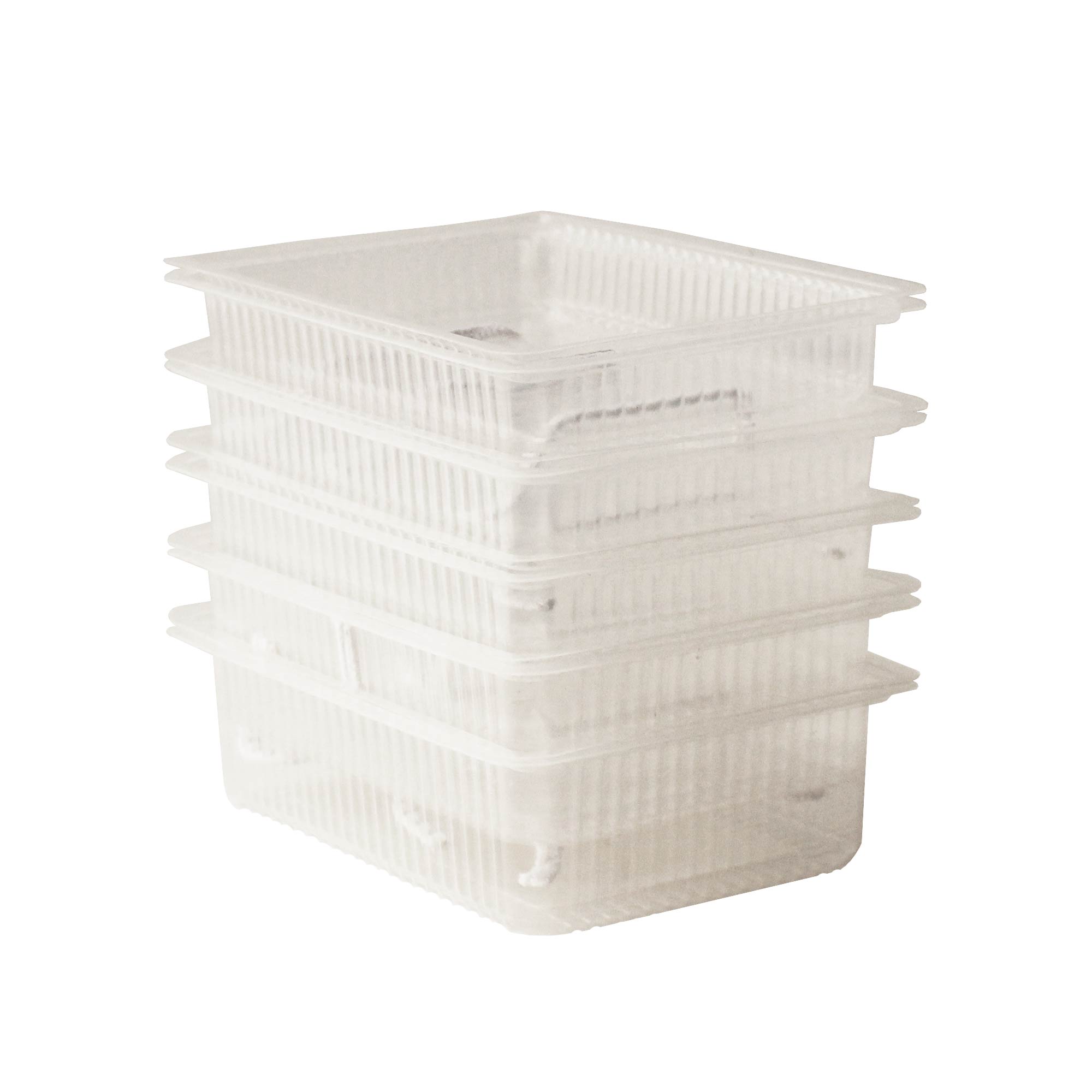
Self Watering Microgreens Growing Trays – …
Self-watering microgreens grow trays for growing small quantities of microgreens on any countertop or windowsill … [More]
Premium Bamboo Microgreens Grow Mats
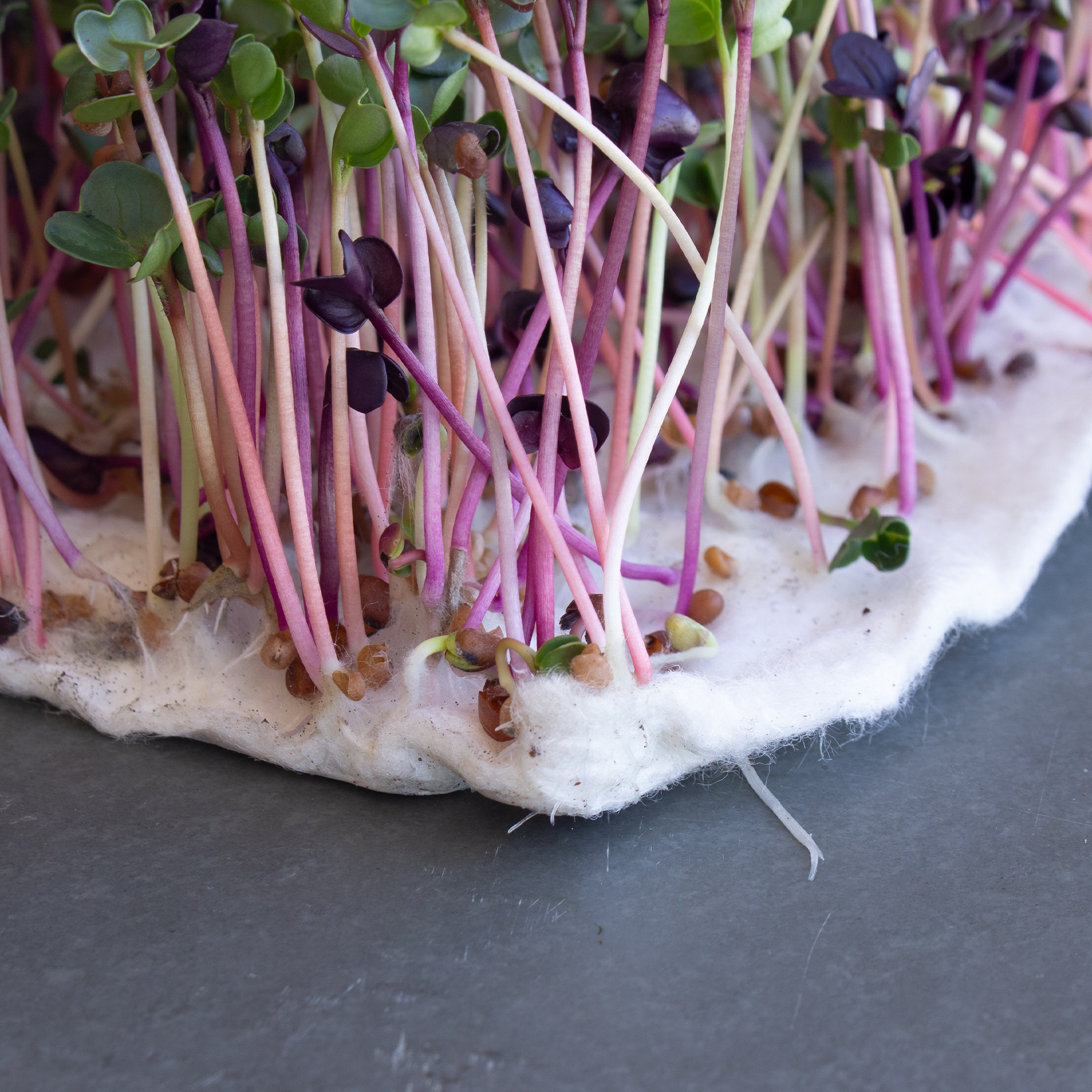
Premium Bamboo Microgreens Grow Mats – Pac…
Microgreens hydroponic grow mats made from premium, sustainable bamboo fiber… [More]
Two of those numbers will look high. Sunflower at 7.7 ounces sits above the four to six most growers run, and radish at 1.9 sits above the usual one. Neither trial was run on your substrate or your watering routine, so treat the winning rate as the top of a range to test toward.
What yield should a tray actually give you?
This is the question underneath the seeding density question, and it is where the seed cost gets settled.
Lima reported fresh weight per square metre at each rate. Converted to a 1020 tray at the same 0.129 square metres, sunflower came in near 1.0 kilogram. Radish sat at 0.57 and green cabbage at 0.49. Red cabbage, the lightest of the four, managed about 0.35.
Put those beside the seed and the picture inverts. Sunflower returns the most weight and eats 7.7 ounces of seed to do it. Red cabbage returns a third of that weight on under an ounce. Weight per tray and margin per tray are different questions, and only one of them is in any paper.
Signore found something that belongs here too. In their rapini trial, moving from 3 to 5 seeds per square centimetre raised yield 24 per cent. Harvesting three days later raised it up to 55 per cent. If you are chasing weight, cycle length is the larger lever and it costs no seed at all.
Does more light let you seed more densely?
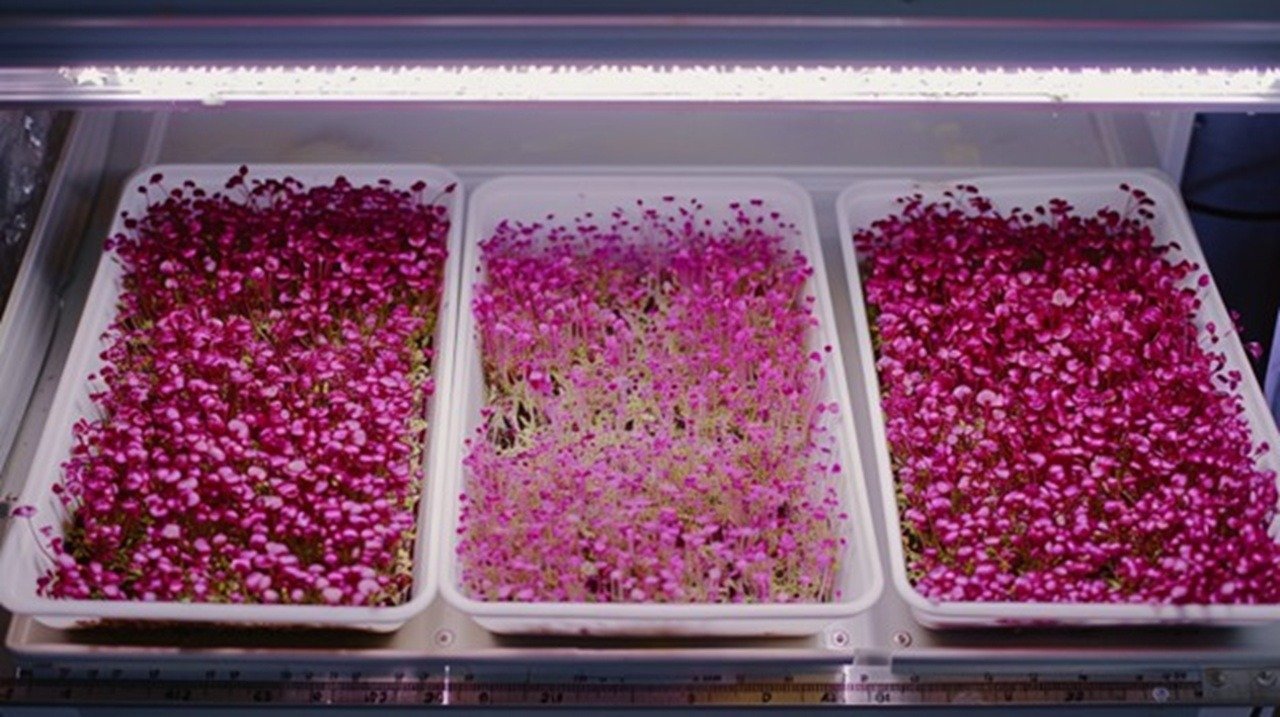
Less than you have been told, and two labs now agree on roughly how much less.
Lima crossed four light intensities from 50 to 200 µmol m⁻² s⁻¹ with three seeding densities in each of four crops. Light moved fresh weight in green cabbage only, peaking near 158 µmol, and the gain was about ten per cent for roughly three times the irradiance. Seeding density moved every crop.
Cowden’s team in Copenhagen ran a harder version of the same test. Their brightest fixture delivered 5.86 times the photons of their cheapest one. The extra light bought 1.10 times the fresh weight. Their statistical model put seeding density at 6.81 per cent of the variation in fresh weight and the light term at 2.09.
Here is the distinction that matters, and most coverage misses it. This is an argument against more light, not against better light. Cowden’s far-red recipe produced 110 to 127 per cent of the fresh weight of the comparison recipes at a lower PPFD. Spectrum cost almost nothing. Intensity was expensive and barely moved anything. If you are still working out your microgreens light requirements in low light, that difference is the one worth acting on.
Is there a seeding density calculator worth trusting?
There are several, they all cost nothing to use, and not one of them shows you where its numbers came from.
That is not a small complaint. A calculator returns a single figure with the authority of arithmetic, and the figure inherits whatever chart was typed into it. When one cheat sheet can carry 15 grams and 450 grams per tray without making clear which crop is which, the calculator inherits that too and hides it behind a clean interface.
Before you trust one, ask it three things. Which trial or dataset is behind this crop’s number. What tray area it assumes, because a 1020 is 0.129 square metres of sown surface and a 1010 is half that. And whether the figure is seed mass or seed count. Thousand-seed weight varies enough that 5 seeds per square centimetre is 115 grams per square metre in rapini and 195 in kale.
There is also a reason no single number can be right for everyone. De Freitas found beet peaked at 300 grams per square metre under broad white light but was still climbing at 450 under narrow red. Same crop, same greenhouse, different lamp, and the correct seeding density moved by half.
What does crowding the tray cost you?
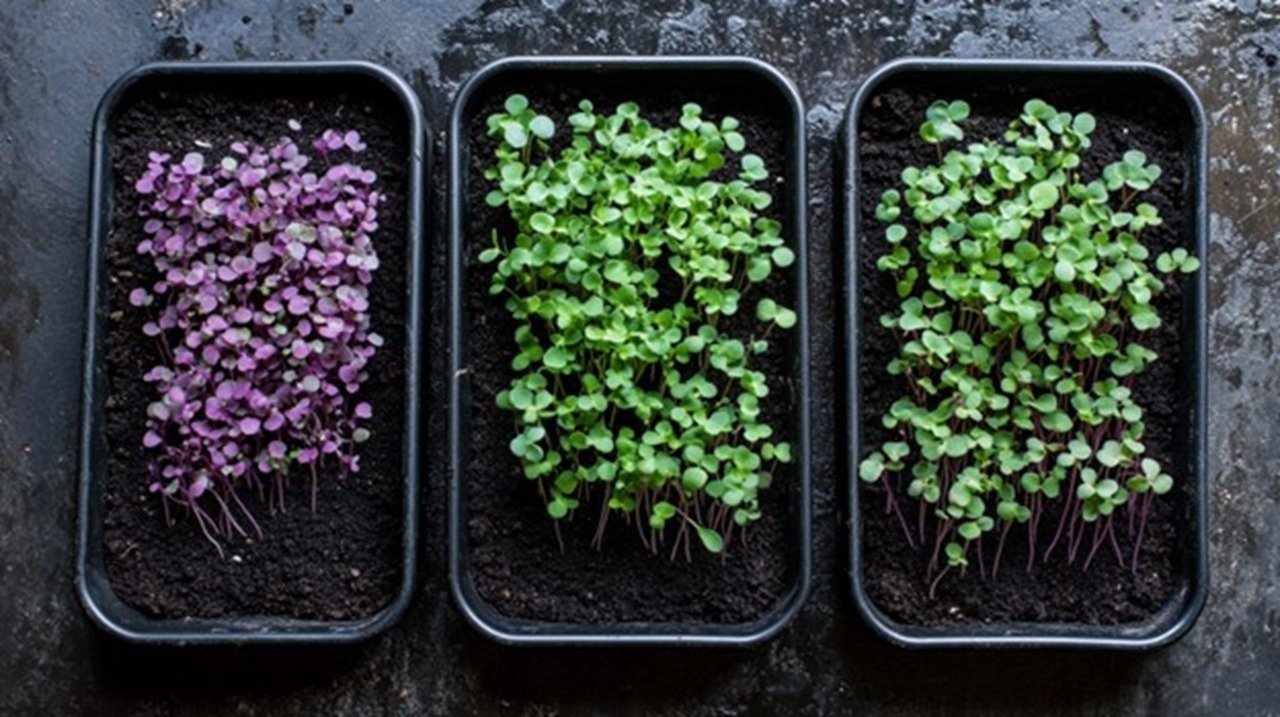
Three things, all measured, and none of them show up in a yield figure.
Colour and antioxidants go first. At Lima’s highest rates, carotenoids fell 13 to 44 per cent depending on crop, and anthocyanins fell in three of the four. Red cabbage was the exception and gained 62 per cent, which is worth knowing if colour is what you sell.
Uniformity goes next. Signore’s kale lost 41 per cent of its canopy uniformity moving from 3 to 5 seeds per square centimetre, growing irregularly toward the centre of the tray. Moving air through a canopy that shape is its own problem, covered separately in our guide to microgreens airflow. Rapini’s true leaves came in 30 per cent shorter at the same jump.
And the seed stops paying for itself. Cowden put 50 per cent more seed in and got 37 per cent more weight, meaning each plant ran at about 91 per cent of its lower-density self. Lima saw the same conversion decline in every crop. Past a point the tray is fuller and the return per gram is falling, which is the part a yield chart will never tell you. Dense trays also hold moisture longer, and that is worth reading alongside what makes microgreens unsafe to eat.
Wrap-up: microgreens seeding density
The short version is that seed rate is the lever and light intensity mostly is not. Two labs on two continents now agree on roughly the size of both. The winning rate has a ceiling, and you can find yours in one cycle with three trays and a scale.
The longer version is that the honest chart is smaller than the ones in circulation. Eight crops have published numbers. Broccoli, the most-searched crop of all, has been in one density trial. Its seed rates and yields ran several times higher than any other trial’s, and its heaviest rate still won, so it never found a ceiling. There’s still no broccoli rate you can trust.
Seeding density is one input into whether a tray pays. If you want to see where it sits against seed cost, cycle time, and price, the microgreens business hub is where the rest of the numbers live.
More seeding density trials
This post builds on four trials. The research database holds more, on crops from basil and amaranth to fenugreek and pea. Here are the newest.
- Loading the newest papers…
Search the seeding density papers
The list updates on its own each week as new papers come out.
Microgreens Profitability Calculator
Seed is your second biggest cost. Most growers have never priced it per tray.
Put your own seed price, tray count, and sale price in, and see what each crop actually returns. Your numbers, not a range off somebody else’s blog.
Educational only. No income is promised. Results vary by crop, market and season.
Microgreens seeding density: frequently asked questions
Does the growing medium change the right seeding rate?
A few trials grew the same crop on different media at different seed rates, including radish, amaranth, and fenugreek. In fenugreek, cocopeat gave the best yield, and 25 grams a tray beat 30. Lima and Signore, the main trials behind this post, didn’t compare media, so treat any published rate as a starting point on your own medium.
Does a low germination rate change how much seed to sow?
Every rate in this post is sown mass or sown count, not plants that came up. Lima used non-treated seed and reported no germination percentage. A lot testing at 80 percent quietly leaves you a fifth short of the stand you think you sowed, so test the lot before trusting the scale.
Should you soak seeds before sowing at a high rate?
Neither trial here tested soaking, so nothing in this post supports an answer either way. Lima sowed dry into coconut fiber and kept trays dark and stacked for the first four days. If you soak, the useful comparison is a split tray against your own unsoaked control rather than a rule copied from another crop.
What happens if you sow too thinly?
You lose coverage before you lose much else. Signore found higher rates improved how completely rapini covered the substrate, and suggested coverage is part of what keeps a tray from lodging. A thin tray also leaves bare medium open under the canopy. Neither trial measured what that does to contamination risk.
Can you sow two crops in one tray at a single rate?
Nothing here supports it. Lima ran each of the four crops as a separate experiment and states plainly that no statistical comparison between species was performed. The winning rates in the chart above differ by nearly twenty times between sunflower and cress, so one rate across a mixed tray is wrong for at least one of them.
Is seeding density the biggest lever you have?
Not according to the one trial that measured several levers at once. Cowden ranked fertilizer ahead of seed rate by more than two to one, and ranked seed rate ahead of the light term by about three to one. Density is a strong lever and not the strongest, which matters before you spend a season tuning it alone.
References
Cowden, R. J., Markussen, B., Ghaley, B. B., & Henriksen, C. B. (2024). The effects of light spectrum and intensity, seeding density, and fertilization on biomass, morphology, and resource use efficiency in three species of Brassicaceae microgreens. Plants, 13(1), 124. https://doi.org/10.3390/plants13010124
de Freitas, I. S., da Costa Mello, S., & Nemali, K. (2024). Supplemental light quality affects optimal seeding density of microgreens. Urban Agriculture & Regional Food Systems, 9(1), e20064. https://doi.org/10.1002/uar2.20064
Lima, F. M., Manjavachi, M. K. P., Menas, A. J. F., Nadai, T. J. L. L., Mello, S. C., Sala, F. C., Silva, F. B., Zorzeto-Cesar, T. Q., & Purquerio, L. F. V. (2026). Seeding density outweighs light intensity in microgreens yield on a vertical farming system. Horticulturae, 12(9), 1149. https://doi.org/10.3390/horticulturae12091149
Signore, A., Somma, A., Leoni, B., & Santamaria, P. (2024). Optimising sowing density for microgreens production in rapini, kale and cress. Horticulturae, 10(3), 274. https://doi.org/10.3390/horticulturae10030274