My next-door neighbor Marty called me out of the blue last week. He’d been eating my microgreens for months. Then he read something online about mold on microgreens and got worried.
“Hey Andrew, can microgreens make you sick?”
The short answer is no, not usually. As of May 2026, no foodborne outbreak in the published literature is associated with eating microgreens themselves (Xavier et al., 2025). That includes the May 2026 Canadian recall, where four brands pulled product over a contaminated broccoli seed lot. No illnesses were reported. But Marty’s question deserves a longer answer. Three specific pathogens matter. Three specific plants do not belong on your tray. And if you are pregnant, the math changes.
So here is what a nutritionist who grows his own trays would actually tell you.
If you want to know what is on recall this week, the microgreens recall tracker reads the FDA site twice a day and lists every recall and outbreak that names microgreens, sprouts or sprouting seed.
Key Takeaways
Microgreens are safe to eat when grown and handled properly. No documented foodborne outbreak has been linked to microgreens (Xavier et al., 2025), though recalls have occurred and microgreens carry the same pathogen risks as fresh leafy greens. Three pathogens, three plants, and pregnancy status decide the practical risk.
Continue reading, and you will find what the regulations actually require, which pathogens to know, which plants to avoid, and the specific guidance for pregnancy and high-risk eaters.
Now you know what's risky. Here's where to actually start.
The Microgreens Health Guide (Starter) picks up where this post leaves off. The right varieties, the right amounts, the simplest ways to add microgreens to your diet without overhauling everything.
- ✓Which 7 varieties belong on your plate first, and why
- ✓Daily serving sizes that deliver real nutrition without overdoing it
- ✓The fundamentals you need before spending one dollar on seeds
- ✓Instant digital download. Read it tonight.
One-time purchase. Just $7.
GET MY STARTER GUIDE →Instant PDF download. Read it in under 30 minutes.
Yes, microgreens are safe to eat when grown and handled properly. According to a 2025 review in Food Research International, no foodborne outbreak in the published literature has been directly linked to microgreens (Xavier et al., 2025). That is a stronger record than sprouts, which have caused multiple outbreaks of Salmonella and E. coli O157:H7.
The reason comes down to growing conditions. Sprouts need warm, humid, dark environments that bacteria love. Microgreens grow under light, harvested above the seed and root line, where conditions are less favorable for pathogen growth. The FDA currently classifies microgreens as not requiring Time/Temperature Control for Safety, while sprouts and cut leafy greens do require it.
That does not mean microgreens carry zero risk. Recalls have happened, and a 2023 review documented contamination during indoor production when food safety systems fail (Topalcengiz et al., 2023). The most recent example is the May 2026 Canadian microgreens recall, where four brands pulled product within nine days after a contaminated broccoli seed lot reached multiple growers. No illnesses were reported, but the recall shows how one upstream supplier issue can cascade across a category. The risk is real but lower than sprouts, and it is manageable.
*The FDA on safe handling of raw produce. The same handling principles that apply to lettuce or spinach apply to microgreens.*
Where can microgreens make you sick? Three places: seed contamination, growing medium contamination, and post-harvest handling. Each one has a specific countermeasure.
What pathogens could make you sick from microgreens?
Three pathogens account for nearly all microgreens contamination risk: Salmonella, Listeria monocytogenes, and E. coli O157:H7. A 2024 study tested twenty types of microgreens and found that all three pathogens transferred readily from contaminated seeds or growing substrate to the edible plant (Işık et al., 2024). The smaller the seed and the longer the harvest time, the higher the transfer.
A 2018 study on E. coli colonization found that microgreens behave more like sprouted seeds than like mature lettuce when contamination occurs (Wright & Holden, 2018). Once a pathogen establishes on a tray, it grows fast.
Symptoms of foodborne illness usually appear within 1 to 3 days. Vomiting, diarrhea, abdominal pain, and flu-like symptoms (fever, headache, body aches) are the typical signs. Most healthy adults recover in a few days without treatment.
Mold is a separate concern. The fuzzy white growth that growers see on damp trays is sometimes harmless root hair, but real mold can produce mycotoxins. If a tray smells off or has visible spreading growth across cotyledons (not just at the root zone), discard it.
If you suspect foodborne illness, contact your healthcare provider. In the US, the Poison Control Center is available at 1-800-222-1222.
How do you grow safe microgreens at home?
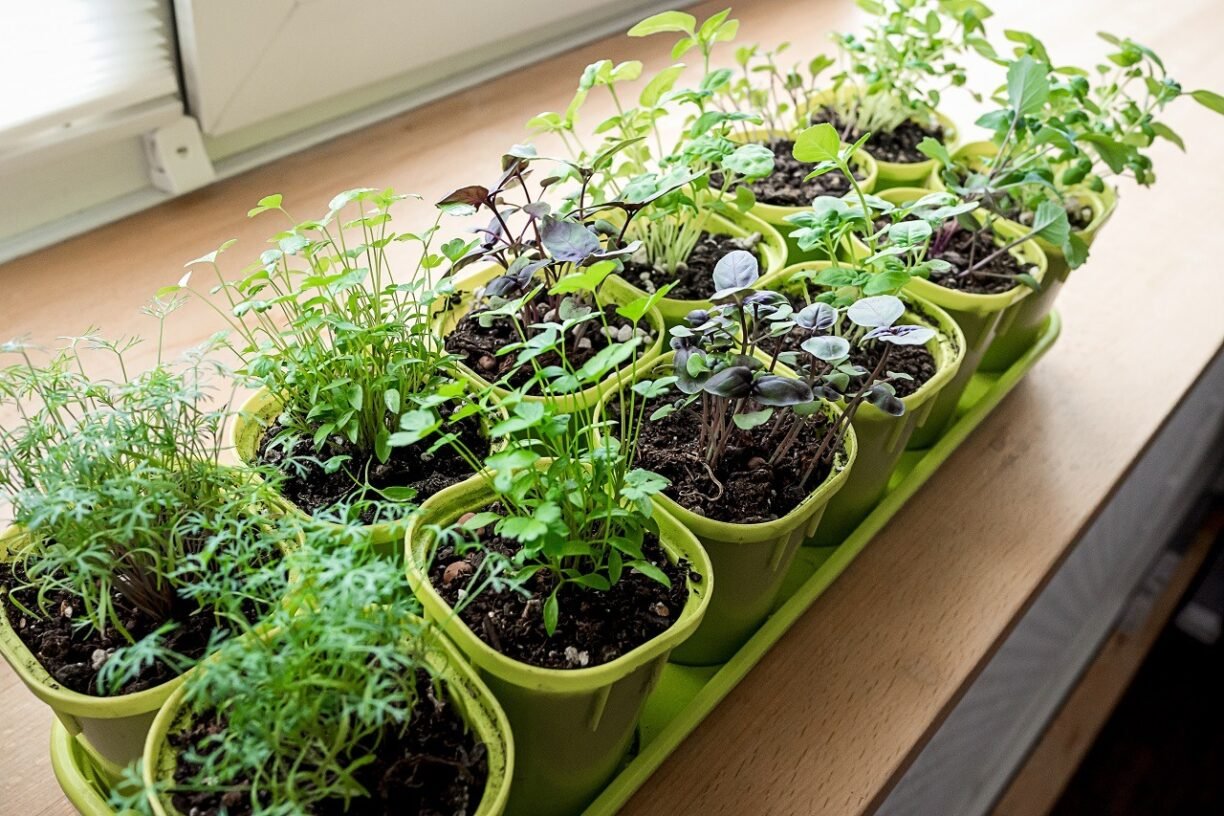
Safe home-grown microgreens come down to three things: clean seeds, clean substrate, and prevention rather than rescue. The reason is mechanical. Studies show pathogens transfer to microgreens primarily through contaminated seeds and contaminated growing medium (Işık et al., 2024). If those two sources are clean, the risk drops sharply.
Certain varieties are more susceptible to disease than others. Radish, watercress, Swiss chard, and Thai basil microgreens are more vulnerable to root rot and damping-off, the two main growing problems. Pythium and Phytophthora are water molds that destroy seedling roots in over-irrigated or poorly-drained trays. Damping-off is a separate fungal infection that prevents germination or causes the first leaves to wilt and brown.
Here is the principle: there is no cure for plants once damping-off or root rot sets in. Trays cannot be rescued. They can only be prevented. The variables you control are seed source, substrate sterility, drainage, air circulation, and moisture level.
The exact protocol (specific temperatures, sterilization methods, the cinnamon trick growers swear by) lives in the Microgreens Health Guide below. The principle is the same: prevent rather than rescue.
Selling what you grow? Buyers ask harder questions than home growers do. Start with food safety for microgreen growers, which covers the FDA rules, GAP and the records to keep.
Which plants should you never grow as microgreens?
Three plants do not belong on a microgreens tray, even though their seeds are sometimes sold for that purpose: nightshades (tomato, eggplant, potato), buckwheat in large quantities, and excessive amounts of high-oxalate greens. Each has a specific compound and a specific risk.
Nightshades contain solanine. Tomato, eggplant, and potato plants produce solanine and chaconine, two steroidal glycoalkaloids that are toxic to humans (Hennessy et al., 2020). The mature fruits are safe to eat (the tomato itself, the potato tuber). The green seedling stage is not. Symptoms of solanine poisoning include diarrhea, fever, headache, abdominal pain, and vomiting. Skip nightshades.
Buckwheat contains fagopyrin. Buckwheat seeds, flour, and tea are safe in normal amounts. But buckwheat sprouts and microgreens contain fagopyrin, a compound that causes phototoxicity (skin sensitivity to sunlight) when consumed in significant quantities (Benković & Kreft, 2015). Research suggests intake should stay under 40 grams of buckwheat sprouts per day (Kreft et al., 2013). Most growers avoid buckwheat microgreens entirely.
Dark greens carry oxalates. Kale, spinach, chard, and rhubarb contain oxalates. In normal microgreen serving sizes (a few grams as garnish or salad topping), oxalates are not a concern for most people. In very large quantities, oxalates inhibit calcium absorption and are a known risk factor for calcium-oxalate kidney stones (Alexander et al., 2021). If you have a history of kidney stones, eat these microgreens in moderation rather than as a daily large-volume snack.
Are microgreens safe to eat if you’re pregnant or at higher risk?
Microgreens are generally safe in pregnancy when grown and handled properly, but pregnancy raises the stakes on the same pathogens that affect everyone else. Listeria monocytogenes is the specific concern. About one in seven listeriosis cases occurs in pregnant women, and pregnancy-related listeriosis increases the risk for fetal and neonatal death by approximately 21% (Wadhwa Desai & Smith, 2017).
The risk applies to all raw produce, not microgreens specifically. But because microgreens are eaten raw and carry the same Listeria susceptibility as other fresh greens (Xavier et al., 2025), the same caution applies. The same logic extends to anyone with a weakened immune system, newborns, and older adults. Listeriosis is more dangerous in these groups, regardless of the food source.
The practical answer for pregnant readers: store-bought microgreens labeled “triple-washed” still benefit from a rinse. Home-grown microgreens are reasonable if the seeds, substrate, and handling are clean. If you are in the third trimester (when listeriosis risk peaks), the cautious approach is to eat microgreens cooked rather than raw during this window. A handful added to soup, eggs, or stir-fry at the last minute is a low-risk way to get the nutrition.
This information is educational and is not a substitute for professional medical advice. Talk with your physician before making significant changes to your diet during pregnancy.
Wrap-up: Can microgreens make you sick?
The honest answer is rarely, but the conditions matter. No documented foodborne outbreak has been linked to microgreens themselves, but the pathogens (Salmonella, Listeria, E. coli) and the toxic plants (nightshades, buckwheat in volume, high-oxalate greens) are real risks worth understanding. Pregnancy and immune-compromised status raise the stakes without making microgreens off-limits.
Microgreens safety is one piece of a larger picture. The microgreens health and science hub gathers everything from nutrition profiles by variety to the latest research on phytonutrients, so the safety question fits into the full nutritional picture.
Now you know what's risky. Here's where to actually start.
The Microgreens Health Guide (Starter) picks up where this post leaves off. The right varieties, the right amounts, the simplest ways to add microgreens to your diet without overhauling everything.
- ✓Which 7 varieties belong on your plate first, and why
- ✓Daily serving sizes that deliver real nutrition without overdoing it
- ✓The fundamentals you need before spending one dollar on seeds
- ✓Instant digital download. Read it tonight.
One-time purchase. Just $7.
GET MY STARTER GUIDE →Instant PDF download. Read it in under 30 minutes.
Frequently asked questions
How can you tell if microgreens have gone bad?
Spoiled microgreens have three reliable signs: a sour or off smell, slimy leaves, and yellowing or brown patches that spread across cotyledons rather than staying at the root line. Fresh microgreens smell faintly green and grassy. If the smell is wrong, discard the tray or package. Store-bought microgreens last 5 to 7 days refrigerated in a ventilated container.
Should you wash microgreens before eating them?
Yes, wash microgreens before eating, even if the package says triple-washed. A quick rinse under cool running water removes any surface contamination missed in processing. Pat dry with a clean towel or use a salad spinner. The exception is home-harvested microgreens cut above the soil line into a clean bowl, which can be eaten directly if your seed and substrate were clean.
Can you eat microgreens raw, or do you need to cook them?
Microgreens are designed to be eaten raw, and most varieties lose flavor and nutrition when cooked. Raw is the standard. Two exceptions: anyone immune-compromised may prefer microgreens cooked into eggs, soups, or stir-fries, and pregnant women in the third trimester may want the same precaution. For everyone else, raw is fine and preferred.
Have there been any recent microgreens recalls?
Yes. The most recent was the May 2026 Canadian recall, where four brands pulled product within nine days after a single contaminated broccoli seed lot reached multiple growers. No illnesses were reported, and no documented outbreak has ever been traced to microgreens consumption (Xavier et al., 2025). Periodic recall checks are reasonable if you eat commercial microgreens regularly. The Canadian Food Inspection Agency and the U.S. FDA both publish searchable recall databases.
Are microgreens safe for kids and older adults?
Microgreens are safe for healthy children over 12 months and for older adults eating them as part of a normal diet. The caution applies to immune-compromised individuals of any age. Wash thoroughly, buy from reputable sources, and store properly. For toddlers and infants under 12 months, follow standard pediatric guidance on raw greens.
Can growing microgreens at home make you sick?
Home-grown microgreens are safe when the seeds and substrate are clean. The risks come from contaminated seeds, contaminated soil, and damp trays that grow mold. Buy seeds labeled for sprouting or microgreens from reputable suppliers, use a sterile starting medium, and discard any tray with off smells or spreading growth. The exact home safety protocol is in the Microgreens Health Guide above.
References
Alexander, R. T., Fuster, D. G., & Dimke, H. (2021). Mechanisms underlying calcium nephrolithiasis. Annual Review of Physiology, 84, 559–583. https://doi.org/10.1146/annurev-physiol-052521-121822
Benković, E. T., & Kreft, S. (2015). Fagopyrins and protofagopyrins: Detection, analysis, and potential phototoxicity in buckwheat. Journal of Agricultural and Food Chemistry, 63(24), 5715–5724. https://doi.org/10.1021/acs.jafc.5b01163
Hennessy, R. C., Nielsen, S. D., Greve-Poulsen, M., Larsen, L. B., Sørensen, O. B., & Stougaard, P. (2020). Discovery of a bacterial gene cluster for deglycosylation of toxic potato steroidal glycoalkaloids α-chaconine and α-solanine. Journal of Agricultural and Food Chemistry, 68(5), 1390–1396. https://doi.org/10.1021/acs.jafc.9b07632
Işık, S., Çetin, B., & Topalcengiz, Z. (2024). Transfer of Salmonella, Escherichia coli O157:H7 and Listeria monocytogenes from contaminated soilless substrate and seeds to microgreens. International Journal of Food Microbiology, 414, 110612. https://doi.org/10.1016/j.ijfoodmicro.2024.110612
Kreft, S., Janeš, D., & Kreft, I. (2013). The content of fagopyrin and polyphenols in common and tartary buckwheat sprouts. Acta Pharmaceutica, 63(4), 553–560. https://doi.org/10.2478/acph-2013-0031
Topalcengiz, Z., Chandran, S., & Gibson, K. E. (2023). A comprehensive examination of microbial hazards and risks during indoor soilless leafy green production. International Journal of Food Microbiology, 411, 110546. https://doi.org/10.1016/j.ijfoodmicro.2023.110546
Wadhwa Desai, R., & Smith, M. A. (2017). Pregnancy-related listeriosis. Birth Defects Research, 109(5), 324–335. https://doi.org/10.1002/bdr2.1012
Wright, K. M., & Holden, N. J. (2018). Quantification and colonisation dynamics of Escherichia coli O157:H7 inoculation of microgreens species and plant growth substrates. International Journal of Food Microbiology, 273, 1–10. https://doi.org/10.1016/j.ijfoodmicro.2018.02.025
Xavier, I. B., Tavares, J. L., Pontes, E. D. S., Magnani, M., & Alvarenga, V. O. (2025). Understanding food safety on sprouts and microgreens: Contamination routes, outbreaks and challenges. Food Research International, 214, 116589. https://doi.org/10.1016/j.foodres.2025.116589