Disclosure: We’re reader supported. When you buy through links on our site, we may earn a commission: Full Disclosure.
I bought the entire Eminence collection at Amazon at Christmas 2021 for my wife. To tell you the truth, I use the facial every morning.
So I am not neutral about skincare, which is why I went and read the research on microgreens and skin health instead of the blog posts about it. The gap between those two is wider than I expected.
Here is what the evidence supports, what it does not, and where the line between them sits.
Key takeaway
Skin does respond to what you eat, but almost every well-measured result in this area is topical, not dietary. Vitamin C, vitamin E and sulforaphane all have human trials behind them, and all three were applied to skin rather than eaten. On diet specifically the evidence is real and thin (Pullar et al., 2017).
Below: what skin needs and how it gets it, what microgreens contribute, which ones earn a place on the plate, and what happens if you put them on your face instead.
Episode 7 of the series on what microgreens do for health. The introduction sets up the whole argument, and Episode 6 covered eyes.
Before your next grocery run
What would you actually put on the plate?
You now know which nutrients matter and which crops carry them. That is what a post can do. It is also the part that changes nothing on its own, because nobody eats a nutrient. They eat lunch.
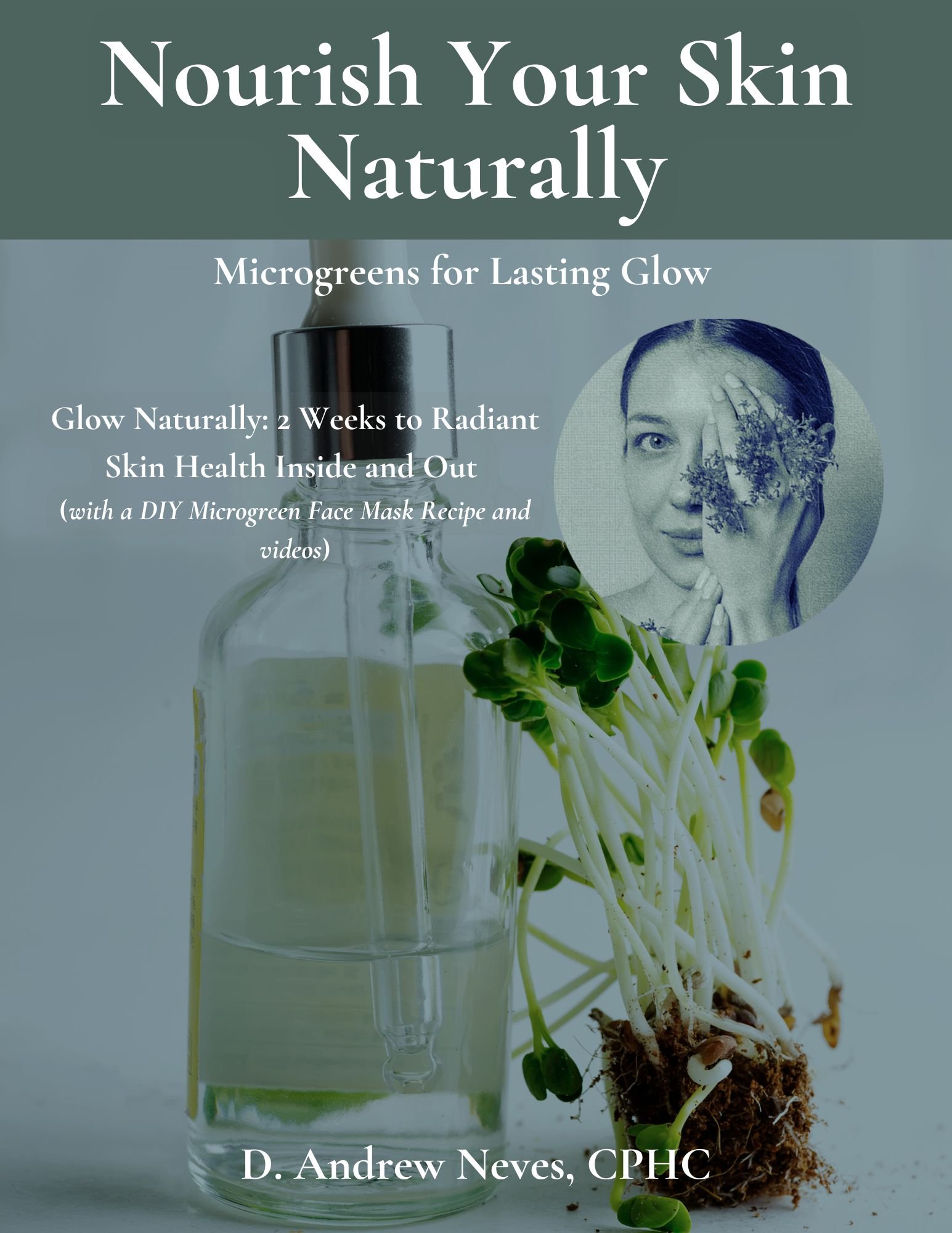
Nourish Your Skin Naturally is the lunch. Which microgreens, how much, worked into meals you already cook instead of a new routine to keep up. The mask recipe is in there too, carrying the same caveats this post just gave you.
Seventeen dollars, and you decide tonight instead of reading studies for a fortnight.
Educational only. Nothing in it treats a skin condition, and results vary.
What does skin actually need, and how does it get there?
Four minutes of TED-Ed on how skin is built, which is worth watching before anyone sells you something to put on it.
Two layers matter here. The epidermis on top does the barrier work and is made mostly of keratinocytes, which harden as they rise and form the water-tight outer layer called the stratum corneum. Those cells also do immune work and help repair wounds (Piipponen et al., 2020). Underneath, the dermis carries the strength and the stretch, holds the blood supply, and is dense with collagen (Pullar et al., 2017).
That structure is the reason diet is slow to show. The epidermis has no blood vessels of its own, so anything you eat has to reach the dermis first and diffuse upward. Skin changes over weeks, not days.
It also explains where most skincare writing on this subject goes wrong. You will read that vitamins C and E from the diet are proven to protect against UV damage, usually with a 2008 study attached. Read the study and it is people applying a formulation of 15% ascorbic acid, 1% alpha-tocopherol and 0.5% ferulic acid to their skin for four days, then being irradiated. The protection was real and it was measured on skin that had the stuff rubbed into it (Murray et al., 2008). Nobody in it ate anything.
Same story for vitamin C alone. Ten patients, half the face treated for twelve weeks, significant improvement in photoaging scores and biopsy evidence of new collagen (Fitzpatrick & Rostan, 2002). Topical again.
The review that covers both routes says it plainly: how well topical vitamin C works compared with simply eating more of it is poorly understood (Pullar et al., 2017). What we do have on the eating side is water. Drinking more of it measurably changes skin hydration and its mechanical behaviour (Rodrigues et al., 2015).
Do microgreens do anything for your skin?

They are a dense source of the nutrients that skin research keeps pointing at. That is the honest claim, and it is a smaller one than you will usually be sold.
You will see it put much more strongly than that. The line everywhere is that microgreens carry up to 40 times the nutrients of mature plants. That number is not in the review it usually gets attached to, and it is not in the study behind that one either.
What the study actually did was measure four nutrient groups, vitamin C, carotenoids, vitamin K and vitamin E, across 25 commercially grown microgreens, and compare them against mature leaves of the same plants. The microgreens were denser. How much denser swung enormously by crop and by nutrient, which is exactly what the 40 times version throws away (Xiao et al., 2012).
So microgreens are a concentrated way to eat vitamins that matter to skin. What nobody has run is the study that would close the loop: feed people microgreens, measure their skin, compare against a control. Until that exists, microgreens are a good vehicle for the right nutrients rather than a treatment for anything.
Which microgreens are worth eating for skin?
Borage has the closest thing to a human trial, and it is worth reading what the trial did. Women took borage oil or flaxseed oil for twelve weeks at 2.2 grams of fatty acids a day, against a placebo. Roughness and scaling fell significantly in both oil groups, and water loss through the skin dropped by around 10% at six weeks (De Spirt et al., 2008).
Note two things. They took oil capsules, not microgreens, and whether a tray of borage delivers a comparable dose of gamma-linolenic acid is unmeasured. And hydration improved in the placebo group too, which is the sort of detail that usually gets left out. The borage nutrition profile has the numbers I do have.
After borage the case rests on nutrient content rather than skin studies, so treat these as reasonable rather than proven:
- Carrot and radish for vitamin A, which cells need in order to divide and grow.
- Mustard and fenugreek for vitamin C, which collagen synthesis depends on (Pullar et al., 2017).
- Arugula for polyphenols. The step from eating antioxidants to having fewer fine lines is an inference, not a measurement.
- Broccoli for sulforaphane, the most studied compound on this list and the subject of the next section. More on sulforaphane here.
- Kale and watercress for general vitamin and mineral density. Both are good food. Neither has a skin study.
Watercress is the one to watch out for. It gets credited with increasing circulation, which improves skin oxygenation, which reduces fine lines. Nothing supports those three steps or the joins between them. Eat it anyway. Just not for that reason.
How you get them down matters less than that you do. Salads and sandwiches work. So does blending, if that is easier, though juicing has trade-offs worth knowing about before you buy a machine for it.


Should you put microgreens on your face?
Sulforaphane is where this gets interesting, and where the old page went furthest wrong.
Researchers at Johns Hopkins applied a sulforaphane-rich broccoli sprout extract to human skin, then measured sunburn redness under controlled UV. Redness fell by an average of 37.7%. The range across the six people tested ran from 8% to 78%, and six people is a small study (Talalay et al., 2007).
Read what that is. Applied to skin, not eaten. A concentrated extract, not a handful of greens. Redness, not aging, and not cancer, whatever you have read about sulforaphane neutralizing UV radiation.
For a mask you make at home the evidence is thinner still. Borage and honey is a reasonable pairing and cosmeceutical masks have been reviewed as a category (Nilforoushzadeh et al., 2018), but whether blending microgreens into one adds anything is unmeasured. If you try it, wash the greens properly and patch test first, because patch testing is the standard way to find a reaction before your whole face finds it for you (Lazzarini et al., 2013).
The one product here I actually use
This section carries affiliate links. Buy through one and we earn a commission at no extra cost to you. As an Amazon Associate we earn from qualifying purchases. Full disclosure.
Eminence makes a Stone Crop line that uses sunflower, broccoli, clover and swiss cress among its ingredients. I bought the collection for my wife back in 2021 and then started using the facial myself, which is the whole of my evidence and I am not going to dress it up as more.
They are cosmetics. They clean, they exfoliate and they moisturise, and I am not going to tell you they do anything to your cells.


Does your skin type change which microgreens help?

A little, and less than the internet suggests.
Dry skin. Borage is the reasonable pick, because gamma-linolenic acid is the compound with the supplement trial behind it and that trial measured water loss and scaling (De Spirt et al., 2008).
Oily skin. Arugula gets recommended for its sulfur compounds and sebum regulation. I have not found a study measuring that, so it goes here as a plausible idea rather than a finding.
Sensitive skin. Fenugreek is the usual suggestion, on the basis of its anti-inflammatory compounds. You will sometimes see it called soothing without any risk of a reaction, which is an absolute no food has ever earned. Patch test it like anything else (Lazzarini et al., 2013).
On organic against conventional, the case is stronger for topical use than for eating, simply because material left on skin is not rinsed and swallowed. No study I could find measures skin outcomes either way. Wash thoroughly regardless.
This information is educational and is not a substitute for professional medical advice. Talk with your physician or a dermatologist before making significant changes to your diet or before using microgreens to address a skin concern.
Wrap-up: microgreens and skin health
The defensible version of this topic is narrow and still worth knowing. Skin depends on nutrients that reach it slowly from the inside. Microgreens are a concentrated way to eat several of them. Borage has a supplement trial behind its active compound, and sulforaphane has a human trial too.
The thing that surprised me on the way through is that the strongest human results here, vitamin C, vitamin C with vitamin E, and sulforaphane, were all measured on skin things were put on rather than eaten. That does not make eating well pointless. It does mean anyone promising you a glow from a salad is ahead of the evidence.
Everything past that, the cancer prevention and the acne and the promised transformation, is unsupported. The smaller claim is the one that happens to be true, and it is the one worth acting on.
Skin is one piece of a larger picture. If you want to see how the nutrition evidence stacks up across the whole subject rather than one organ, the microgreens nutrition research hub is where the rest of it sits, and the beginner’s nutritional guide is the gentler way in.
Next in the series, Episode 8 on hair, where the evidence is thinner again.
Before your next grocery run
What would you actually put on the plate?
You now know which nutrients matter and which crops carry them. That is what a post can do. It is also the part that changes nothing on its own, because nobody eats a nutrient. They eat lunch.
Nourish Your Skin Naturally is the lunch. Which microgreens, how much, worked into meals you already cook instead of a new routine to keep up. The mask recipe is in there too, carrying the same caveats this post just gave you.
Seventeen dollars, and you decide tonight instead of reading studies for a fortnight.
Educational only. Nothing in it treats a skin condition, and results vary.
Microgreens and skin health: frequently asked questions
Can microgreens help with acne?
No trial has tested them against it, so there is no direct evidence either way. Acne has drivers a salad does not reach. A dermatologist is the right person for that plan, and I mean an actual dermatologist.
Does it matter whether you grow them or buy them?
For eating, not much, as long as both are fresh and washed. For anything you put on your face it matters more, because you know how your own trays were handled and you do not know that about a clamshell that has travelled. Wash either way.
How long do they keep?
Not long, and that is the standing problem with the whole category. Short shelf life and rapid deterioration are why postharvest handling has its own literature (Mir et al., 2016). Cut or buy what you will eat within a few days rather than stocking up, and keep them cold.
What is filaggrin, and can you eat your way to more of it?
This page ranks for that question, so here is the straight answer. Filaggrin is a protein in the skin barrier, and the variants that reduce it are inherited (Mu & Zhang, 2020). I found nothing showing any food raises it. If your barrier is the problem, that is a dermatologist question.
Are they safe to eat every day?
Daily intake has not been studied specifically, so there is no number worth quoting at you. The realistic caution is allergy rather than quantity, and it is the same caution that applies to any food you have not eaten much of before.
Does any of this apply to men?
The borage trial enrolled women only (De Spirt et al., 2008), so strictly speaking that result is about women. Nothing else cited here is sex specific. Skin structure is skin structure, and the vitamin work was not split that way.
References
De Spirt, S., Stahl, W., Tronnier, H., Sies, H., Bejot, M., Maurette, J.-M., & Heinrich, U. (2008). Intervention with flaxseed and borage oil supplements modulates skin condition in women. British Journal of Nutrition, 101(3), 440–445. https://doi.org/10.1017/S0007114508020321
Fitzpatrick, R. E., & Rostan, E. F. (2002). Double-blind, half-face study comparing topical vitamin C and vehicle for rejuvenation of photodamage. Dermatologic Surgery, 28(3), 231–236. https://doi.org/10.1046/j.1524-4725.2002.01129.x
Lazzarini, R., Duarte, I., & Ferreira, A. L. (2013). Patch tests. Anais Brasileiros de Dermatologia, 88(6), 879–888. https://doi.org/10.1590/abd1806-4841.20132323
Mir, S. A., Shah, M. A., & Mir, M. M. (2016). Microgreens: Production, shelf life, and bioactive components. Critical Reviews in Food Science and Nutrition, 57(12), 2730–2736. https://doi.org/10.1080/10408398.2016.1144557
Mu, Z., & Zhang, J. (2020). The role of genetics, the environment, and epigenetics in atopic dermatitis. Advances in Experimental Medicine and Biology, 1253, 107–140. https://doi.org/10.1007/978-981-15-3449-2_4
Murray, J. C., Burch, J. A., Streilein, R. D., Iannacchione, M. A., Hall, R. P., & Pinnell, S. R. (2008). A topical antioxidant solution containing vitamins C and E stabilized by ferulic acid provides protection for human skin against damage caused by ultraviolet irradiation. Journal of the American Academy of Dermatology, 59(3), 418–425. https://doi.org/10.1016/j.jaad.2008.05.004
Nilforoushzadeh, M. A., Amirkhani, M. A., Zarrintaj, P., Salehi Moghaddam, A., Mehrabi, T., Alavi, S., & Mollapour Sisakht, M. (2018). Skin care and rejuvenation by cosmeceutical facial mask. Journal of Cosmetic Dermatology, 17(5), 693–702. https://doi.org/10.1111/jocd.12730
Piipponen, M., Li, D., & Landén, N. X. (2020). The immune functions of keratinocytes in skin wound healing. International Journal of Molecular Sciences, 21(22), 8790. https://doi.org/10.3390/ijms21228790
Pullar, J. M., Carr, A. C., & Vissers, M. C. M. (2017). The roles of vitamin C in skin health. Nutrients, 9(8), 866. https://doi.org/10.3390/nu9080866
Rodrigues, L., Palma, L., Tavares Marques, L., & Bujan Varela, J. (2015). Dietary water affects human skin hydration and biomechanics. Clinical, Cosmetic and Investigational Dermatology, 8, 413–421. https://doi.org/10.2147/CCID.S86822
Talalay, P., Fahey, J. W., Healy, Z. R., Wehage, S. L., Benedict, A. L., Min, C., & Dinkova-Kostova, A. T. (2007). Sulforaphane mobilizes cellular defenses that protect skin against damage by UV radiation. Proceedings of the National Academy of Sciences, 104(44), 17500–17505. https://doi.org/10.1073/pnas.0708710104
Xiao, Z., Lester, G. E., Luo, Y., & Wang, Q. (2012). Assessment of vitamin and carotenoid concentrations of emerging food products: Edible microgreens. Journal of Agricultural and Food Chemistry, 60(31), 7644–7651. https://doi.org/10.1021/jf300459b