I almost scrolled past the study. Tucked into a nutrition journal, it found a broccoli microgreen extract boosted bone-building cells in a lab dish.
Here is why that caught my eye. For years, the talk around broccoli microgreens has been cancer research and antioxidants. Bones barely got a mention. A growing body of lab work points to the cells that build your skeleton, and a 2026 study tested the idea on human cells.
If you have ever asked whether broccoli microgreens and bone health belong together, you are asking a sharp question. I want to walk you through what the research shows and where it stops. Then you can decide what a tray of these greens is worth to you.
Key Takeaways
Broccoli microgreens are a top food source of glucoraphanin, the compound the body turns into sulforaphane. In lab and animal studies, sulforaphane raised bone-building cell activity and slowed bone breakdown. A 2026 study found a broccoli microgreen extract boosted bone-building activity in human cells (Gambari et al., 2026). Human eating trials are still to come.
Below you will find: what the study found, how sulforaphane acts on the cells that build and break down bone, the other bone nutrients in these greens, and how to prep them so the sulforaphane survives.
Get the sulforaphane, skip the guesswork
You know the what and the why. The Broccoli Microgreens Sulforaphane Routine is the how, in one place, so you stop guessing and start eating.
- The exact serving, timing, and the two-minute prep that protects the compound
- A 7-day plan you just follow, plus a grow-your-own quick start
- Done-for-you meal ideas and a print-and-stick fridge checklist
What does the research say about broccoli microgreens and bone health?
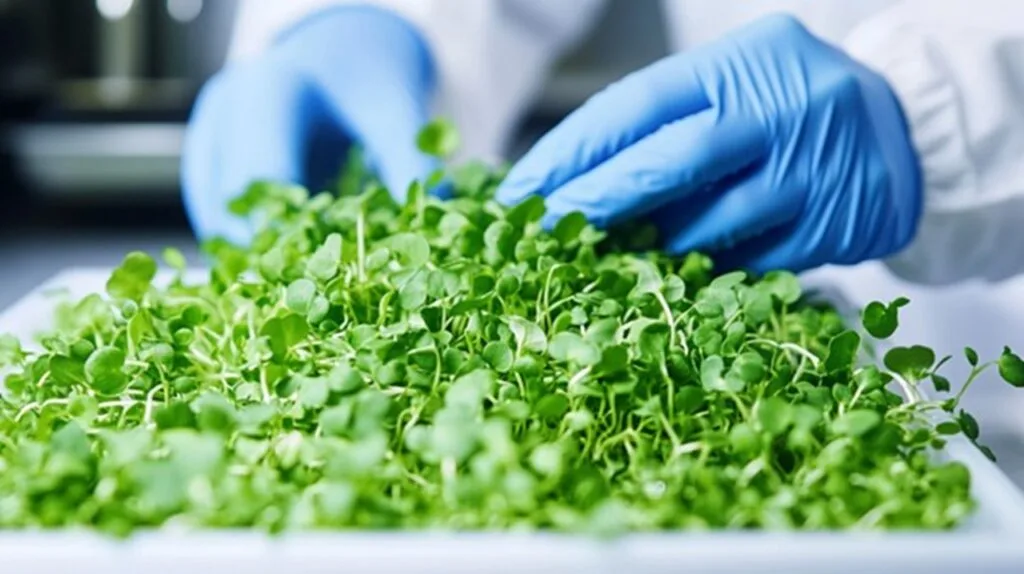
Here is the short answer. Early lab research suggests broccoli microgreens may support the cells that build bone, but the work sits in petri dishes, not people.
The strongest piece is a 2026 study in the journal Food & Function. Researchers took an extract from broccoli microgreens and put it on human stromal cells, the kind that can turn into bone-building cells. At safe doses, the extract nudged more of those cells down the bone-building path and switched on their antioxidant defenses (Gambari et al., 2026). In plain terms, the greens seemed to tell young cells, build bone.
That is a real signal, and it is worth your attention. It is also where honesty matters. The cells lived in a lab, not in a body, and nobody has yet run a trial where people eat broccoli microgreens and get their bones scanned.
So the right read on broccoli microgreens and bone health is cautious optimism. The mechanism looks promising, and the food is harmless. The human proof is still missing. Keep that frame as we look at how sulforaphane works.
How does sulforaphane affect the cells that build and break down bone?
The sulforaphane in broccoli microgreens appears to work both sides of the bone equation. In cell and animal studies, it turns up the cells that build bone and turns down the cells that break it down.
Your skeleton is never finished. Bone-building cells called osteoblasts lay down new bone, and bone-breaking cells called osteoclasts clear the old away. A 2016 study found sulforaphane pushed young cells to become osteoblasts and lowered RANKL, the signal that switches osteoclasts on (Thaler et al., 2016). In mice, that shift raised bone volume by about 20 percent over five weeks, even in animals with low estrogen, like after menopause.
Much of it runs through Nrf2, the antioxidant switch sulforaphane is known for. A 2025 review calls sulforaphane a promising way to slow bone loss, with one caveat: the dose matters, because too much can backfire on bone-building cells (Lavhale et al., 2025).
None of this proves a plate of greens rebuilds your hip. It shows a believable path from sulforaphane to stronger bone. For the full story, see our guide to sulforaphane and microgreens. Next, the bone nutrients these greens carry.
Which other nutrients in broccoli microgreens support bone health?
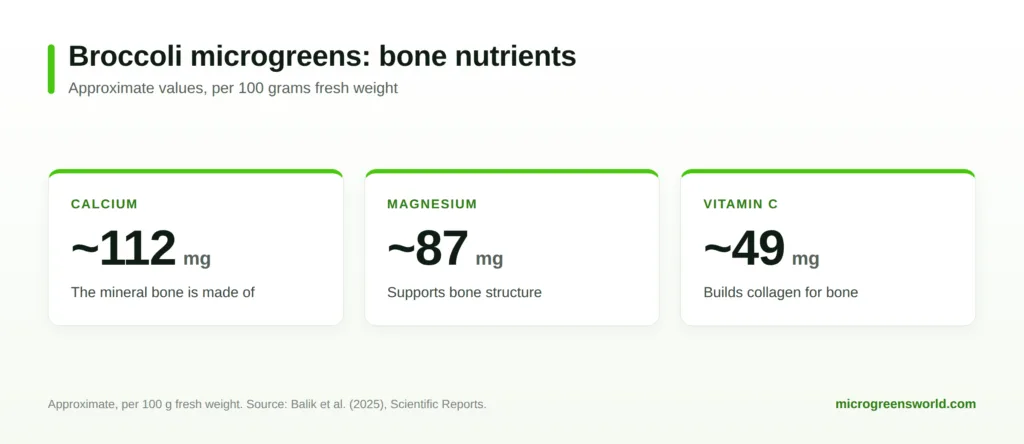
Sulforaphane is not the only bone story here. Broccoli microgreens also carry minerals your body uses to build and keep bone, no lab required.
In one analysis of six microgreens, broccoli came out on top for magnesium, at about 87 milligrams per 100 grams (Balik et al., 2025). Magnesium helps hold the bone matrix together, and most of your body’s supply is stored in bone. The same greens brought about 112 milligrams of calcium, the mineral bone is mostly made of.
Vitamin C rounds out the picture at roughly 49 milligrams. Your body needs it to build collagen, the flexible scaffold that mineral sits on. Vitamin C pulls a second shift here, too: it helps the plant turn glucoraphanin into sulforaphane, which matters for the next section.
Growing conditions move these numbers, so treat them as ballpark. Even so, broccoli microgreens and bone health line up on more than one front, and you can see the fuller nutrient picture in our broccoli microgreens nutrition guide.
Knowing the nutrients is one thing. Getting the sulforaphane out is another.
How do you get the most sulforaphane from broccoli microgreens?
Want the most sulforaphane from broccoli microgreens? Eat them raw, and chew them well. That is most of the game right there.
Here is the reason. Raw broccoli microgreens hold glucoraphanin, not sulforaphane. The two only meet when an enzyme called myrosinase gets released, and that happens when you chew or chop the leaves. Cook the greens hard, and you can wreck that enzyme.
Freshness matters just as much. In one human trial, fresh sprouts delivered about three times more absorbed sulforaphane than a supplement whose enzyme had been switched off (Atwell et al., 2015). You can also stack the odds. A 2025 study found that adding a myrosinase source, like a pinch of mustard powder, raised how much sulforaphane formed, and a little vitamin C helped too (Zhu et al., 2025).
So the simple moves are raw, fresh, and well chewed, with a pinch of mustard or a squeeze of lemon if you want more. Add them at the end of a warm dish, never cooked into it. Dialing in exact amounts and timing is where a real routine comes in. First, how much should you actually eat?
How much broccoli microgreens should you eat for bone health?
Honest answer: there is no official dose of broccoli microgreens for bone health. The lab studies used concentrated extracts, not a plate of greens, so their numbers do not translate to your kitchen.
What most people do is simpler. Add a small handful of fresh broccoli microgreens to meals most days of the week, the way you would any salad green. A regular habit beats a big one-off, since sulforaphane clears your system within a day or so. Consistency, not a precise gram count, is what keeps the compound around.
Variety matters more than volume for sulforaphane. Broccoli sits near the top of the crucifer family for glucoraphanin, and fresh, well-grown seed makes a real difference in what ends up on your plate. If you grow your own, you also control how fresh they are, which is half the battle.
Matching a daily amount to your own goals is where a real plan helps, and that is worth setting up with intention. For most, treat broccoli microgreens and bone health as a steady habit, not a prescription. Next, what all of this adds up to.
This information is educational and is not a substitute for professional medical advice. Talk with your physician before making significant changes to your diet or before using microgreens to address a health concern.
Wrap-up: Broccoli microgreens and bone health
So where does this leave us? Broccoli microgreens and bone health share a believable, early story. In cell and animal studies, sulforaphane turned up bone-building cells and turned down bone-breaking ones, and a 2026 study saw the same push in human cells. The greens also carry vitamin K, calcium, and magnesium, the nutrients bone is built and kept with.
What is missing is a human trial of people eating them, so hold this as promising, not proven. Eat them fresh and well chewed, and let a steady habit do the work.
Bone is one piece of what these tiny greens offer. To see how the rest of the health research stacks up, our microgreens health hub gathers it in one place.
Get the sulforaphane, skip the guesswork
You know the what and the why. The Broccoli Microgreens Sulforaphane Routine is the how, in one place, so you stop guessing and start eating.
- The exact serving, timing, and the two-minute prep that protects the compound
- A 7-day plan you just follow, plus a grow-your-own quick start
- Done-for-you meal ideas and a print-and-stick fridge checklist
Broccoli microgreens and bone health: frequently asked questions
Are broccoli microgreens better than broccoli sprouts for sulforaphane?
Both are strong sources. Broccoli sprouts, harvested a few days after germination, often test highest for glucoraphanin, the sulforaphane precursor. Microgreens are grown a little longer and come in just behind, with a milder taste. For a concentrated hit, sprouts edge ahead; for everyday meals, microgreens are the easier green.
Can broccoli microgreens replace osteoporosis medication?
No. Broccoli microgreens are a food, not a treatment. No study shows broccoli microgreens for bone health can replace osteoporosis medication or reverse bone loss in people, and the research so far runs on cells and animals. If you take a bone drug, keep your doctor in charge.
Can you eat too much broccoli microgreens?
For most healthy people, a normal food serving is fine. Broccoli microgreens are just young broccoli, so a handful in meals sits well within everyday eating. Very large raw amounts can cause gas or bloating, and people with thyroid concerns may want to go easy. When in doubt, ask your doctor.
Are broccoli microgreens safe if you have a thyroid condition?
In normal food amounts, usually yes. Crucifers like broccoli contain goitrogens, compounds that can affect the thyroid, but everyday servings are a small dose, and the effect mostly matters with very high raw intake or low iodine. If you have a thyroid condition, run your intake past your doctor first.
How do broccoli microgreens compare to mature broccoli for bone support?
Gram for gram, the young greens carry more glucoraphanin, the sulforaphane precursor at the center of the bone research. So when it comes to broccoli microgreens and bone health, a small serving can match or beat a larger helping of florets. For calcium and vitamin K, both plants contribute, so a varied plate helps.
Do broccoli microgreens interact with blood thinners?
They can, so check with your doctor. Broccoli microgreens are rich in vitamin K, which helps blood clot and can work against warfarin and similar blood thinners. You do not have to avoid them, but a steady, consistent intake is easier to manage than big swings. Anyone on these drugs should ask their prescriber.
References
Atwell, L. L., Hsu, A., Wong, C. P., Stevens, J. F., Bella, D., Yu, T.-W., Pereira, C. B., Löhr, C. V., Christensen, J. M., Dashwood, R. H., Williams, D. E., Shannon, J., & Ho, E. (2015). Absorption and chemopreventive targets of sulforaphane in humans following consumption of broccoli sprouts or a myrosinase-treated broccoli sprout extract. Molecular Nutrition & Food Research, 59(3), 424–433. https://doi.org/10.1002/mnfr.201400674
Balik, S., Elgudayem, F., Dasgan, H. Y., Kafkas, N. E., & Gruda, N. S. (2025). Nutritional quality profiles of six microgreens. Scientific Reports, 15(1), 6213. https://doi.org/10.1038/s41598-025-85860-z
Gambari, L., Amore, E., Carpentieri, S., Di Padua, F., Dalle Carbonare, L. G., Cominacini, M., Valenti, M. T., & Grassi, F. (2026). Glucosinolate-rich broccoli microgreen extract promotes osteogenic differentiation and antioxidant responses in human stromal cells: Implications for nutraceutical modulation of bone metabolism. Food & Function. https://doi.org/10.1039/d6fo02085b
Lavhale, M. P., Mandlik, S. K., Shinde, V. M., & Mandlik, D. S. (2025). Nrf2 signaling in bone health: Unlocking new avenues for osteoporosis management. Inflammopharmacology, 33(11), 6419–6455. https://doi.org/10.1007/s10787-025-01985-7
Thaler, R., Maurizi, A., Roschger, P., Sturmlechner, I., Khani, F., Spitzer, S., Rumpler, M., Zwerina, J., Karlic, H., Dudakovic, A., Klaushofer, K., Teti, A., Rucci, N., Varga, F., & van Wijnen, A. J. (2016). Anabolic and antiresorptive modulation of bone homeostasis by the epigenetic modulator sulforaphane, a naturally occurring isothiocyanate. The Journal of Biological Chemistry, 291(13), 6754–6771. https://doi.org/10.1074/jbc.M115.678235
Zhu, W., Cremonini, E., Mastaloudis, A. F., Mitchell, A. E., Bornhorst, G. M., & Oteiza, P. I. (2025). Optimization of sulforaphane bioavailability from a glucoraphanin-rich broccoli seed extract in a model of dynamic gastric digestion and absorption by Caco-2 cell monolayers. Food & Function, 16(1), 314–328. https://doi.org/10.1039/d4fo04561k