

Comprehensive Food Safety for Microgreens
Same seed lot. Your name on the tray.
On October 7 the FDA wrote microgreens into an open outbreak investigation. Here is what a one-person farm does about it before the next seed order.
Digital guide, templates and the Seed Lot Record app. Third edition. One payment, no subscription.
What changed this month
Two sprout outbreak investigations are open at the FDA right now, and both sit on the recall page, which is checked twice a day. Both trace to a seed lot.
The broccoli case stood at 32 illnesses in six states on October 9, three people hospitalized. On October 7 the FDA changed how it describes that outbreak. The new words are “broccoli sprouts and microgreens grown from a contaminated seed lot.”1 The lot is W4105. The company that sold it as garden seed told its customers not to plant or sprout it, and not to grow microgreens from it.2
The alfalfa case is larger: 76 illnesses in 16 states, six hospitalized, lot SAL2-24JB.3 The small bags of that seed carried no lot code at all.4
Canada got there first. In May, a seed recall and two microgreens recalls were announced within about two weeks, tied to one lot.
Sprouts still carry the history. The FDA counts 52 sprout outbreaks between 1996 and 2020.5 Microgreens are not in that column, and in a 2014 USDA experiment they grew far less bacteria than sprouts from the same contaminated radish seed.6 Safer, then. Not safe. The bacteria still multiplied on the microgreens, and the seed does not know what you plan to grow from it.
Safer than sprouts is not a food safety plan
Here is the part nobody on page one of Google tells you. The law requires a sprout grower to sanitize the seed and test the water from every production batch, and the batch waits until the result comes back. The law asks none of that of a microgreens tray.
If you sell under $25,000 a year, the Produce Safety Rule does not even count you as a covered farm. No inspector is scheduled to look at your trays. So who checks them? Your buyer does. The chef, the grocer, the co-op manager. Sooner or later one of them asks a short question: where did this seed come from, and can you show me?
Can you picture handing over one sheet and watching the question go away?
That sheet is what this page is about.
What I wrote for the grower who hates paperwork
I am a Preventive Controls Qualified Individual, and I grow. Those two facts do not meet in most food safety material. The courses are written for a plant with a quality department. You have a rack, a sink and a Tuesday.
So I wrote Comprehensive Food Safety for Microgreens: Minimizing Risks from Seed to Plate for a one-person farm. It follows one grower, Alex, from the morning the lab calls to the day his records answer every question a buyer has. Each step he takes is a step you can take the same week, and the forms he fills in are the ones you get, already laid out.
Open the preview and read the table of contents. Then come back, and I will walk you through what each section lets you show.
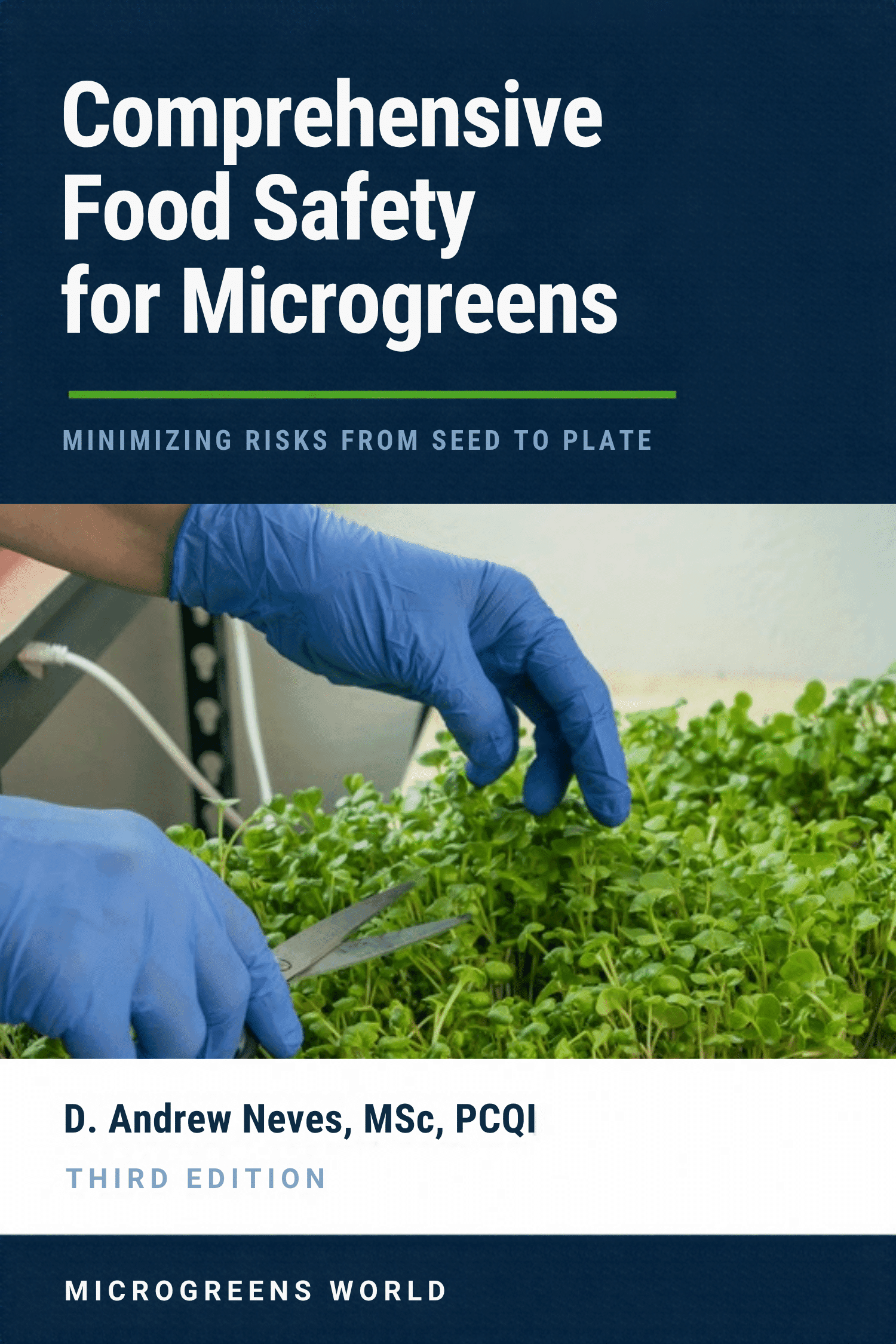
Click the cover to preview the guide. Now in its third edition.
Digital guide, templates and the Seed Lot Record app. Third edition. One payment, no subscription.
What changes once your records exist
- A buyer asks about your seed and you open one sheet: supplier, lot, certificate of analysis, the date it went into which trays.
- A recall notice names a lot, and from one log you know whether you ever bought it, and which trays it touched.
- The chef who wanted “something in writing” before putting you on the menu gets it, and the conversation moves to price.
- You stop carrying the question in your head. The sheet carries it.
No income is promised here and none can be. What the guide gives you is the paper trail. What you do with the door it opens is yours.
Nine steps, in the order a farm actually runs
The guide follows one process flow from seed to plate, 80 pages, with eleven appendices. Each section ends with what to write down, so the record builds itself as you read.
Seed selection and treatment. How to buy seed by the lot, what to ask a supplier for, how to store it, and the seed sanitation procedure Alex adopts after the lab call.
Substrate and growing environment. Choosing a growing medium you can defend, and the handful of conditions you watch so mold never gets the room it wants.
Water quality management. Where water enters your system, what to test and how often by source, the thresholds, the corrective actions when a result comes back high, and the annual water assessment FSMA now asks for.
Harvesting practices. The cut is where a clean tray meets a dirty blade. Tools, hands, surfaces and timing, written as a routine.
Washing and packaging. What to wash, what not to, how to dry, and how to package so the clock on shelf life starts as late as possible.
Monitoring and testing. Which labs test microgreens, how often to sample at your volume, the recall plan you write before you need it, and what the newer rapid tests change.
Consumer education and regulatory compliance. The card in the clamshell, the line on the label, where FSMA touches a farm your size and where it does not, and a section on FSMA Rule 204 traceability.
Digital record keeping. The chapter on moving the logs off paper, told through the temperature reading Alex nearly missed.
The templates toolkit. Appendices A through M: testing labs, the hazard analysis worksheet, seed sourcing, the preventive controls table with the seed sanitation SOP, training, the seed and water records, delivery, the hygiene protocol, and the step-by-step food safety plan.
Digital guide, templates and the Seed Lot Record app. Third edition. One payment, no subscription.
The forms do the work you were dreading
Most food safety guides end where the work begins. This one ships with the forms, as files you open today and print the day a buyer wants paper. And it comes with the Seed Lot Record, a phone app built from the same seed SOPs for a farm with one grower and one phone. You log each seed lot at the receiving bench, even with no signal. Only four fields are required to save one. Snap up to three photos of the bag, so the label itself backs up the record when a buyer asks. The app picks the oldest lot when you start trays. It traces any lot to its trays and harvests, and back again. When a buyer wants paper, it prints your records as the forms. Sign in at farm.microgreensworld.com with the email you buy with, using a 6-digit code. No password to forget.
The Seed Sourcing SOP Module
The seed lot is where this month’s outbreak started, and it is where your record has to start. This module is the whole of that step, as a working system: six standard operating procedures (select the variety, verify the supplier, order and procure, receive and store, the courier delivery addendum, and the storage process controls), the forms they run on (Approved Variety List, Approved Supplier List, Supplier Verification Log, Growing Cycle Log, Variety Trial Log, Seed Receiving Log), a Supplier Letter of Guarantee and a Per-Shipment Seed Declaration you send to the seed company, a 60 to 90 minute training module with its knowledge check, and the facilitator guide for teaching it.
Every SOP carries its own hazard analysis, critical limits and corrective actions, and the receiving procedure is built so that the question “did we ever use that lot?” is answered from one log in under an hour. It was written for a larger farm system now in production. This is the first time it is being offered on its own.
The rest of the toolkit, each one a file you open and fill in:
How to Write a Standard Operating Procedure. Three pages on the ten parts of an SOP and how to write one by watching the job done once.
The SOP template. Headings, numbering and the revision table already in place.
The Seed Sanitation SOP. Purpose, scope, materials, six steps from dilution to dry storage, ready to sign and date.
The Post-Harvest Water SOP. Changing and sanitizing wash water, with the turbidity check and the log entry built in.
The Seed Handling Records sheet. Lot, seed type, supplier, date received, storage, treatment and date, who handled it, germination rate.
The Water Handling Records sheet. Date, source, what was tested, the result, the method, who ran it, maintenance and corrective action.
The Food Safety Plan checklist. Six pages that walk the plan in order, so you can see what you have and what you still owe.
The Microgreens Production Hazard Analysis. Every step from seed sourcing to distribution, the hazard, the control, and the SOP number it belongs to. Thirty-nine control points on four pages.
Everything is a document you open, not a course you schedule. I wonder how quickly the drawer of seed bags turns into a record once the sheets are already drawn and the supplier letter is already written.
Digital guide, templates and the Seed Lot Record app. Third edition. One payment, no subscription.
What it costs, and what it costs not to
One rejected delivery to a restaurant costs more than this guide. One recall you have no way to trace through your own trays costs a great deal more, and that bill is not paid in dollars.
$97
The guide, the templates toolkit, the Seed Sourcing SOP Module and the Seed Lot Record app together. You pay once. There is no subscription, and the app keeps working on your phone with no signal.
$97. Instant access. One payment, no subscription.
Why this week and not next quarter
Two investigations are open. The FDA says both pages will be updated as more downstream recalls come in, and the broccoli page already lists four.1 If your seed came from any of those lots, the only way you find out quickly is a lot code on a sheet, matched against the active list.
Your next seed order is the natural starting line. Set up the seed receiving log before the bags arrive, write the lot on the first tray, and the record starts on day one instead of being rebuilt from receipts later.
That is the whole urgency. No countdown clock, no price going up on Friday. The seed is on its way and the log is not started yet.
$97. Instant access. One payment, no subscription.
Who is telling you this
I am D. Andrew Neves. I hold an MSc and I am a Preventive Controls Qualified Individual (PCQI). That is the credential the FDA’s preventive controls rule names for the person who writes and oversees a food safety plan. I cofounded JPure Farms and Nanny’s Farm and have grown microgreens for over seven years. I am a certified small business coach, a science writer and international speaker, and an Amazon #1 best-selling author. I am a board-certified health and wellness coach with over 30 years in the health coaching industry.
Every protocol in the guide has run on a real rack. None of it was written from a conference room.
If something doesn’t work
If a file won’t open or download, or the app won’t load or sign you in, email support@microgreensworld.com within 30 days of purchase. We’ll fix it, replace it or refund it. Refunds cover technical problems with the files or the app, not the content itself or a change of mind, so please read the policy before you buy: Returns and Refunds Policy.
“Is this written for a farm my size?”
That is the question I hear most, and the people who answer it best are growers who have read my work for years.
“Just wanted to let you know how much I appreciate you and all you do for us in the microgreens business. You are amazing and are such a great resource.”T.F., Alabama
“First of all I so enjoy your teaching and articles on microgreens, thank you for your continually education on microgreens.”Peggy W., Living Greens
“After three decades of being in the microgreens and sprouts industry, even before the word microgreens became popular, I applaud Andrew with much honor and respect for his work.”Lou Duncanson, Green Garden Organics
The testimonials and case studies on this website are, to the best of our ability to determine, all true and accurate. They were provided willingly, without any compensation offered in return. These testimonials and case studies do not represent typical or average results. Each individual’s success will be determined by his or her desire, dedication, marketing background, product, effort and motivation to work and follow recommendations. There is no guarantee you will duplicate the results stated here. You recognize any business endeavor has inherent risk for loss of capital.
One log, before the next bag of seed arrives
Will your records answer the question before a buyer asks it? One way to find out, and it starts with the seed receiving log.
Get the guide, open the seed receiving log, and write today’s lot against today’s tray.
$97. Instant access. One payment, no subscription. Educational only. Not compliance or legal advice.
P.S. The FDA now writes “sprouts and microgreens” in the same sentence, and the lot named in that sentence was sold under more than one label. Comprehensive Food Safety for Microgreens is the 80-page guide, the eight templates, the Seed Sourcing SOP Module and the Seed Lot Record app, $97, one payment. The seed does not know what you plan to grow from it. Your records should.
Footnotes
- U.S. Food and Drug Administration. (2026, October 9). Outbreak investigation of Salmonella: Sprouts (September 2026). https://www.fda.gov/food/outbreaks-foodborne-illness/outbreak-investigation-salmonella-sprouts-september-2026. The October 7 update reads: “linked to broccoli sprouts and microgreens grown from a contaminated seed lot.”
- Eden Brothers LLC. (2026, October 7). Eden Brothers recalls calabrese broccoli seeds due to possible Salmonella contamination. U.S. Food and Drug Administration. “They should not plant, sprout, eat or share them, and should not use them to grow microgreens.”
- U.S. Food and Drug Administration. (2026, October 1). Outbreak investigation of Shiga toxin-producing E. coli and Salmonella: Sprouts (August 2026).
- Berlin Seeds. (2026, September 23). Berlin Seeds recalls alfalfa sprouting seed because of possible health risk. U.S. Food and Drug Administration. “The 1/4 lb., 1/2 lb., and 1 lb. packages do not bear a lot code.”
- U.S. Food and Drug Administration, Human Foods Program. (2024). FDA issues final guidance for seeds used for sprouting. “Between 1996 and 2020, there were 52 reported outbreaks… associated with contaminated sprouts.”
- Xiao, Z., Nou, X., Luo, Y., & Wang, Q. (2014). Comparison of the growth of Escherichia coli O157:H7 and O104:H4 during sprouting and microgreen production from contaminated radish seeds. Food Microbiology, 44, 60–63. https://doi.org/10.1016/j.fm.2014.05.015
- 21 C.F.R. Part 112, Subpart M, Sprouts (§§ 112.141–112.150), and § 112.4 on which farms the rule covers.
No outbreak list is a measure of risk. Sourcing, handling and records are what change it.
