A number in a trade story did not sit right, so I went and read the docket.
What I found was a list. Thirteen produce suppliers were paid in full in the twelve days before 80 Acres Urban Agriculture, Inc. filed for Chapter 7 on 25 August. Several hundred were not, and they now sit behind more than $112 million of secured debt. The thirteen were not better liked.
If you are selling microgreens wholesale, that list is worth twenty minutes of your time. The company does not have to matter to you. The law that sorted it applies to your trays, because microgreens are a perishable agricultural commodity, and the protection that decided who got paid is sitting unused in most growers’ paperwork.
Key Takeaway
Unlicensed growers keep PACA trust rights. A grower selling produce of their own raising is not a dealer and needs no license (7 U.S.C. § 499a(b)(6)). Preserve the right with written notice within 30 days of payment falling due. But agreeing to payment terms longer than 30 days disqualifies the sale (7 C.F.R. § 46.46(e)(2)).
The sections below cover what the trust is, why your license status changes nothing, how an unlicensed grower preserves the right, and the payment term that cancels it before you deliver.
Selling wholesale
The paperwork matters. So does who you hand it to.
Trust rights protect a sale you have already made. They do nothing about finding buyers worth selling to, or agreeing terms you can live with. The Microgreens Sales Accelerator is nine live sessions on that side of the business, with feedback on your own numbers and a cohort working through it alongside you.
See the Sales AcceleratorNine-week live course, $297 one time. Results vary by grower, market and effort.
What happens if the buyer of your microgreens goes bankrupt?
Your unpaid invoices may already sit in a federal trust that ranks ahead of the bank. USDA’s Agricultural Marketing Service administers that trust, and the video above is their own explainer for small and mid-sized growers, filmed in 2013 and still accurate, since the provisions date from 1984.
The Perishable Agricultural Commodities Act puts produce a buyer has received, plus inventory and receivables derived from it, into a statutory trust for unpaid sellers until they are paid in full (7 U.S.C. § 499e(c)(2)).
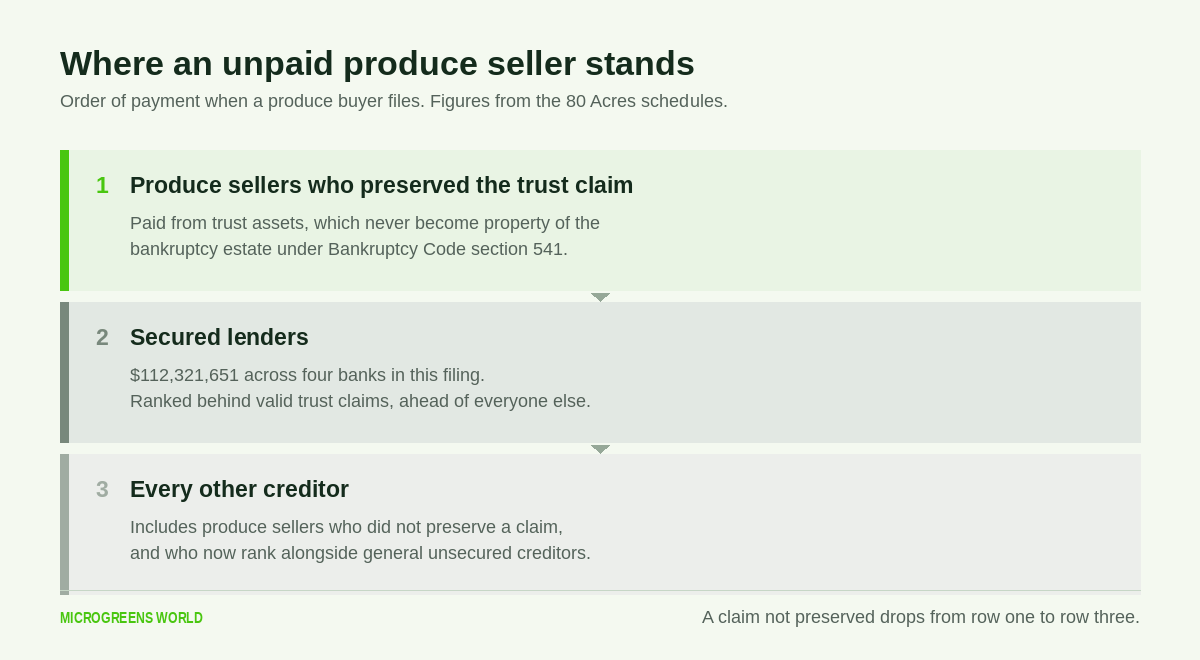
The effect shows up in bankruptcy. Trust assets never become property of the estate under Bankruptcy Code § 541, because the buyer holds them for you rather than owning them. Secured lenders queue behind that.
The 80 Acres filing shows the shape of it, and the settlement list first appeared in the microgreens weekly digest for 4 September. Thirteen produce suppliers were settled in full in the twelve days before the petition, totaling $2,005,128.25. Everyone else joined a line behind more than $112 million of secured debt.
Courts call this a floating trust. You do not have to trace your trays to a particular pallet. You prove what you are owed and that a commingled pool of produce assets exists. The buyer must show what sits outside it (National Agricultural Law Center, n.d.).
None of it is automatic. Selling microgreens wholesale puts you inside the statute. The next two sections cover what you have to do to stay there.
Do you need a PACA license to sell microgreens?
Almost certainly not, and your license status does not affect your trust rights either way. Two separate provisions keep most growers outside the licensing requirement.
The first is a quantity gate. A dealer is someone buying or selling in wholesale or jobbing quantities. The regulation defines that as one ton, 2,000 pounds, of produce in any single day (7 C.F.R. § 46.2(x)). One ton of cut produce in a day is a distribution-scale number.
The second is broader. A producer selling a commodity of their own raising is not a dealer at all, whatever the volume (7 U.S.C. § 499a(b)(6)). Grow it and sell it, and the definition does not reach you.
One edge worth knowing. A grower who markets produce grown by others is a dealer under the same regulation (7 C.F.R. § 46.2(m)(3)). Buying trays from neighboring growers and reselling them is a different activity from selling your own.
The $230,000 figure that circulates is a retailer test rather than a grower test. It applies once a retailer’s annual invoice cost of produce purchases crosses that line.
None of this decides whether you are protected. The trust attaches to what your buyer is, not to what you are, which is why selling microgreens wholesale to a licensed distributor puts you inside it. State and local rules are a separate question, and the licenses and permits you need before you start selling cover those.
What preserves a PACA trust claim, and what forfeits it?
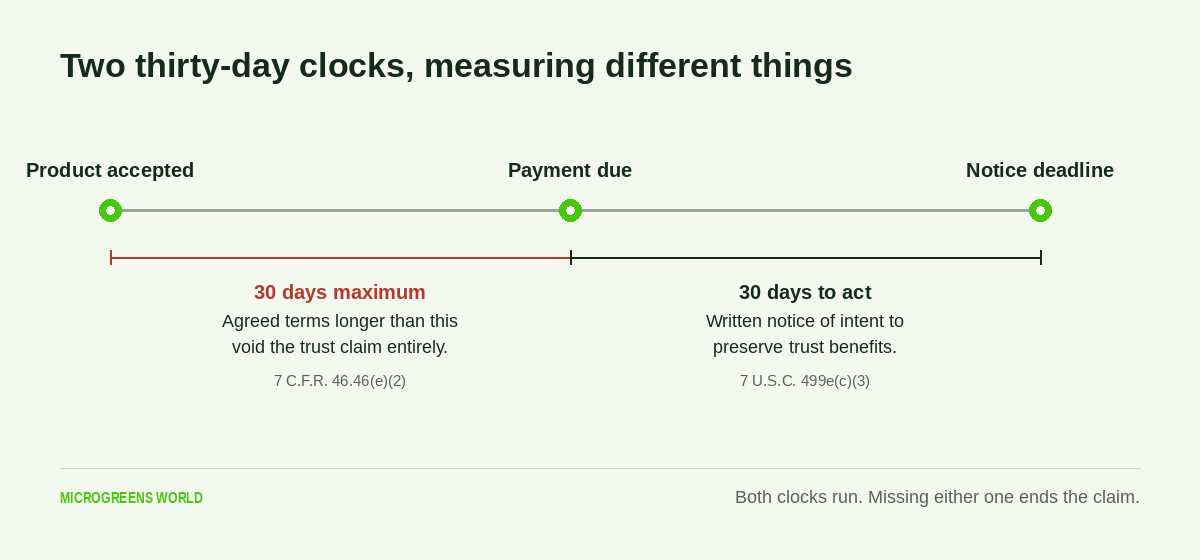
Two methods preserve a claim, and one term quietly destroys it. The statute sets out the methods. The regulation sets a payment ceiling that overrides both.
The first method belongs to licensees only. A licensee may give notice on its ordinary billing or invoice statements, using wording the statute prescribes word for word (7 U.S.C. § 499e(c)(4)).
The second is open to everyone, licensed or not. It is a separate written notice of intent to preserve trust benefits, given to the buyer within thirty days of the payment deadline passing (7 U.S.C. § 499e(c)(3); 7 C.F.R. § 46.46(f)).
The ceiling is where growers lose. Where the parties agree terms extending payment beyond thirty days, the seller cannot qualify for the trust at all (7 C.F.R. § 46.46(e)(2)). A grower selling microgreens wholesale on net-60 terms has forfeited the protection before the first delivery, and nothing later puts it back.
That is worth sitting with, because payment terms usually get agreed by the buyer’s purchasing office and accepted without much thought. The term that feels like a cash-flow inconvenience is the one deciding where you stand if the buyer files.
None of this is paperwork to draft from a blog post. The notice carries prescribed contents and real legal consequences, and I am not a lawyer, so this is not legal advice. Read the USDA guidance, then take your own invoices to someone qualified.
Are restaurants a riskier buyer for your microgreens?
Your protection depends on what your buyer is, not on what you are. The trust attaches to produce received by a commission merchant, dealer or broker (7 U.S.C. § 499e(c)(2)). Sell to a buyer who is none of those, and there is no trust to preserve.
A distributor buying in wholesale quantities is a dealer, and the answer is easy. A single independent restaurant is harder.
The regulations never mention restaurants. A restaurant would reach dealer status through the retailer route, which turns on the invoice cost of all its produce purchases crossing $230,000 in a calendar year (7 C.F.R. § 46.2(m)(2)). A small kitchen buying from three local growers may sit well under that. A restaurant group with central purchasing is a different proposition from one dining room.
So the same tray carries different protection depending on where it goes. That is the part missing from most advice about selling microgreens wholesale to restaurants, which treats landing the account as the finish line and stops there.
USDA runs a public license search, so a buyer’s PACA status is a matter of record rather than something you take on faith. Whether a particular buyer meets the dealer definition is a legal question, and it belongs with someone qualified rather than with me.
Does your wholesale price account for the risk of not being paid?
Usually not, and the gap is easy to miss. Growers benchmark a wholesale price against other growers. Almost nobody prices the risk that the invoice goes unpaid.
Being inside the trust is a recovery position rather than a payment. Beneficiaries rank ahead of the buyer’s other creditors, but enforcing that priority means an action in federal district court, and courts cost money and time (USDA AMS, n.d.). There is no published figure for what produce sellers typically recover, so treat it as better odds rather than a number.
The 80 Acres schedules show both ends of it. Thirteen suppliers were settled in full before the petition and never had to enforce anything. Everyone else joined a queue behind $112,321,651 of secured debt and will find out later what the estate holds.
Which makes terms, buyer and price one decision rather than three. A higher price from a buyer on sixty-day terms who may not meet the dealer definition is not obviously a better deal than a lower price from a licensed distributor paying in ten.
Most advice about selling microgreens wholesale skips that entirely. It compares dollars per pound and stops, as though every buyer carried the same risk.
Wrap-up: selling microgreens wholesale when the buyer might not pay
Whether an unpaid invoice is a loss or a claim comes down to your buyer’s status and your payment terms. Selling microgreens wholesale puts both in play, and neither is about how well you grow.
Most growers already qualify without a license and never find out, because the question arrives on the day a buyer stops answering the phone. The thirteen names in the schedules are the argument for asking sooner.
The paperwork is not something to settle from a blog post, mine or anyone’s. What this post can do is tell you the question exists.
Getting paid for what you grow is its own job, separate from growing it well. Pricing, buyer selection and cash flow all sit together, and the microgreens business hub is where those pieces connect.
Selling wholesale
The paperwork matters. So does who you hand it to.
Trust rights protect a sale you have already made. They do nothing about finding buyers worth selling to, or agreeing terms you can live with. The Microgreens Sales Accelerator is nine live sessions on that side of the business, with feedback on your own numbers and a cohort working through it alongside you.
See the Sales AcceleratorNine-week live course, $297 one time. Results vary by grower, market and effort.
Frequently asked questions: selling microgreens wholesale
Does PACA apply if I only sell inside my own state?
Only partly. PACA reaches transactions in interstate or foreign commerce, which the Act defines to include commerce between states and commerce that passes outside a state before returning (7 U.S.C. § 499a(b)(3)). Selling microgreens wholesale entirely within one state, to a buyer who never ships across a line, may fall outside it.
Are frozen or dried microgreens covered by PACA?
Frozen produce is covered. The Act’s definition reaches fresh fruit and vegetables whether or not frozen (7 U.S.C. § 499a(b)(4)), while the regulation excludes produce manufactured into an article of food of a different kind or character (7 C.F.R. § 46.2(u)). Where drying and freeze-drying sit is not settled by those definitions alone.
What does a PACA license cost?
As of 2010 the base annual fee is $995, plus $600 for each additional branch or business facility, with aggregate fees capped at $8,000 (USDA AMS). Growers selling microgreens wholesale are rarely required to hold one, and the fee is set by the Department rather than scaled to volume.
What is a PACA reparation complaint?
It is USDA’s dispute route for unfair conduct or non-payment, separate from any court action. It begins with an informal complaint to the Secretary and must be filed within nine months of the violation (7 U.S.C. § 499f(a)(1)). Claims under $30,000 can be decided without a hearing.
What happens if a produce business operates without a required license?
The penalty runs to $1,200 for each offense and $350 for each day it continues (USDA AMS). The figures in the statute itself are lower and have been adjusted since. A firm that can show the failure was inadvertent rather than wilful may be able to settle for the fees due plus a smaller sum.
What does “responsibly connected” mean under PACA?
It is PACA’s term for the people behind a firm. A partner, an officer, a director, or anyone holding more than ten percent of the stock is responsibly connected (7 U.S.C. § 499a(b)(9)). The status carries licensing consequences for those individuals, which is separate from who owes money on an invoice.
References
National Agricultural Law Center. (n.d.). The Perishable Agricultural Commodities Act: An overview. University of Arkansas. https://nationalaglawcenter.org/overview/paca/
Perishable Agricultural Commodities Act, 7 U.S.C. §§ 499a–499t (1930), statutory trust added by amendment (1984), 7 U.S.C. § 499e(c).
Regulations Under the Perishable Agricultural Commodities Act, 7 C.F.R. § 46.46 (2026).
U.S. Department of Agriculture, Agricultural Marketing Service. (n.d.). PACA licensing. https://www.ams.usda.gov/rules-regulations/paca/licensing
U.S. Department of Agriculture, Agricultural Marketing Service. (n.d.). PACA trust. https://www.ams.usda.gov/rules-regulations/paca/paca-trust
In re 80 Acres Urban Agriculture, Inc., No. 26-11324-BLS (Bankr. D. Del. filed Aug. 25, 2026).