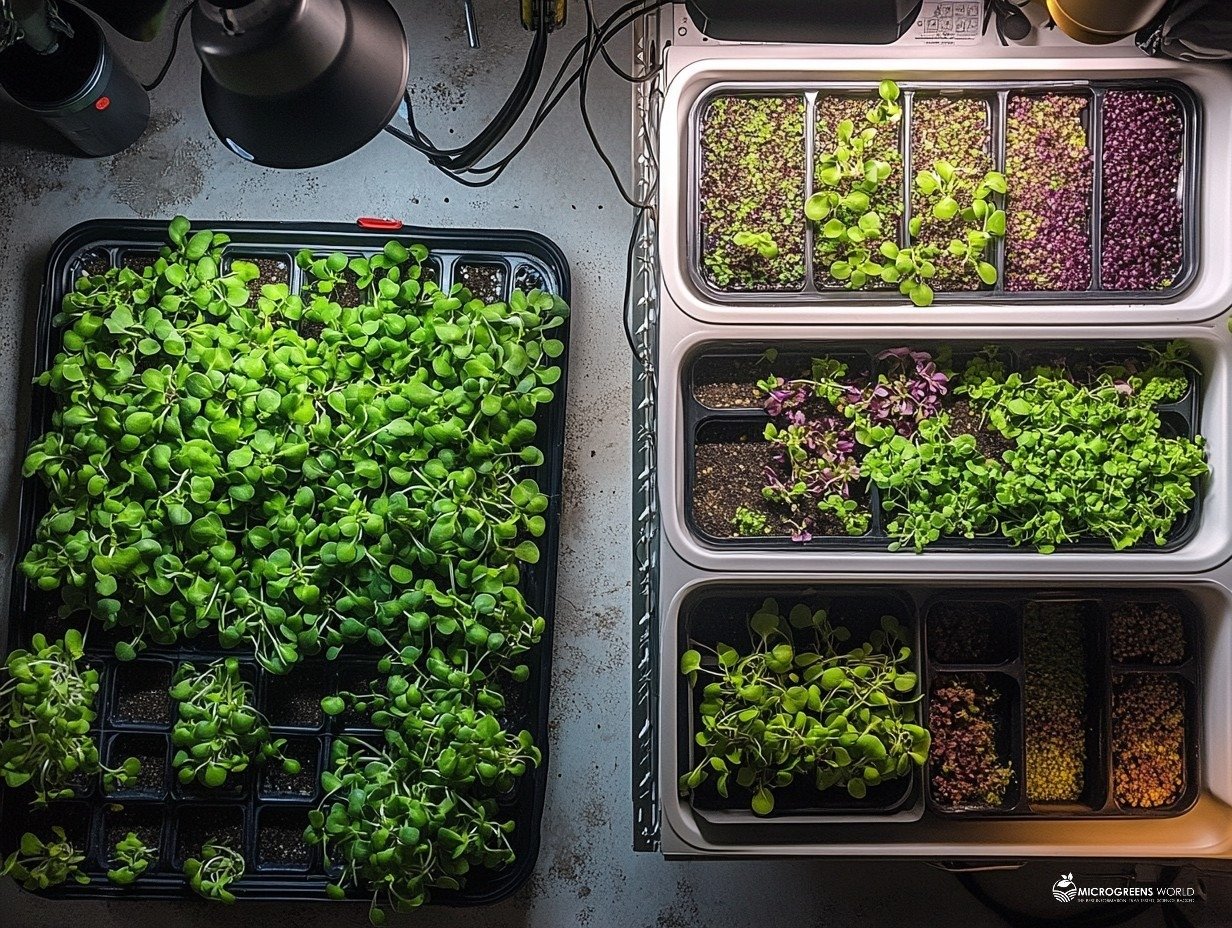
You have seen the posts. Trays of perfect, vibrant microgreens, captioned with promises of easy money from a spare room. And it is true that microgreens can be profitable. But that tidy story has led a lot of people straight into a failed business.
So why do microgreens businesses fail? Not because the growing is hard, growing is the easy part. About half of new microgreens businesses do not make it through their first year, and it is almost always because running the business around the growing is where people come undone. They master the trays and neglect everything else: the buyers, the numbers, the systems that actually keep a business alive.
That is the real story this post tells. Microgreens businesses rarely fail at the crop. They fail at operational efficiency, at pricing, at finding steady buyers, at tracking the money. The growers who survive are not the best growers in town. They are the ones who treated it like a business from day one.
Key Takeaways
About half of new microgreens businesses fail in their first year, and almost never because of the growing. They fail at the business: weak systems, poor pricing, and no steady buyers. The growers who last treat production, profit, and sales as one connected system, and they start small enough to get it right (LendingTree analysis of BLS data, 2025).
Keep reading why standard business advice does not fit microgreens, what the growers who survive do differently, and a 90-day plan for staying in the half that makes it.
Why do most microgreens businesses fail?
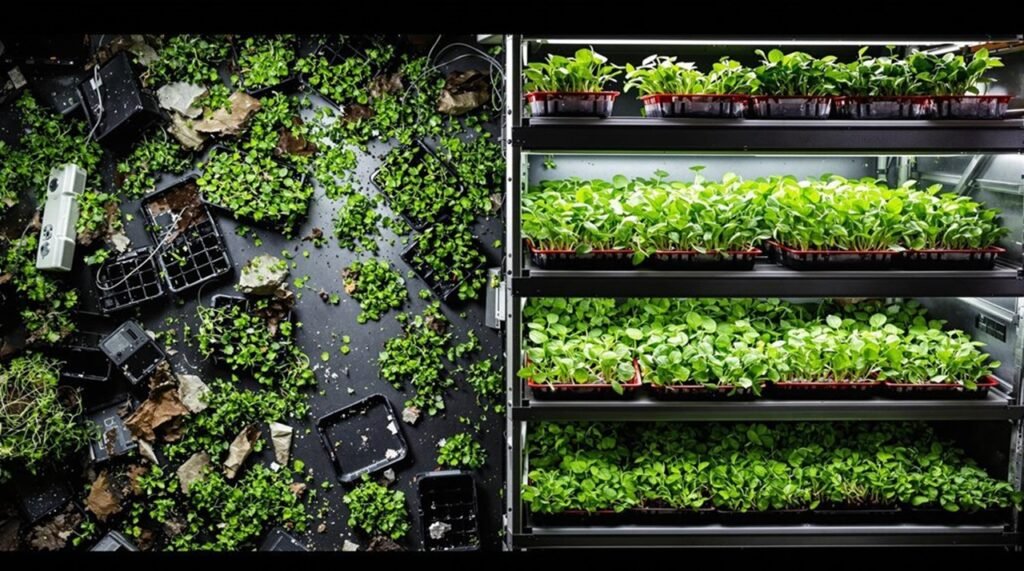
The short answer: they run out of money before they build a real business, and they almost never see it coming.
About half of new microgreens businesses do not survive their first year. That number gets quoted a lot in the industry, and it lines up with what the US Bureau of Labor Statistics reports for small businesses generally. Roughly half are gone within five years (LendingTree analysis of BLS data, 2025). Microgreens just compress that timeline, because the startup costs are low enough that people jump in fast, without a plan, and find out the hard way that low startup cost is not the same as easy money.
Here is the thing almost everyone gets wrong about why microgreens businesses fail. It is not the growing. Growing microgreens is genuinely the easy part; the seeds sprout, the trays fill in, and you get a harvest. What sinks people is everything around the harvest. Poor operational efficiency. No real pricing. No steady buyers. No system for tracking whether they are actually making money or just staying busy. The crop succeeds, and the business fails.
So the skill that matters is not better growing. It is thinking like a business owner: watching your numbers, lining up demand before you scale production, and building the boring systems that keep a small operation alive. The growers who last are the ones who figured that out early.
What separates the microgreens businesses that survive?
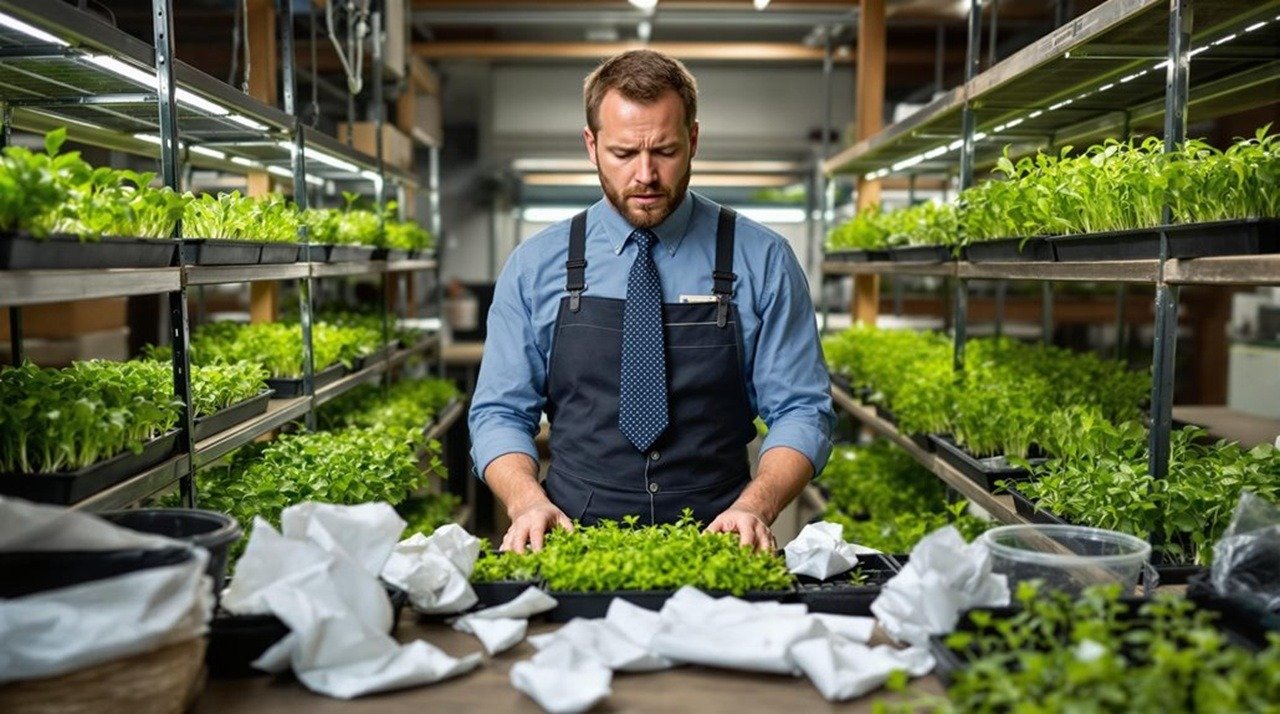
The growers who last all manage the same three things at once. Call it the Success Triangle: production, profit, and sales. Most failing operations are good at one corner, maybe two. The survivors hold all three together.
Here is why all three matter and why one alone is not enough. Get production right but misread demand, and you grow beautiful trays nobody buys, that is waste. Nail your sales but fumble your pricing, and you can be busy and broke at the same time, strong revenue draining straight out through weak margins. Price well, but grow inconsistently, and you lose the buyers you worked to win. Pull one corner out, and the other two start to wobble. They only work as a set.
You can see the triangle decide outcomes in real operations. A startup in Portland had the growing pains but ignored the other two corners entirely; it overproduced with no confirmed buyers, ended up with gorgeous trays and nobody to sell them to, and folded. Farmbox Greens in Seattle did the opposite. They tracked their numbers closely, grew only against pre-orders so production matched real demand, and built steady relationships with chefs to lock in sales. As Seattle’s first indoor vertical farm, they survived and scaled on disciplined planning, not luck. Same crop, opposite corners of the triangle, opposite results.
And they are not alone. Real operations like Great Northern Microgreens in Minnesota, Gangsta Greens in Connecticut, and Piedmont Microgreens in North Carolina all stay in business the same way, by matching steady local demand to consistent, well-priced production. The crop is the easy part. Holding all three corners together is the actual business.
Why is starting small an advantage, not a limitation?

New growers often treat “small” as the thing to escape as fast as possible. That is backward. Starting small is one of the biggest advantages you have, and scaling too soon is one of the fastest ways microgreens businesses fail.
A small operation is easier to run well. Your overhead stays low, so you are not bleeding cash on rent and equipment before you have steady buyers. You can adjust your pricing quickly, test what your local market actually wants, and fix mistakes while they are cheap. And you can build real relationships with the handful of customers you have, the kind of personal service a big operation cannot match, which is what turns first-time buyers into regulars.
Small also keeps your risk low while you figure out the parts that actually decide survival. Use the early, low-stakes phase to build the boring systems before you scale them: track your production and sales so you are not guessing, watch your waste closely because thrown-out trays are pure lost margin, and get a real harvest schedule in place so you are hitting orders consistently instead of scrambling. These are the systems that break operations at scale. Far better to get them right with ten trays than to discover they are missing at a hundred.
Then you scale on purpose. Grow methodically, only adding capacity once your demand, your pricing, and your systems can all handle it. The growers who blow up fast and flame out almost always skipped this step. The ones who last earned each level before they climbed to it.
What does a 90-day plan to avoid failing look like?
Knowing why microgreens businesses fail is useful only if you do something different. So here is the shape of a first 90 days built around survival instead of guesswork, starting with the foundation month that decides most of it.
The first few weeks are about getting the fundamentals in place before you scale anything. Weeks one and two go to your growing setup and your financials together, dialing in consistent production while you build a real picture of your costs and pricing, so the numbers are honest from day one. Week three shifts to market: who you are selling to, how you reach them, and lining up early partners or buyers before you have a glut of product. Week four focuses on keeping the customers you land, the simple retention habits that turn a one-time sale into a standing order.
That first month builds the foundation. The rest of the 90 days is where you put it to work, growing against real demand, refining your pricing as you learn what the market pays, and tightening your systems so the business runs on something steadier than your memory. By the end of the quarter, you are not hoping it works. You have evidence, real buyers, real numbers, real systems, instead of a beautiful crop and crossed fingers.
The hard part is rarely understanding any of this. It is sitting down and actually building the plan, in order, for your own operation. That is exactly what the next step is for.
Wrap-up: How to make sure your microgreens business is not one that fails
So why do microgreens businesses fail? Almost never at the crop, and almost always at the business around it: no validated demand, weak pricing, thin systems, and the quiet assumption that growing well is enough.
The fix is not complicated, but it does take discipline. Treat it like a real business, not a hobby with a side of income. Validate that buyers exist before you scale production. Price for a premium product instead of racing competitors to the bottom. Start small, get your systems right while the stakes are low, and grow only when your demand and your numbers can carry it. Do that, and you land in the half that makes it, not the half that quietly disappears.
None of this requires being the best grower in your area. It requires being the most deliberate business owner. The growers still standing in year two are rarely the ones with the prettiest trays. They are the ones who planned.
If you want to see how a business plan fits with pricing, market research, and everything else that goes into a microgreens operation, the microgreens business hub is where it all connects.
Why microgreens businesses fail: frequently asked questions
Is a microgreens business profitable?
It can be, but profit is not automatic. Microgreens have strong margins per tray, yet about half of new businesses still do not survive their first year, almost always because of weak business systems rather than weak growing. The growers who turn a real profit are the ones who validate demand, price for a premium, and track their numbers.
How long before a microgreens business becomes profitable?
There is no fixed timeline, and anyone promising one is guessing. Some growers cover costs within a few months once they have steady buyers; others take longer to build demand. Your speed depends on how quickly you line up repeat customers, not on the crop, which grows fast regardless.
What are the cons of running a microgreens business?
The real downsides are labor intensity, the constant pressure of a perishable product, and thin margins if your pricing is wrong. It also demands skills beyond growing: pricing, marketing, and daily consistency. None of these are dealbreakers, but they are why treating it casually tends to end badly.
Is the microgreens market saturated?
No. Demand is still growing, driven by interest in fresh, local, nutrient-dense food. But the market is local, not national, so “saturated” depends entirely on your area. Your job is not to worry about a national figure, it is to find enough repeat buyers within driving distance to support your trays.
Do I really need a business plan to avoid failing?
You need a plan in the real sense, knowing your buyers, your numbers, and your next steps, even if it is not a formal 40-page document. Most failures trace back to skipping that thinking and growing on hope. A simple, working plan is what turns “I want to sell microgreens” into a business that lasts.
References
Barlongo, A. J., & Mercado, M. F. (2024). Introducing microgreens to Pinggang Pinoy: Prospects in cultivation, marketability, and indigenous crops utilization. DMMMSU Research Journal, 8, 35–61. https://doi.org/10.62960/dmmmsu.v8i.40
Dubey, S., Harbourne, N., Harty, M., Hurley, D., & Elliott-Kingston, C. (2024). Microgreens production: Exploiting environmental and cultural factors for enhanced agronomical benefits. Plants, 13(18), 2631. https://doi.org/10.3390/plants13182631
LendingTree. (2025). What percentage of businesses fail? An analysis of US Bureau of Labor Statistics data. https://www.lendingtree.com/business/small/failure-rate/
Muftiyatunnisa, S., Darsono, D., & Anantanyu, S. (2023). The impact of social media on microgreens product knowledge and purchase intention. SEISENSE Journal of Management, 6(1), 6–18. https://doi.org/10.33215/sjom.v6i1.834
Singh, A., Singh, J., Kaur, S., Gunjal, M., Kaur, J., Nanda, V., Ullah, R., Ercisli, S., & Rasane, P. (2024). Emergence of microgreens as a valuable food, current understanding of their market and consumer perception: A review. Food Chemistry X, 23, 101527. https://doi.org/10.1016/j.fochx.2024.101527
Business Disclaimer
The information provided in this article and related materials is for educational and informational purposes only. It should not be considered specific business, financial, or legal advice. While we strive to provide accurate and current information, business conditions vary widely by location, market, and circumstance. Always consult with qualified business, financial, and legal professionals before making any business decisions or investments. The author and publisher are not responsible for any business outcomes, financial losses, or legal consequences resulting from the use of this information. Readers assume full responsibility for their business decisions and acknowledge that success in microgreens or any business venture cannot be guaranteed.