Disclosure: We’re reader supported. When you buy through links on our site, we may earn a commission: Full Disclosure.
I went looking for the day somebody first said the word microgreens out loud. I did not find it.
What I found were two stories that cannot both be true. One puts the moment in a San Francisco kitchen in the early 1980s. The other puts it in Virginia in 1992, with a chef, a grower and a food writer in the room. Almost every article about the microgreens revolution picks one and never mentions the other.
That bothered me enough to go and check, and it turned out to be the smaller surprise. A lot of the other numbers everyone repeats do not hold either.
Key takeaway
Nobody has established who named microgreens. Two accounts circulate. One puts it in San Francisco in the early 1980s, the other in Virginia in 1992, and neither rests on a dated document. What is settled is the nutrition. Across 25 varieties, red cabbage microgreens carried six times the vitamin C of the mature vegetable (Xiao et al., 2012).
Below: what the 2012 study actually measured, why chefs moved off sprouts, what the crop does for a small urban farm, and which market numbers survive a look at their sources.
Listen to the audio version:
For growers thinking about the business side
You know the crop. The business is a different skill.
Your Growth Path walks the parts nobody teaches you in a grow room: what to sell, who to sell it to, and what it actually costs to keep a tray rotation profitable. Work through it at your own pace.
Results vary with your market, your costs and the hours you put in. Nothing here promises an income.
Who actually invented microgreens?
Short answer: nobody knows. The CBS segment above is worth watching before you read on, because it lands somewhere very different from the version you have probably been told.
The version you meet first puts microgreens on San Francisco menus in the early 1980s. It sits in the nutrition literature, in trade writing, and in the encyclopedia entry most people land on. Follow it back and it rests on one unnamed industry source quoted in a government magazine.
The competing version is more specific, which is what makes it interesting. Chef Craig Hartman, then at the Clifton Inn outside Charlottesville, kept asking grower Michael Clark for smaller lettuce. Clark kept cutting it smaller. Food writer Pam Parseghian of Nation’s Restaurant News asked what was on her plate, and the name got invented to answer her.
Good story. Also unconfirmed, and the two men remember it differently. Clark’s own company page describes a book photo shoot rather than a magazine visit, and adds a line nobody else in this argument has managed: they cannot really verify it was the first use of the term (Planet Earth Diversified, 2005).
CBS went to Virginia in 2022 and told the same story with both men named, the strongest outside corroboration the Virginia account has (Pogue, 2022). Note the date, though. CBS says 1993. The written accounts say 1992. Nobody has a document that settles the year, and neither man has ever worked in California.
What is the difference between microgreens and sprouts?
Water and light, mostly. Then everything else follows from those two.
Sprouts came first in the American diet. Alfalfa and mung bean landed in health food stores through the 1960s and 1970s alongside the natural foods movement. They germinate in water, in the dark, and you eat the whole thing after two to seven days: seed, root and shoot together.
Microgreens grow in soil or a soilless medium, under light, and get cut at seven to twenty-one days once the cotyledon leaves have opened and sometimes the first true leaves with them. You harvest stem and leaf. The root and the spent seed hull stay behind in the tray.
That distinction sounds fussy until you notice it drives the food safety difference, the shelf life, the price, and the reason a chef can cook with one and not the other. It also separates microgreens from baby greens, which are harvested later and behave more like small salad leaves.
What did the 2012 USDA microgreens study actually find?

It measured vitamins and carotenoids in 25 commercially available microgreens against published values for the mature plants, run jointly by the University of Maryland and USDA-ARS at Beltsville (Xiao et al., 2012). Three numbers get quoted constantly, and all three hold up.
| Finding | What the paper says |
|---|---|
| Vitamin C, red cabbage | 147.0 mg/100 g fresh weight, six times the 24.4 mg published for the mature vegetable |
| Vitamin E, red cabbage | “Over 40 times” the mature crop, against 0.06 mg/100 g |
| Beta-carotene, cilantro | Three times the mature leaf. Cilantro also topped all 25 for lutein and zeaxanthin |
Two things get lost in the retelling. Red cabbage was not the vitamin E champion, green daikon radish was. And the tidy “about five times more nutrients” line everyone hangs on the study is not in the study. It comes from the USDA’s magazine write-up two years later (USDA ARS, 2014). Lester put it less tidily, finding levels “in some cases 4-6 times more concentrated than in the leaves of a mature plant” (Gray, 2012). The full red cabbage numbers repay a look.
One more correction, and it took some digging. You will see it claimed there were around 300 scientific papers on microgreens before 2012. Searching Google Scholar, OpenAlex, Semantic Scholar and Crossref together returns 38 records for the entire period before 2013, against more than 2,000 since. Strip the trade press, the how-to books and the false matches out of that first group and 14 are peer-reviewed journal articles, the earliest from 2004. This field is younger than almost everyone writing about it assumes.
This information is educational and is not a substitute for professional medical advice. Talk with your physician before making significant changes to your diet or before using microgreens to address a health concern.
How did microgreens get off the garnish plate?
Slowly, and then all at once when the 2012 numbers landed.
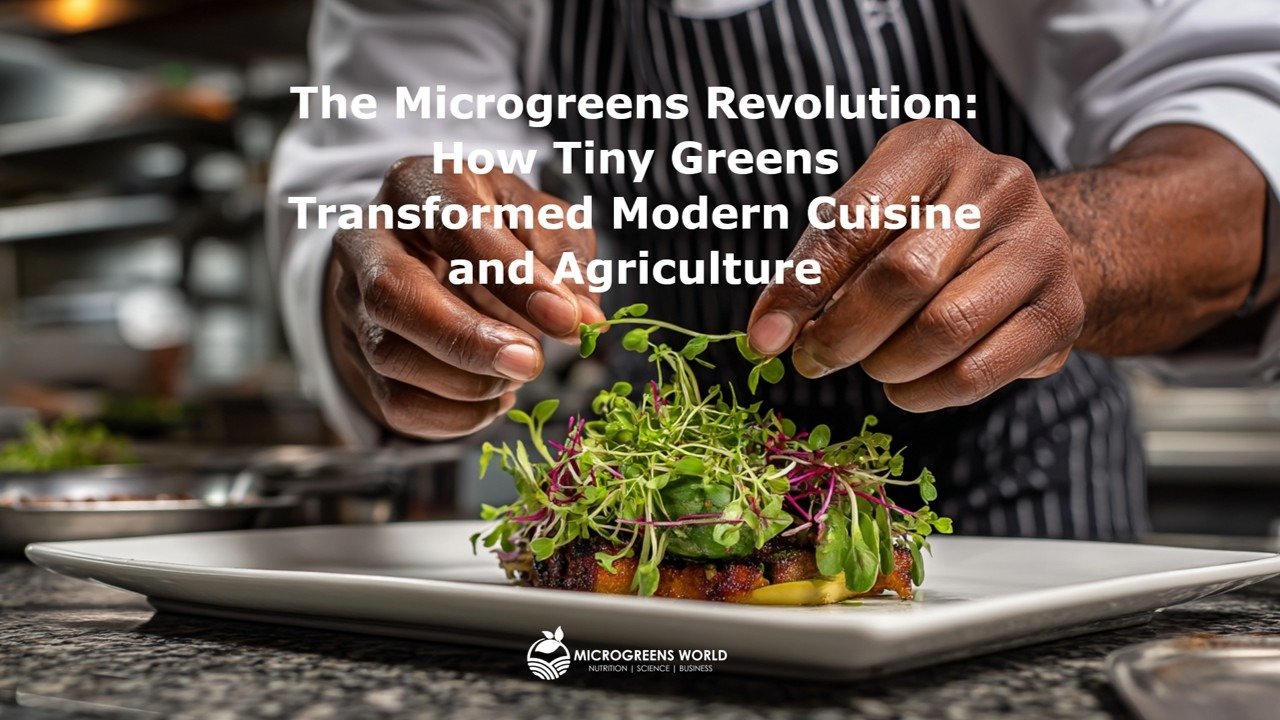
For the first stretch they were bought for looks, and not much more. What changed the argument was farm to table, because microgreens fit that logic almost too neatly: grown locally, grown year round, harvested days before service, and too short-lived to ship far anyway.
Ryan Pfeiffer, then chef at Chicago’s Blackbird, told Produce Business in 2016 what the shift looked like from the pass. “It’s common to see microgreens just kind of thrown on the plate. Here, if it doesn’t have a purpose it doesn’t go on the plate. Nothing is just a garnish” (Lehndorff, 2016). Blackbird closed in 2020 after twenty-two years, but the standard he described outlived it.
Growers moved with the kitchens. David Sasuga, who owns Fresh Origins in San Marcos, California, described the range opening up: “When we started out we had maybe five varieties and now we have over 100” (Lehndorff, 2016). Shiso, amaranth, unusual herbs, blends built for one restaurant. Danielle Horton of Urban Produce put the commercial version plainly: “We can work with a chef to create a blend grown for them and put their name on the label.” Which varieties chefs reach for has kept widening since.
Are microgreens safer than sprouts?
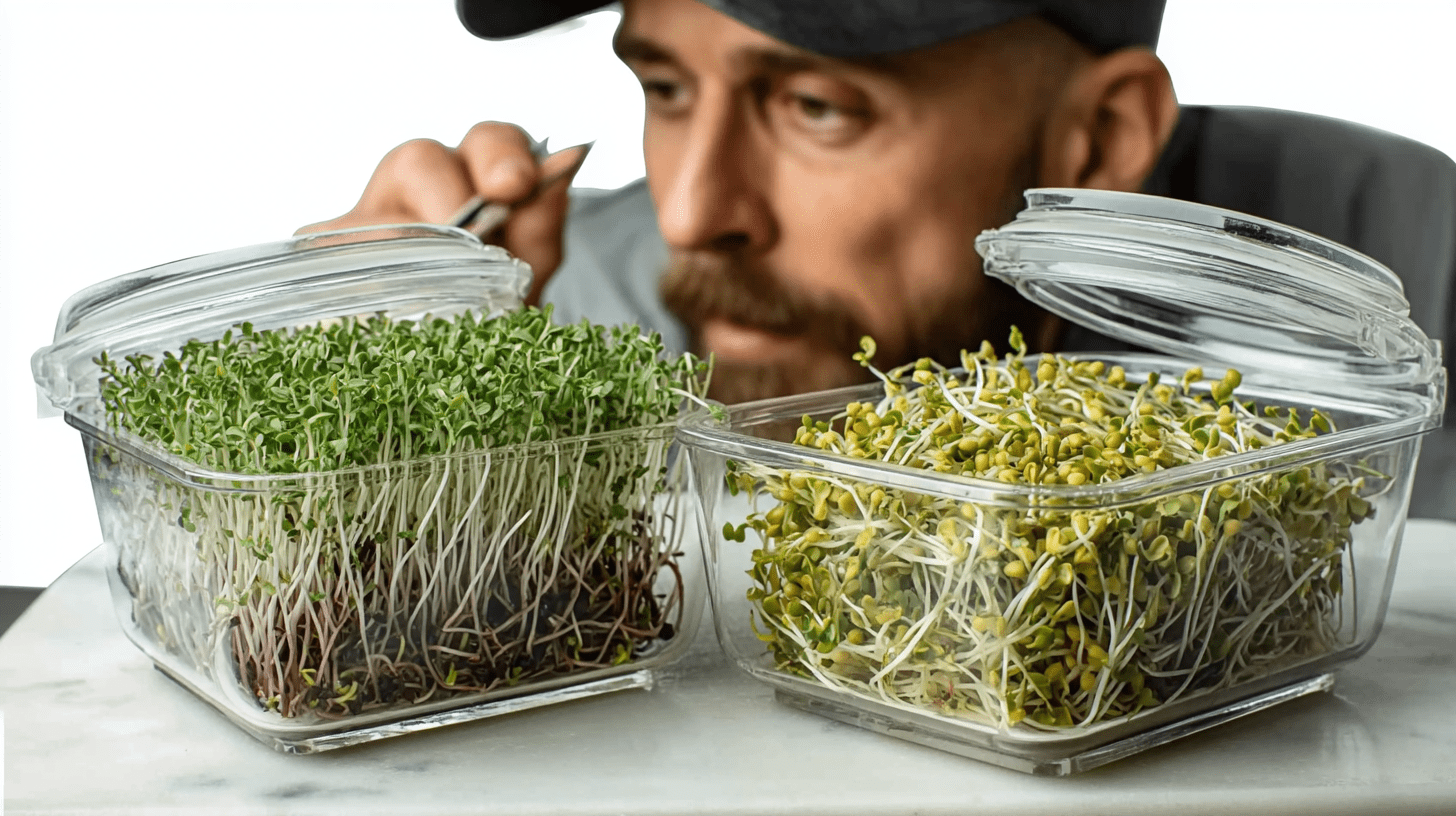
Probably, and the reason is the growing method rather than the plant. No regulator has ever said so, though, so be precise about who claims what.
The sprout record is not in dispute. From 1996 to July 2016 the FDA counted 46 reported foodborne illness outbreaks in the United States linked to sprouts: 2,474 illnesses, 187 hospitalizations and three deaths (FDA, n.d.). The mechanism is seed-borne. If a few harmful bacteria sit on the seed, FDA says, they can reach high levels during sprouting even under sanitary conditions at home. Warm and humid is what a sprout needs and what Salmonella likes. Restaurants read that list and took raw sprouts off the menu.
Microgreens look better here, and a 2020 review from a USDA and University of Maryland team says why. They sit in solid medium rather than soaking, get light and moving air, rarely have their water recirculated, and are cut above the root. Work the review cites found pathogens 3 to 5 log cfu/g higher on sprouts (Turner et al., 2020).
The caveats matter. Those same authors warn that hydroponic microgreens with recirculated water may carry sprout-like risk, so this belongs to the system and not the crop. There have been recalls, two of them Class 1 in Canada in May 2026 for possible E. coli, neither linked to any illness (CFIA, 2026). What holds: no foodborne illness outbreak has ever been attributed to microgreens in the United States.
Why do microgreens suit urban farming so well?
Because the crop is finished before a field crop has finished germinating, and it stacks.
Seven to twenty-one days from seed to harvest changes the economics of a small space. Shallow roots and almost no height mean shelves stack, so a basement or a warehouse corner becomes production floor rather than storage.
The cash flow argument is the one growers feel first. A field crop ties up money for a season, while a microgreens tray turns over in under three weeks, which is why so many operations start small and self-fund. University of Missouri Extension’s 2024 planning budget gives the only per-tray figures I would put in front of anyone: on a 10 by 20 inch tray, cabbage returned $19.45 over costs, broccoli $14.36, a mix $14.20, peas $6.58 and radish $5.84, against $4,384 of equipment (Ale & Cabrera-Garcia, 2024). Budget assumptions for planning, not earnings anyone is promising you.
Short shelf life turns out to be a moat. A crop that cannot travel far cannot be undercut by a distant producer, so local growers keep local accounts. On water, be careful with the figure you have seen. That 95 percent saving is not a microgreens number. The documented estimate is that indoor soilless lettuce needs about three percent of the water field lettuce takes (Tavan et al., 2021), and nobody has published the equivalent for microgreens.
How big is the microgreens market really?
Nobody knows that either, and the honest version of this section is more useful than a confident number would be.
Grand View Research put the global microgreens market at $1.8 billion in 2025, growing at 14.6 percent a year to 2033 (Grand View Research, 2025). That is one firm’s estimate and I would cite it as exactly that, because the four firms publishing on this crop cannot agree with each other. Their base-year values for the same market run from $1.8 billion to $3.0 billion. Their growth rates run from 6.62 percent to 14.6 percent. They do not even agree on which continent buys the most, with three naming North America and one naming Europe.
So when you read that the market will hit a particular figure by a particular year, check which firm said it and what year they actually said. The one regional claim with real agreement is that Asia-Pacific is growing fastest, somewhere above 12 percent a year.
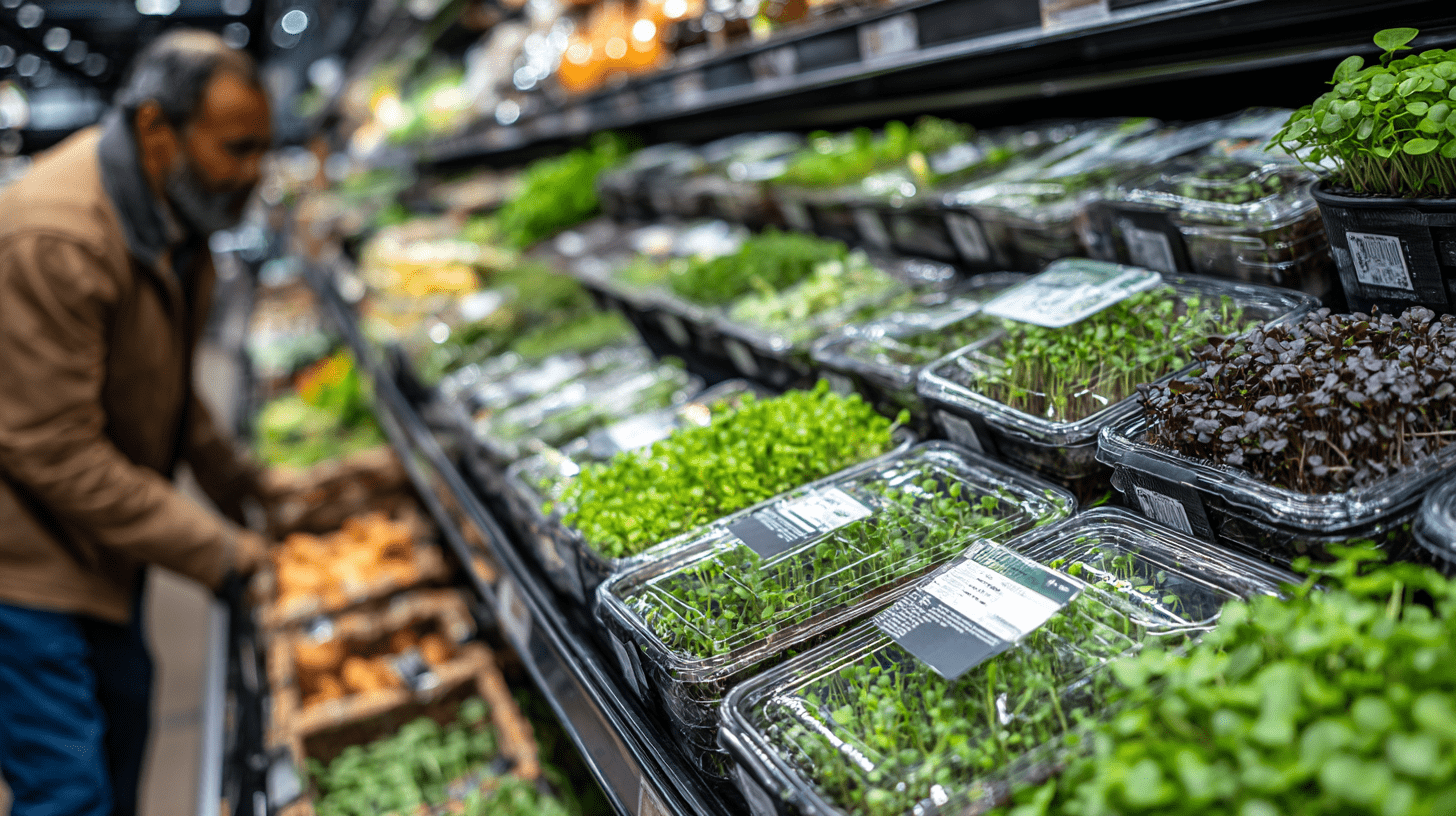
What is not in doubt is where the crop is sold. It started restaurant-only. It is now in supermarket clamshells, subscription boxes, grow-at-home kits, and shelf-stable formats like pesto that get around the freshness problem. The buyers changed, and that is the part the market reports are late to.
Wrap-up: what the microgreens revolution actually looks like
A crop with no agreed birthday, one solid piece of nutrition science behind it, a clean safety record so far, and a market nobody can size to within 67 percent. Stranger than the tidy origin story, and closer to true.
The pattern worth taking away is that the checkable parts of this story hold and the repeated parts often do not. The 2012 nutrition numbers and the outbreak figures both survive scrutiny. The origin date, the water saving, the paper counts and most of the market projections do not.
Growing this crop for money is a different question from understanding it, and it has its own set of things people repeat without checking. If you are weighing it as a business, the microgreens business hub is where the operational side lives.
For growers thinking about the business side
You know the crop. The business is a different skill.
Your Growth Path walks the parts nobody teaches you in a grow room: what to sell, who to sell it to, and what it actually costs to keep a tray rotation profitable. Work through it at your own pace.
Results vary with your market, your costs and the hours you put in. Nothing here promises an income.
Microgreens revolution: frequently asked questions
Can I grow microgreens at home without special equipment?
Yes. A shallow container, a growing medium, seeds, water and enough light will do it. Equipment makes results more consistent and lets you run more trays, but nothing on the beginner list needs to come from a specialist supplier. Start with one tray of one thing.
Which varieties are easiest for a first-time grower?
Radish, sunflower and peas. They germinate fast, grow with some vigour behind them, and forgive the mistakes everyone makes early on with watering and seeding density. Save the slower and fussier herbs until you have run a few trays that worked.
Why do microgreens cost more at the store than sprouts?
More goes into them. Medium, bench space, light, labour at harvest, and a crop cycle several times longer. Add a short window between harvest and the shelf, which means more waste for whoever is selling them, and the premium stops looking mysterious.
How long do microgreens keep after harvest?
Not long, and that is a property of the crop rather than a failure of your handling. Refrigerate them dry, in something that stops them getting crushed, and use them within a few days. Shelf life remains the problem the industry has not solved (Turner et al., 2020).
Should you wash microgreens before eating them?
Rinse them under running water and dry them gently unless the package says they have already been washed, in which case follow the label. Be careful with them. They bruise easily and wet leaves go slimy fast, so dry matters as much as the rinse.
Do microgreens grow back after you cut them?
Mostly no. The cut usually takes the growing point with it, which is the end of that plant. Peas are the common exception and will often give a second, thinner cut. For everything else, compost the tray and start again rather than waiting on regrowth that is not coming.
References
Ale, M., & Cabrera-Garcia, J. (2024). Microgreens planning budget (G693). University of Missouri Extension. https://extension.missouri.edu/publications/g693
Canadian Food Inspection Agency. (2026, May 15). Kyan Culture brand and Farm Boy brand organic microgreens recalled due to pathogenic E. coli. https://recalls-rappels.canada.ca/en/alert-recall/kyan-culture-brand-and-farm-boy-brand-organic-microgreens-recalled-due-pathogenic-e
Food and Drug Administration. (n.d.). FDA concludes major sampling study of sprouts. https://www.fda.gov/food/hfp-constituent-updates/fda-concludes-major-sampling-study-sprouts
Grand View Research. (2025). Microgreens market size, share and trends analysis report. https://www.grandviewresearch.com/industry-analysis/microgreens-market-report
Gray, N. (2012, September 6). Microgreens backed to pack a nutritious punch. NutraIngredients. https://www.nutraingredients.com/Article/2012/09/06/Microgreens-backed-to-pack-a-nutritious-punch
Lehndorff, J. (2016, May 25). Micro management: Tiny greens give chefs fresh flavors to play with. Nibbles. https://johnlehndorff.wordpress.com/2016/05/25/micro-management-tiny-greens-give-chefs-fresh-flavors-to-play-with/
Planet Earth Diversified. (2005). The invention and definition of nanogreens. https://www.planetearthdiversified.com/nano%20invention.htm
Pogue, D. (2022, November 20). The long and short of microgreens [Video]. CBS Sunday Morning. https://www.cbsnews.com/video/the-long-and-short-of-microgreens/
Tavan, M., Wee, B., Brodie, G., Fuentes, S., Pang, A., & Gupta, D. (2021). Optimizing sensor-based irrigation management in a soilless vertical farm for growing microgreens. Frontiers in Sustainable Food Systems, 4, 622720. https://doi.org/10.3389/fsufs.2020.622720
Turner, E. R., Luo, Y., & Buchanan, R. L. (2020). Microgreen nutrition, food safety, and shelf life: A review. Journal of Food Science, 85(4), 870–882. https://doi.org/10.1111/1750-3841.15049
USDA Agricultural Research Service. (2014, January). Specialty greens pack a nutritional punch. Agricultural Research, 62(1). https://agresearchmag.ars.usda.gov/2014/jan/greens
Xiao, Z., Lester, G. E., Luo, Y., & Wang, Q. (2012). Assessment of vitamin and carotenoid concentrations of emerging food products: Edible microgreens. Journal of Agricultural and Food Chemistry, 60(31), 7644–7651. https://doi.org/10.1021/jf300459b