
Microgreens World · Growing, and the science behind it
What actually controls a tray, and what only sounds like it does.
Most growing advice was written for somebody else’s room. This page holds what the papers say about seed, media, light, climate, and water, the pages growers here actually read, and the honest places where nobody has measured it yet.
The rule
The advice that failed you was probably written for a different room. A basement in Denver and a spare bedroom in Cape Town get the same instructions, and one of them loses the tray. So I went to the papers on seed, media, light, climate and water, kept what held up, and say plainly where the evidence runs out. Some of the answers are boring. Those get printed too.
D. Andrew Neves
Start here
All growing pages →Five pages, picked by what growers actually clicked from Google over the last twenty-eight days rather than by what got published last.
Growing
Best microgreens growing kits in 2026
More people land here than on anything else in this wing, and most of them are about to spend money before their first tray.
166 clicks in 28 daysGrowing
Growing microgreens at home in containers
Sixteen thousand people saw this in search last month. If the site has a front door for growers, this is it.
90 clicks in 28 daysGrowing
Growing microgreens without soil
The question that splits every beginner, answered without picking a side before the evidence does.
23 clicks in 28 daysGrowing
Proper microgreens airflow
Wilt and mold are usually one problem wearing two names, and the fix costs less than a tray.
Read it before the next moldGrowing
Temperature and humidity
Two dials most growers never actually set, and the reason a method that worked in spring stops working in July.
The numbers nobody measures
The six factors
All growing pages →In the order the plant meets them, from the seed in your hand to the tray in the fridge. Every harvest that goes wrong went wrong on one of these six.
-
No. 01
Seed
Germination rate and cleanliness decide the tray before you have done anything to it. Most trays people blame on technique were lost at the seed.
Choosing and sourcing → -
No. 02
Growing media
What you sow into has to hold water without holding mould, and the choice changes yield and what ends up in the leaf. Peat is not a neutral default.
Soil, coir, mats or nothing → -
No. 03
Light
Too little and the stems stretch and fall over. Too much and some crops stop gaining. The number that matters is not brightness, it is how much reaches the tray.
What the studies measured → -
No. 04
Climate
Temperature, humidity and air movement. Mould and wilt both live here, and a method that worked in spring stops working in July for reasons nobody wrote down.
Temperature and humidity → -
No. 05
Water
How much, how often, and what is dissolved in it. This is also where nitrate comes from, which is the part of growing almost nobody measures.
Watering from seed to cut → -
No. 06
Harvest and after
When you cut and how you keep it. Storage temperature is the single best evidenced lever on this whole list, and it costs nothing to get right.
Timing and keeping →
Most asked
Six questions growers type into a search box, each one answered on a page here rather than in a paragraph on this one.
The evidence
Four pages where the numbers came from named studies rather than from other blogs. Where a figure could not be traced back to a paper, it came off.
Light
Microgreens lighting requirements
Ten studies named, nineteen references. Broccoli peaked between 50 and 100 µmol/m²/s in Shahkoomahally 2025, which is a number you can set a lamp to.
19 referencesFood safety
Can microgreens make you sick?
Nine references, most of them from food microbiology journals. Anyone selling what they grow should have read this one before their first market.
9 referencesWater
Microgreens watering mastery
Di Gioia 2016 measured radish transpiring about 2.1 mm a day across the first ten days. That is a rate you can water to instead of guessing.
7 referencesMedia
Organic microgreens farming
Nine sources behind the page, and one correction. The famous five times figure traces to Xiao 2012, which measured microgreens and then compared them against the USDA database rather than against mature plants grown alongside. That is not the same experiment.
9 sources, one correction
The papers themselves live in the research portal. Over two thousand studies on microgreens, 1978 to 2026, added to weekly. Search the library →
Real growers, real results
Four people who wrote in. Their words, not mine, and not edited.
“I used Andrew’s book, switched from coco coir to soil, and my first tray grew evenly with no mold or weak spots!”
Jim C.
Oregon“After three decades in the microgreens and sprouts industry, even before the word microgreens became popular, I noticed people charge hundreds and thousands of dollars for what Andrew gifted us. He has laid down a path to healing and making healthy eating a family and community thing.”
Lou Duncanson
Green Garden Organics, Florida. Wrote the foreword to Children of the Soil.“Most sources are pretty decent, but there is one source in particular that far surpasses all of the sources that I have discovered. Most importantly, Microgreens World emphasizes evidence-based information, citing scientific studies to support its content. It is my go-to source.”
Glen Howard
Greny’s Greens, Canada“Honestly, we have learned quite a lot from your digests, especially the research sections. The business is growing with us, we are basically pioneers in live microgreens here in casa, so thanks for your help, the information saves us time.”
Simon Denton
Microgreens farm owner, Casablanca, Morocco
Testimonials reflect individual experiences. Results vary. We do not guarantee income or health outcomes.
Before you buy anything
Is your room actually ready?
A few questions about your space, your water and your light, and you get back the list of what to fix first. Not a shopping list. The things already costing you trays. No account.
Check my setup →Tells you what to fix, not what to buy.
Two machines for this
One diagnoses a tray that is already going wrong. The other is the reference you keep open while you grow.
Free · no account
Microgreens Troubleshooter
A tray is failing and every search result names a different cause. Describe what you are actually looking at and get back the causes worth checking, in the order worth checking them.
Open the troubleshooter →App · free to search
Microgreen Assistant Pro
A searchable database of 101 varieties, each one carrying sowing density, seed preparation, blackout days, days under light and harvest window. Behind a free account: a seven chapter growing course, eleven tray problems written up with the symptom, what causes it, how to prevent it and what to do now, plus an assistant that answers from the library. Three varieties carry a full day by day guide today. The rest are reference cards while those get written.
Free to search the varieties. $20 a month adds the advanced topics.
See what is in it →
The guides
Three documents you can work from, plus a free five minute check for anyone selling what they grow.
Digital guide · PDF
Microgreens pest control guide
Identifying what is in the tray, keeping it out of the next one, and treating what is already there.
$17
Protect my tray →Digital catalog · PDF
The edible plant catalog for growing microgreens
Over a hundred varieties with what each one is actually like to grow, so the next thing you try is not a guess.
$27
Find my next variety →Free · five minutes · anonymous
Food safety gap assessment
Selling what you grow puts you in front of an auditor eventually. This walks your operation and shows you the documentation you do not have yet.
Find my gap →Professional guide · PDF
Comprehensive food safety for microgreens
Minimising risk from seed to plate. Written for anyone whose greens leave their own kitchen, and it opens by saying there are no well documented FDA confirmed US outbreaks traced to microgreens, which is the honest place to start.
$197 $97
Pass my inspection →
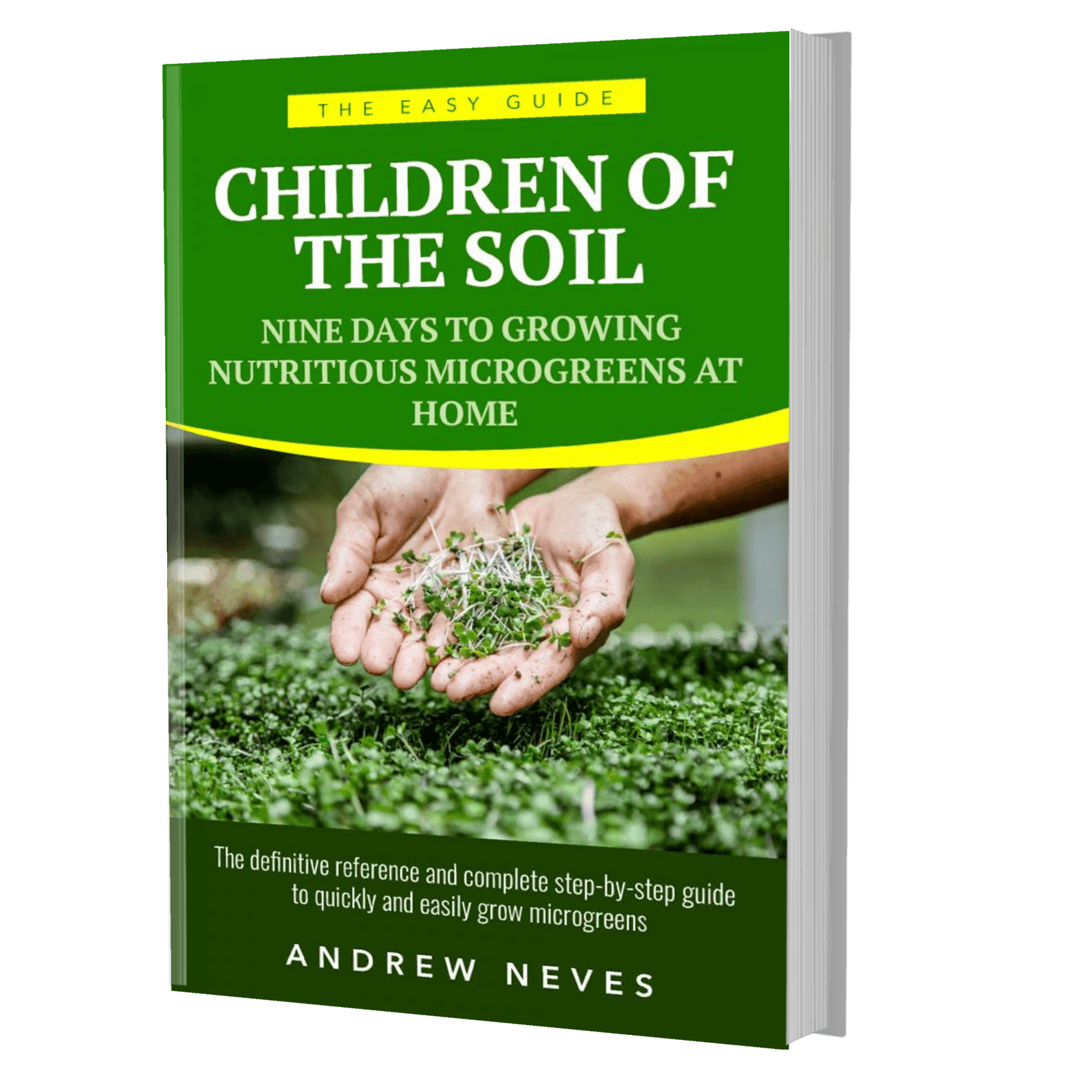
The book
Children of the Soil
The Easy Guide to growing microgreens at home
Nine days from a dry seed to a tray you can cut. It walks through the things that actually go wrong on the way, mold, uneven germination and stems too weak to stand, and it was written long before any of the tools on this page existed. Jim’s tray further up this page came out of this book.
$97 $27
Get the book →Tested picks
Three things growers ask about before they spend money. Answered by using them.
Gear
Seeds
Germination rate and cleanliness decide the tray before anything you do to it does. Where to buy, and what to check on arrival.
Pick my seedsGear
Trays
Drainage, depth, rigidity, and whether the thing survives a second season. The cheap ones cost more.
Pick my traysGear
Lights
Spectrum, distance and hours, matched against what the studies in the evidence band above actually measured.
Pick my lights
As an Amazon Associate, we earn from qualifying purchases.
The Variety Library
What you can honestly say about what you grew
You grew it. At some point a customer picks up the bag and asks whether any of the health claims are true, and the answer decides the sale. The Library is the reading behind that answer, crop by crop: what the evidence supports, what it does not, and the exact sentences you can stand behind at a stall.
I read the studies to table level and turn them into plain wording. You spend ten minutes. The reading was my job.
4 of 39
Crops read to table level
Show me what I can say →In the wrong wing? The three doors are on the front page. Take me to the doors →
Microgreens weekly digest
One letter a week, and the new reading lands there first
What the studies said this week, what did not survive checking, and which crop is on the reading pile next. Every new guide goes out here before it goes anywhere else.
No spam. Unsubscribe anytime.
Educational only. Microgreens are food, not treatment. Growing results depend on your room and your work, rules for selling what you grow change by state and county, and no income is promised. Everything on this page takes effort to use. None of it works on its own.
