A question I hear constantly from new commercial microgreens growers: “Do I actually have to follow FSMA?” The answer is almost always no. And that “no” can quietly become one of the most expensive decisions in your business.
Researchers at Purdue University just published a peer-reviewed look at how FSMA-exempt small produce growers think about food safety, what drives their decisions, and what the exemption actually costs them in liability and market reach (Kontor-Manu et al., 2026).
The study focused on field-crop growers, but the findings map almost perfectly onto commercial microgreens operations. In some ways, they matter even more for microgreens, because what you’re growing is a ready-to-eat product with no cooking step standing between your tray and your customer’s plate. That changes the stakes of every decision in this analysis.
Key Takeaways
The 2026 Purdue study found that FSMA-exempt produce growers remain fully liable for foodborne illness regardless of regulatory status, and that exemption from the Produce Safety Rule actively limits market access to wholesale and retail channels requiring food safety certification. Most commercial microgreens operations likely qualify for exemption, But qualifying is not the same as being protected (Kontor-Manu et al., 2026).
Below, I break down what the study found, why it applies specifically to FSMA microgreens growers, and what practical steps make sense right now.
Are most commercial microgreens growers exempt from FSMA?
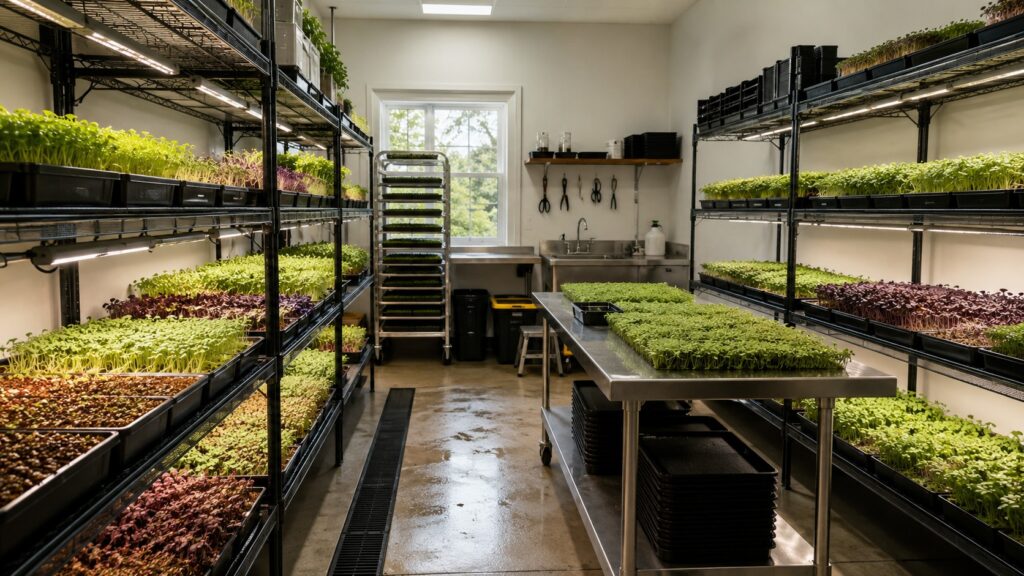
Probably yes. Under the FSMA Produce Safety Rule, farms with average annual produce sales of $25,000 or less are fully exempt from compliance requirements (U.S. Food and Drug Administration, 2015). The Purdue study found that 53% of their participants were below that threshold, and most microgreens operations start smaller than that (Kontor-Manu et al., 2026).
There are also “qualified exemptions” for farms earning between $25,000 and $500,000 in total food sales annually, provided more than half of those sales go directly to consumers or to restaurants and retailers within the same state or within 275 miles. Many CSA-based or farmers market-focused FSMA microgreens growers fit that description.
One thing worth knowing: microgreens are not classified as sprouts under the PSR. Sprouts have their own stricter standards because they’re germinated in water, and the seed and sprout are consumed together. Microgreens, grown to the cotyledon or first-leaf stage in a growing medium, fall under the general produce provisions, which means the standard exemption thresholds apply.
Being exempt sounds like a win. The research suggests it’s more complicated than that.
Does being FSMA-exempt protect you if a customer gets sick?
No. This was one of the most striking findings in the Purdue study. Growers who understood their exemption status were clear-eyed about what it didn’t cover: liability.
One participant put it directly: “You are still responsible, and you will still be held accountable whether you’re following FSMA or not” (Kontor-Manu et al., 2026). Another noted that complying voluntarily, even without being required to, shifts some legal exposure away from the producer. Opting out removes that buffer. A third went further, pointing out that food safety certification essentially moves liability toward the supply chain in a contamination event, rather than concentrating it entirely on the producer.
For FSMA microgreens growers, this matters more than it does for most field crops. Microgreens are a ready-to-eat product. There is no cooking step, no thermal kill, nothing standing between your growing environment and a consumer’s digestive system. If seeds carry Salmonella or E. coli, if irrigation water isn’t tested, if harvest surfaces aren’t sanitized between batches, then contamination goes directly to the customer. That’s a liability exposure even a perfect exemption status can’t erase.
The exemption is not a liability shield. It is a regulatory threshold, and nothing more.
What actually drives food safety decisions on small farms?
Here is where the Purdue research gets interesting and genuinely useful. The study used the Theory of Planned Behavior to map why FSMA-exempt growers do (or don’t) follow food safety practices (Ajzen, 1991). The answer isn’t regulation. Regulation was rarely the primary motivating factor.
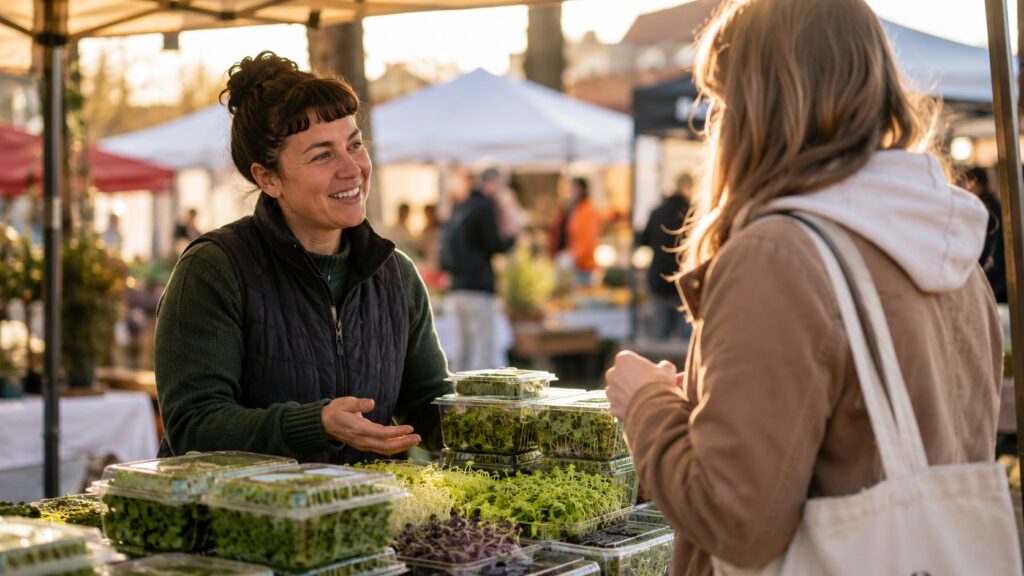
Three things drove behavior. Personal values came first: growers who called food safety “non-negotiable” pointed to the fact that they and their families ate what they grew. Community relationships came second: knowing your customers personally, and not wanting to hurt them, was a stronger motivator than any inspection (Kontor-Manu et al., 2026). Consumer expectations came third: when customers started asking about pesticides, sourcing, and growing practices, growers responded, often changing their methods not because they were required to, but because the relationship made them feel responsible.
That third driver should ring very familiar to anyone selling microgreens. The typical microgreens buyer is more engaged, more health-conscious, and more likely to ask direct questions about your growing process than almost any other produce customer. The research confirms that answering those questions well and having documentation to back up those answers isn’t just good customer service. It’s the mechanism that actually produces safer growing.
How does the FSMA exemption cap your microgreens business growth?
This was one of the most practically significant findings in the study. One participant described losing 50% of their income when a wholesale buyer stopped purchasing from them after GAP requirements took effect. The farm was technically exempt, but the buyer wasn’t interested in exemptions. They needed documentation.
The pattern is well established. Retailers, food hubs, restaurants, and distributors typically impose their own food safety requirements on suppliers, regardless of FSMA status (Bovay, 2023; Minor et al., 2019). For FSMA microgreens growers who want to move beyond direct-to-consumer sales, this ceiling is real, and it’s market-driven, not regulatory. You don’t become exempt from your buyers’ standards just because you’re exempt from the federal rule.
The study also found something subtler: growers were afraid to grow. Some deliberately stayed below exemption thresholds because scaling up meant needing to understand and implement standards they’d never had to engage with. One grower described it simply: “It limits your growth, your size” (Kontor-Manu et al., 2026). Another explained that the prospect of a full compliance learning curve discouraged expansion even when the market opportunity was there.
Getting food safety documentation in place before you need it, even voluntarily, removes that ceiling.
What do microgreens buyers actually want to know about your food safety practices?
The Purdue study found that consumer expectations were among the strongest drivers of food safety behavior on small farms. For field growers, the questions centered on pesticides, animal controls, and sourcing. For microgreens, the questions are more specific and often more technical.
Direct consumers at a farmers market typically want to know:
- Are your seeds organic?
- Do you spray anything on the trays?
- How do you clean between grows?
Restaurant buyers go further: they want a food safety plan, seed certificates of analysis, documentation of your water source and testing, and sometimes proof of food handler certification. Farmers’ market managers increasingly ask for general liability insurance at a minimum.
What the research makes clear is that these buyer questions are a mechanism for safety improvement, not just a sales conversation. Growers in the study changed their actual practices when customers asked about pesticides. The question created accountability that inspection never did. For FSMA microgreens growers, having clean answers to these questions, backed by real records, does double duty: it builds buyer trust and creates exactly the documented-compliance record that reduces liability exposure.
Digital guide · PDF
Comprehensive Food Safety for Microgreens
Written for the grower whose greens leave their own kitchen. It covers what GAP and FSMA each require, the records an inspector opens first, and what to send a buyer who asks.
$97
What should FSMA microgreens growers actually do with this research?
The study’s conclusions point in a clear direction, even though the researchers focused on field-crop growers. The farms that came out ahead treated food safety as a baseline practice, not a regulatory minimum, and they had documentation to show for it.
For microgreens, the starting point is more focused than most growers expect. You don’t need a full GAP audit on day one. You do need to understand your specific risk points: seed sourcing and sanitation, irrigation water quality, growing media safety, harvest surface sanitation, and temperature management during post-harvest handling. Those are the places where contamination enters a ready-to-eat product.
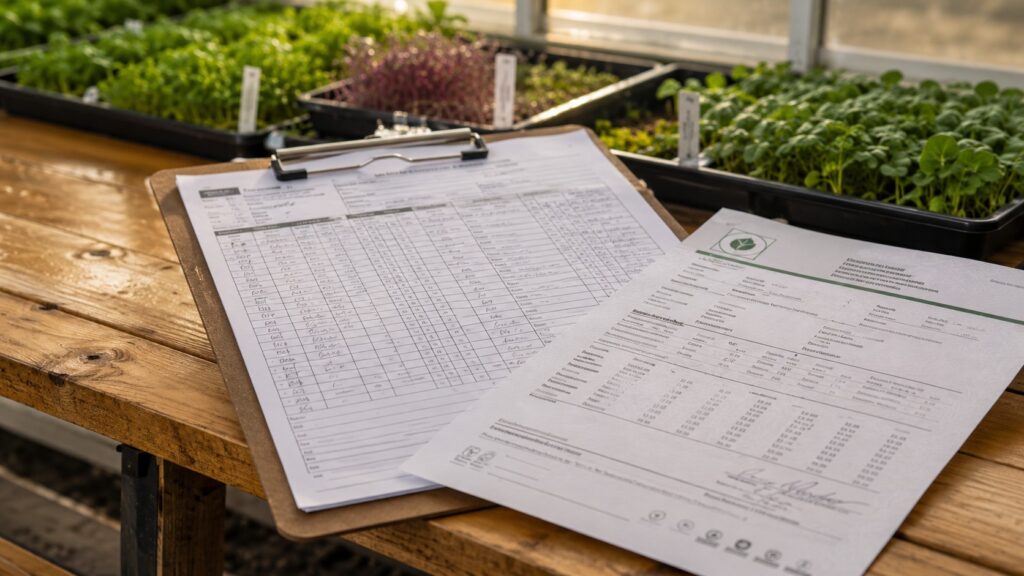
The Purdue study’s biggest single barrier finding was recordkeeping. Growers wanted to do more, but the documentation felt overwhelming. One described “50 different sets of records” (Kontor-Manu et al., 2026). In plain terms, that means the gap isn’t motivation. It’s the documentation infrastructure. A focused SOP system, built around how microgreens operations actually work, makes voluntary compliance achievable even for a two-person farm. The goal isn’t a binder that impresses an auditor. It’s a simple, honest record of what you do and why.
Wrap-up: Does your microgreens farm need to follow FSMA?
The short answer is that most commercial microgreens operations qualify for the FSMA exemption. The longer answer is that the exemption doesn’t protect you from liability, doesn’t satisfy your wholesale buyers, and doesn’t earn consumer trust. The Purdue research confirms that the growers who understood this kept doing the work anyway (Kontor-Manu et al., 2026).
The most useful insight from the study isn’t regulatory. It’s behavioral: the growers who stayed safest were the ones who grew food like their family was eating it. Because for most of them, they were. That’s not a compliance mindset, it’s a values mindset. And the research suggests values-driven food safety is more durable than regulation-driven compliance, because it doesn’t switch off when the inspector leaves.
Food safety in microgreens covers more ground than any single study can map. If you want to see how it fits into everything else that goes into running a compliant, scalable operation, the Microgreens Business hub is the place to start.
Every food safety article in one place: food safety for microgreen growers, grouped by seed, growing, harvest, records, rules and recalls.
FSMA microgreens growers: frequently asked questions
Do farmers’ markets and CSA sales count toward the FSMA exemption calculation? Yes. Farmers’ market, CSA, and on-farm stand sales all count as direct sales in the exemption calculation. If more than half your total food sales are direct-to-consumer and your annual food sales are under $500,000, you likely qualify for modified requirements rather than full compliance.
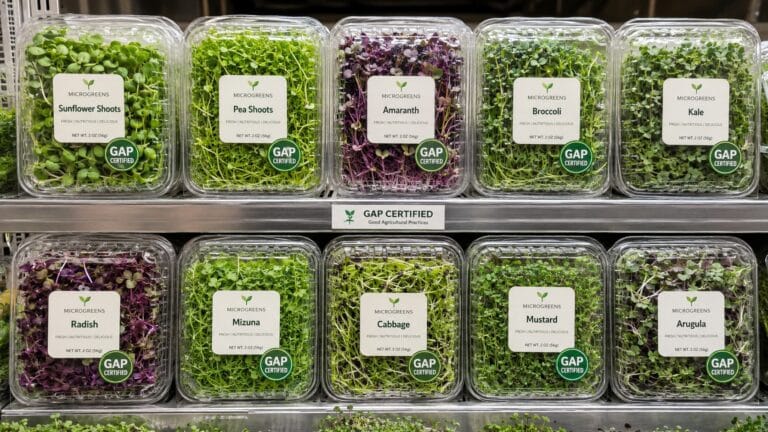
What is the difference between FSMA compliance and GAP certification for microgreens? FSMA is a federal regulatory framework with legally defined compliance thresholds. GAP certification is a voluntary, third-party-audited standard that many buyers require as a purchase condition. You can be FSMA-exempt while still being expected to meet GAP standards by retailers, food hubs, and restaurant buyers.
If my annual sales cross the exemption threshold, how much time do I have to comply? The PSR uses a three-year rolling average of produce sales to determine compliance status, so one strong year doesn’t trigger immediate full compliance. Build documentation habits before you cross the threshold — the learning curve is real (Kontor-Manu et al., 2026).
Do I need to test my irrigation water for a small FSMA-exempt microgreens operation? Not legally required if you’re exempt — but worth doing. Irrigation water is one of the primary contamination routes for microgreens, and water test records are among the first things wholesale buyers ask for. A basic microbial test runs $30 to $50 and builds documentation that serves both liability and market access.
What are the biggest food safety risks specific to microgreens? The primary risks are seed contamination (Salmonella and E. coli on seed surfaces), irrigation water quality, growing media safety, and post-harvest surface sanitation. Microgreens are ready-to-eat with no cooking step — contamination at any of these points reaches the consumer directly. FSMA compliance is one layer of protection, not the whole picture.
How can I communicate food safety practices to customers without a formal certification? Start with specific answers to what buyers typically ask: your seed source, how you handle water, your tray sanitation protocol, and what inputs touch your growing medium. Clear, transparent answers changed grower behavior more reliably than any regulation (Kontor-Manu et al., 2026). Simple logs give your answers credibility.
References
Ajzen, I. (1991). The theory of planned behavior. Organizational Behavior and Human Decision Processes, 50(2), 179–211. https://doi.org/10.1016/0749-5978(91)90020-T
Bovay, J. (2023). Food safety, reputation, and regulation. Applied Economic Perspectives and Policy, 45(2), 684–704. https://doi.org/10.1002/aepp.13315
Kontor-Manu, E., Marshall, M. I., Wiatt, R., & Feng, Y. (2026). Impacts of the Food Safety Modernization Act’s Produce Safety Rule, exemptions, and behavioral insights among small-scale produce growers. Journal of Agriculture, Food Systems, and Community Development. Advance online publication. https://doi.org/10.5304/jafscd.2026.153.006
Minor, T., Hawkes, G., McLaughlin, E. W., Park, K. S., & Calvin, L. (2019). Food safety requirements for produce growers: Retailer demands and the Food Safety Modernization Act (EIB-206). U.S. Department of Agriculture Economic Research Service. https://ers.usda.gov/sites/default/files/_laserfiche/publications/92761/EIB-206.pdf?v=42344
U.S. Food and Drug Administration. (2015). Standards for the growing, harvesting, packing, and holding of produce for human consumption. National Register. https://www.federalregister.gov/documents/2015/11/27/2015-28159/standards-for-the-growing-harvesting-packing-and-holding-of-produce-for-human-consumption