When my friend Alex visited last weekend, he set a fresh packet of chia seeds on my counter like he was handing me gold. I thanked him, then had to admit I had not bought chia seeds in months, because I grow them as chia microgreens now instead. He gave me a look. So I cut a few from the tray on my windowsill and told him to taste.
Then I told him the part that surprises most people. If you go looking for chia microgreens nutrition online, almost every number you find was actually measured in the chia seed, then printed under a microgreen headline. The seed and the microgreen are two different stages of the same plant, and they do not carry the same nutrition.
That mix-up is everywhere, and it is the reason I wanted to lay this out plainly. What follows is what scientists have genuinely measured in the young chia plant, not borrowed from a seed chart. You will also get the honest part most pages skip, which is where the research still has gaps.
Key Takeaways
Chia microgreens are the young seedlings of Salvia hispanica, harvested about 6 to 9 days after sowing. Research that measured the microgreen, not the seed, found it to be protein-dense and a source of the plant omega-3 ALA (Castellaneta et al., 2024; John et al., 2025).
Below, you will see how chia microgreens differ from the seed, what nutrients researchers have measured in them, whether they live up to the health talk, and how to eat and grow them yourself.
Chia Seed Data in DisguiseMost chia microgreen pages quietly use chia seed figures. This sheet gives you the protein, omega-3, sterols, and antioxidants measured in the actual microgreen, with the source printed next to every number. Eight peer-reviewed sources, every DOI printed Each figure labeled dry, fresh, or powder so nothing misleads A plain list of what the research does not yet show A four-page reference PDF you can keep.Get the full data sheet for $7Get the Data SheetOne-time payment. Instant download after checkout.
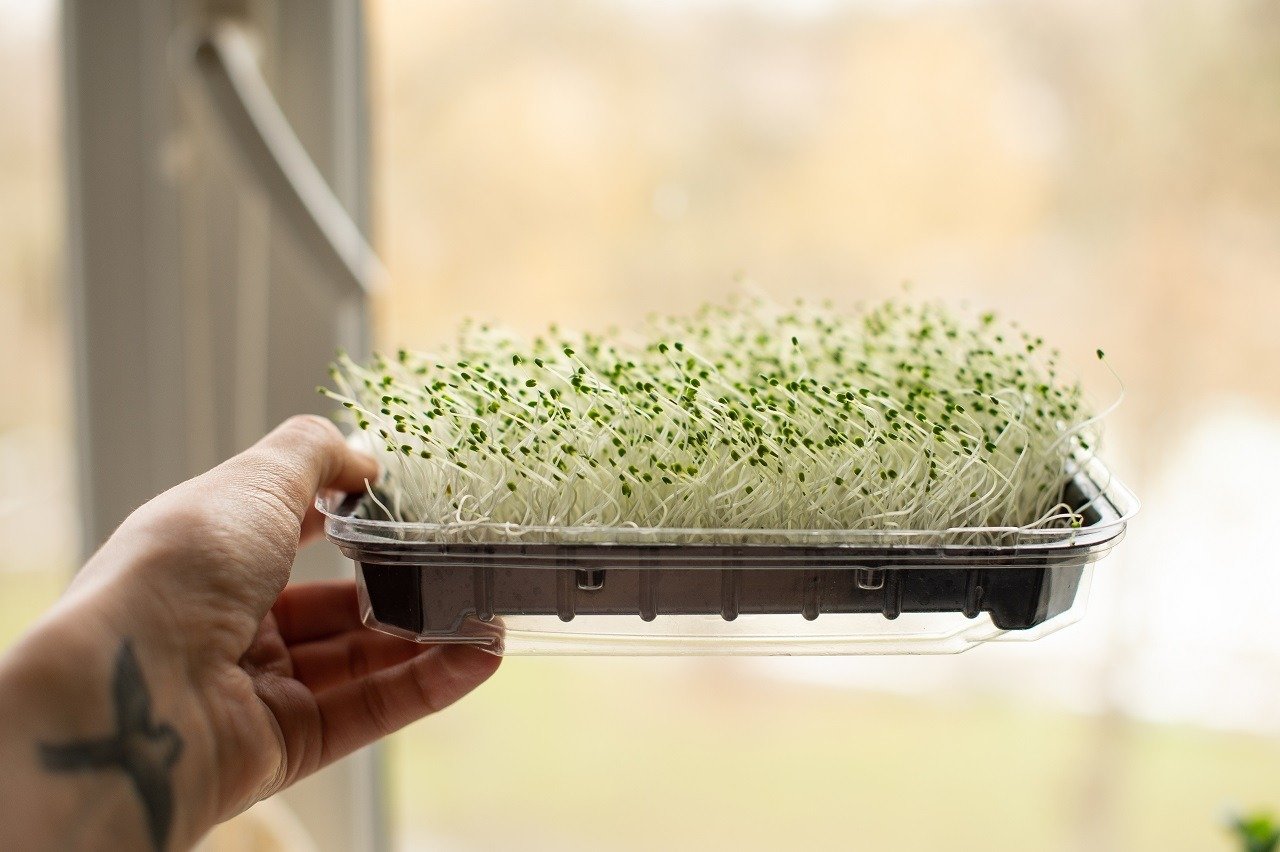
Chia microgreens are the young seedlings of the chia plant, Salvia hispanica, harvested when they are just a week or so old. You grow them from the very same seeds people stir into smoothies, but instead of eating the seed, you let it sprout, push up a stem, and open its first leaves. Most growers cut them about 6 to 9 days after sowing (Junpatiw & Sangpituk, 2019).
Chia has a long history on the plate. It was a staple crop for the Aztecs and Maya centuries before it reached your local grocery shelf (Cahill, 2003). The flavor is mild and a little nutty, with a fresh green finish that does not take over a dish.
If you are new to growing, chia is one of the friendlier varieties to begin with, which is part of why it shows up so often when people first explore chia microgreens nutrition. It earns a spot on most beginners’ list of easy types of microgreens to grow at home.
What is the difference between chia microgreens and chia seeds?

A chia seed and a chia microgreen are two different stages of the same plant, and that difference is bigger than it sounds. The seed is the dry, raw kernel you buy in a bag. The microgreen is the living seedling that grows out of that seed after about a week of light and water. Because they are different stages, they do not carry the same nutrition, and a number measured in one does not automatically apply to the other.
This is the heart of the confusion around chia microgreens nutrition. Sprouting a seed into a microgreen changes its makeup, raising some compounds as the plant builds new tissue (Szopa et al., 2023). One study found chia microgreens held more quercetin than the seed they came from (Adhikari et al., 2025).
Chia microgreens are also not the same as chia sprouts, another point worth sorting out when you compare microgreens and sprouts.
What nutrients are in chia microgreens?
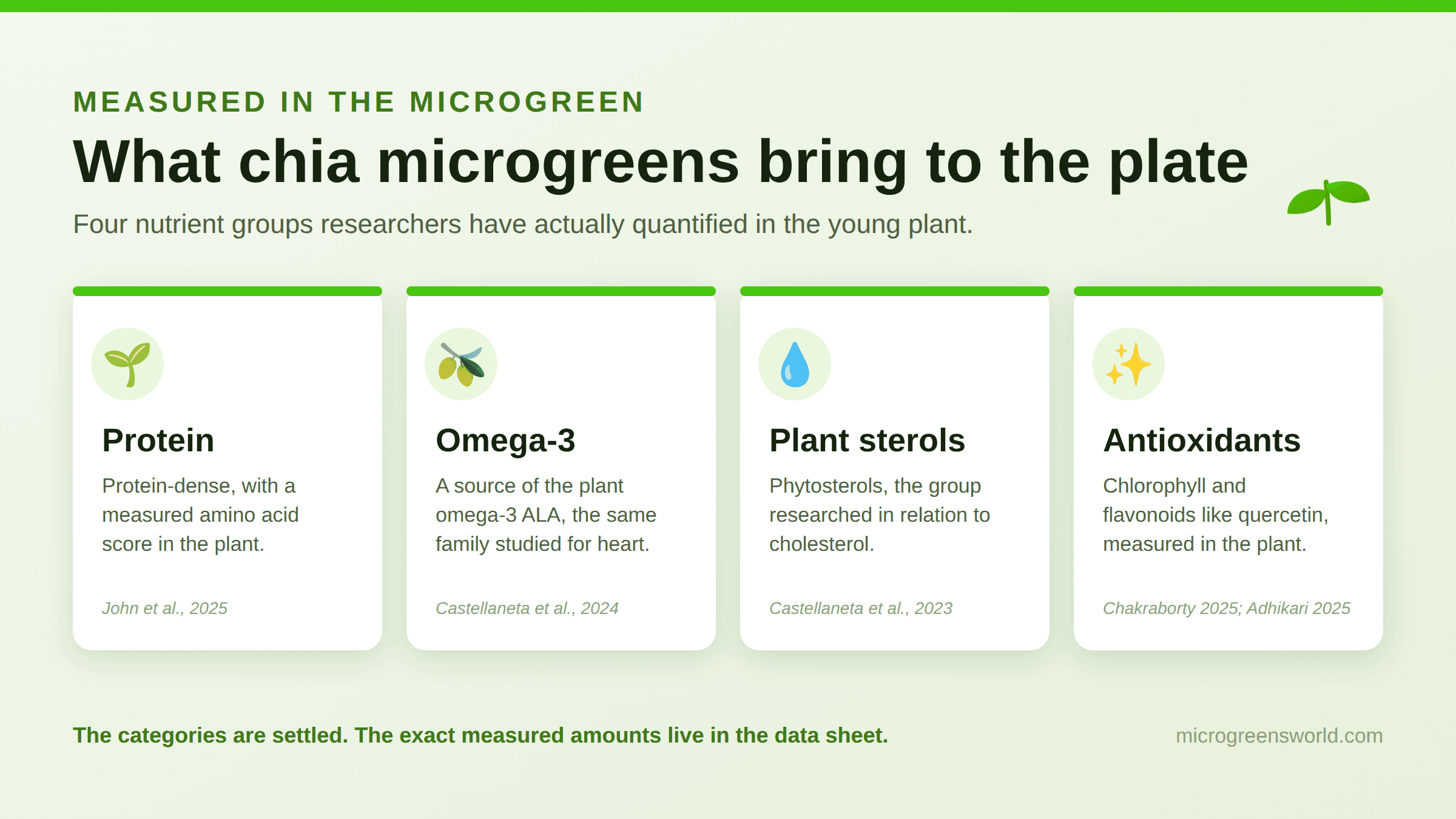
Chia microgreens pack several nutrient groups worth knowing about, and the research points to four in particular. They are protein-dense, with a measured amino acid score that speaks to protein quality (John et al., 2025). They carry the plant omega-3 called alpha-linolenic acid, or ALA (Castellaneta et al., 2024). They also contain plant sterols, the compounds studied in relation to cholesterol (Castellaneta et al., 2023), along with antioxidant compounds like chlorophyll and the flavonoid quercetin (Chakraborty et al., 2025; Adhikari et al., 2025).
Here is the honest part. No complete vitamin and mineral panel for chia microgreens exists yet, the way one does for the seed. So when a chart hands you a tidy table of exact percentages, treat it with suspicion, because the odds are good those figures came from the seed.
The categories above are settled. The exact measured amounts, each tied to its study, are pulled together in the chia microgreens nutrition data sheet rather than scattered loose across this page.
Are chia microgreens good for you?
For most people eating a varied diet, chia microgreens are a nourishing addition, and the research gives real reasons to pay attention, as long as we read it as research rather than a promise about your body. A study of nine edible microgreens measured chia as the highest in chlorophyll and flagged it as a promising anti-inflammatory agent in laboratory testing (Chakraborty et al., 2025). The ALA measured in chia microgreens belongs to the same omega-3 family that nutrition scientists study for heart and brain health (Castellaneta et al., 2024).
Read those findings for what they are. A measured nutrient or a laboratory result is a useful signal, not proof that a handful of greens will change a specific health marker for you. Chia microgreens are food, not medicine, and they do their best work as one part of a colorful plate.
This information is educational and is not a substitute for professional medical advice. Talk with your physician before making significant changes to your diet or before using microgreens to address a health concern.
Can you eat chia microgreens, and how do you use them?
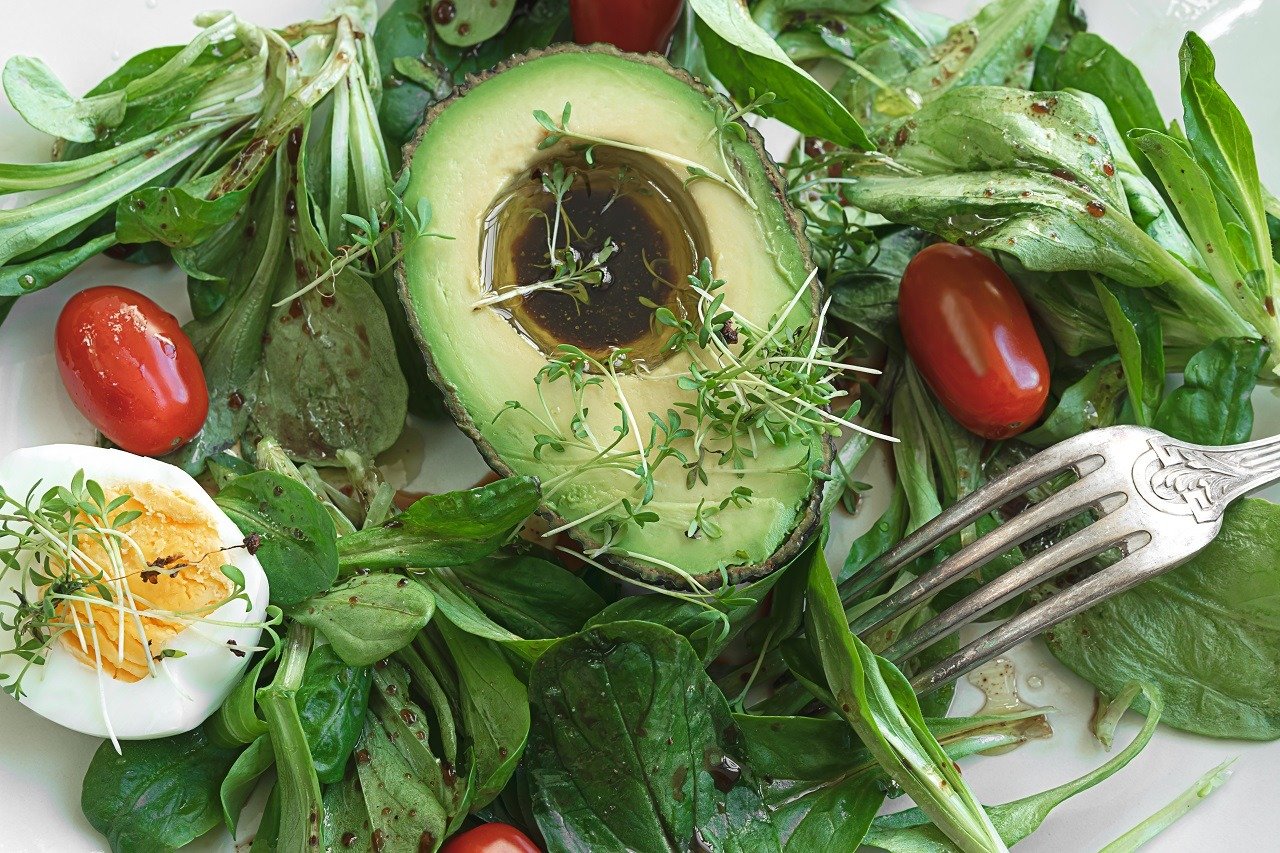
Yes, you can eat chia microgreens, and raw is usually the best way to enjoy them. Heat and heavy processing can break down some of the delicate compounds the young plant worked to build, so a quick rinse and a raw finish keep the most on your plate. Snip them at the base once the first leaves open, give them a gentle wash, and they are ready.
Their mild, slightly nutty taste and soft crunch let them slip into food you already make. Pile a handful onto a salad, blend them into a morning smoothie, or scatter them over soup, eggs, or warm toast right before serving. Adding them at the end, rather than cooking them in, keeps both the texture and the nutrition of the chia microgreens intact.
A little goes a long way. If you want pairing ideas that go beyond a garnish, this guide on how chefs pair microgreens with proteins is a good next stop.
How do you grow chia microgreens?
Growing chia microgreens at home is straightforward, with one quirk you need to know going in. Chia seeds turn gel-like the second they get wet, so you do not soak them, and you do not bury them. You scatter them across the surface of a moist growing medium and leave them there, because they need light to germinate, and that gel coat holds plenty of water on its own.
From there, it stays simple. Keep the tray somewhere warm and well lit, mist rather than drench so the surface stays damp but never soggy, and most trays are ready to harvest about 6 to 9 days after sowing (Junpatiw & Sangpituk, 2019).
The gel coat is really the only thing that makes chia trickier than a typical microgreen. A light, even sprinkle of seed beats a thick clump, since crowded seedlings hold moisture against each other and invite mold. Get that one habit right and a steady supply of chia microgreens is well within reach.
Wrap-up: what chia microgreens nutrition really comes down to
Chia microgreens are the young chia plant, and that is exactly why their nutrition is its own story. The seed and the seedling are different stages, so the numbers measured in one do not transfer to the other. What the research has actually measured in the microgreen is real and worth your attention: protein, the omega-3 ALA, plant sterols, and antioxidants. What it has not measured yet is just as worth admitting, which is why a tidy chart of exact percentages usually traces back to the seed.
Chia microgreens nutrition is one piece of a much larger picture. If you want to see where it fits among the other greens worth growing and eating, the microgreens nutrition hub is the place to start.
Chia Seed Data in DisguiseMost chia microgreen pages quietly use chia seed figures. This sheet gives you the protein, omega-3, sterols, and antioxidants measured in the actual microgreen, with the source printed next to every number. Eight peer-reviewed sources, every DOI printed Each figure labeled dry, fresh, or powder so nothing misleads A plain list of what the research does not yet show A four-page reference PDF you can keep.Get the full data sheet for $7Get the Data SheetOne-time payment. Instant download after checkout.
Chia microgreens nutrition: frequently asked questions
Are chia microgreens the same as chia sprouts?
No, they are different. A sprout is the just-germinated seed eaten whole, root and all, usually grown in water over a few days. A chia microgreen grows longer in a little soil or on a mat, gets light, and you cut the stem and leaves above the surface. The microgreen stage is what most chia microgreens nutrition research measures.
Do chia microgreens have omega-3 like the seeds?
Yes, research has measured the plant omega-3 ALA in chia microgreens (Castellaneta et al., 2024). It belongs to the same fatty acid family the seed is known for, though the amount is its own figure and should not be assumed equal to the seed. This is one of the clearest examples of why chia microgreens nutrition deserves its own data.
Do chia microgreens taste like chia seeds?
Not really. Raw chia seeds are mostly neutral and turn gel-like in liquid, while chia microgreens taste fresh, mild, and a little nutty with a soft crunch. The microgreen is a green vegetable in flavor, closer to a tender salad leaf than to the seed it grew from.
Do you soak chia seeds before growing microgreens?
No, you do not soak chia seeds before growing them as microgreens. Chia forms a gel the moment it gets wet, so soaking turns the seeds into a clump that is impossible to spread. Instead, scatter them dry across a moist surface and let that gel coat hold the water they need.
Can you grow chia microgreens without soil?
Yes, chia grows well on a moist mat, paper towel, or hydroponic pad instead of soil. The gel the seeds form when wet holds water against the surface, so they germinate without being buried. Whatever the base, keep it damp but not soggy and give the tray light.
Are chia microgreens safe to eat raw?
Yes, chia microgreens are commonly eaten raw, and raw is usually how they are enjoyed. As with any fresh produce, rinse them before eating and use clean trays and water while growing to keep things sanitary. Eat them fresh and store any extra in the refrigerator.
References
Adhikari, T., Ray, P. B., & Saha, P. (2025). Comparative study of quercetin content in marketed seeds of Linum usitatissimum L. (flax), Salvia hispanica L. (chia), and Helianthus annuus L. (sunflower) and their microgreens using HPTLC from West Bengal. Indian Journal of Pharmaceutical Education and Research, 59(1s), s221–s228. https://doi.org/10.5530/ijper.20255309
Cahill, J. P. (2003). Ethnobotany of chia, Salvia hispanica L. (Lamiaceae). Economic Botany, 57(4), 604–618. https://doi.org/10.1663/0013-0001(2003)057[0604:EOCSHL]2.0.CO;2
Castellaneta, A., Losito, I., Leoni, B., Santamaria, P., Calvano, C. D., & Cataldi, T. R. I. (2022). Glycerophospholipidomics of five edible oleaginous microgreens. Journal of Agricultural and Food Chemistry, 70(7), 2410–2423. https://doi.org/10.1021/acs.jafc.1c07754
Castellaneta, A., Losito, I., Leoni, B., Renna, M., Mininni, C., Santamaria, P., Calvano, C. D., Cataldi, T. R. I., Liebisch, G., & Matysik, S. (2023). A targeted GC-MS/MS approach for the determination of eight sterols in microgreen and mature plant material. The Journal of Steroid Biochemistry and Molecular Biology, 232, 106361. https://doi.org/10.1016/j.jsbmb.2023.106361
Castellaneta, A., Höring, M., Losito, I., Leoni, B., Santamaria, P., Calvano, C. D., Cataldi, T. R. I., Matysik, S., & Liebisch, G. (2024). Exploration of the lipid profile of edible oleaginous microgreens by mass spectrometry-based lipidomics. Journal of Agricultural and Food Chemistry, 72(20), 11438–11451. https://doi.org/10.1021/acs.jafc.3c09347
Chakraborty, A., Sarkar, A., Hazra, S., Giri, S., Ray, P. B., & Adhikari, T. (2025). Phytochemical and biological evaluation of nine microgreens. Indian Journal of Natural Products and Resources, 16(4), 605–619. https://doi.org/10.56042/ijnpr.v16i4.18526
John, J., et al. (2025). Unlocking the potential of chia microgreen: Physicochemical properties, nutritional profile and its application in noodle production. Food and Bioprocess Technology, 18, 5605–5620. https://doi.org/10.1007/s11947-025-03792-y
Junpatiw, A., & Sangpituk, A. (2019). Effects of seed preparation, sowing media, seed sowing rate and harvesting period on the production of chia microgreens. International Journal of GEOMATE, 17(61), 80–85. https://doi.org/10.21660/2019.61.4726
Mlinarić, S., Gvozdić, V., Vuković, A., Varga, M., Vlašiček, I., Cesar, V., & Begović, L. (2020). The effect of light on antioxidant properties and metabolic profile of chia microgreens. Applied Sciences, 10(17), 5731. https://doi.org/10.3390/app10175731
Szopa, A., Motyka, S., & Ekiert, H. (2023). Chia sprouts and microgreens as new nutraceutical raw materials and their health-promoting impact in modern dietetics. Current Issues in Pharmacy and Medical Sciences, 36(1), 1–9. https://doi.org/10.2478/cipms-2023-0008