Disclosure: We’re reader-supported. When you buy through links on our site, we may earn a commission: Full Disclosure.
I nearly skipped this paper.
The alert that carried it on Sept. 8 read like a hundred others: a salt, a crop, a list of things that went up. But then I opened the tables. A team at CCS Haryana Agricultural University in Hisar added calcium chloride to the Hoagland solution feeding mustard microgreens of two genotypes, and every trait they measured moved the same way, with the higher dose winning every time.
This was a growing trial in a polyhouse in India. Researchers measured the plants. Nobody ate anything, and nothing here is about what happens in a body. What it is about is a dial most hydroponic growers never touch, and a control tray that may have been quietly stressed.
Key Takeaway
In a 2026 nutrient-film trial, 20 mM calcium chloride in a modified Hoagland solution made mustard microgreens about a third longer and more than a quarter heavier per plant, with chlorophyll, glucosinolates and tissue calcium up and nothing measured down (Saroha et al., 2026). The catch: two doses, one season, light and temperature unreported, and control trays that read stressed.
The five sections below cover what was added, what moved, what did not, what the paper leaves out, and how to test it on one channel without betting the room.
The Edible Plant Catalog for Growing Microgreens
Mustard is one crop. The catalog holds more than 200.
Every entry carries the light, temperature and watering the species wants, so the next channel starts from a spec rather than a guess.
Get the catalog$27, one payment, yours to keep.
Do hydroponic microgreens need fertilizer?
The grower in the video above is doing on mustard what the Hisar team did, with a different variable: two growing mats, everything else held the same, and a result he can weigh. Keep that shape in mind, because it is the shape of every honest test in this post.
In a nutrient film system, the water is the only meal the crop gets, so the question is never whether to feed but what to put in the feed. The Hisar team’s answer was calcium chloride, at two strengths, on top of a full solution. Saroha and colleagues grew mustard microgreens of two Indian genotypes, RH 1710 and RH 1975, in a horizontal nutrient film system inside a polyhouse, roots in clay balls in net pots, through the 2023 to 2024 rabi season (Saroha et al., 2026). Picture a shallow gutter with a trickle running down it. That is nutrient film.
The feed was a modified Hoagland solution with 0, 10 or 20 millimoles of calcium chloride per litre added. Three replicates per treatment, harvest at day 14.
Two things the paper does not settle. The abstract says the seed was exposed to the salt before germination, while the methods say the plants were fertigated with it, and the two are never reconciled; I have gone with the methods. And “modified” is never defined, so nobody can reproduce the exact feed.
For a grower the translation is this: 20 millimoles is about 2.2 grams of the dry salt per litre, or 2.9 grams of the usual dihydrate. That is my arithmetic, not theirs, because the paper does not say which form of calcium chloride went into the microgreens’ feed.
What does calcium chloride do to mustard microgreens?
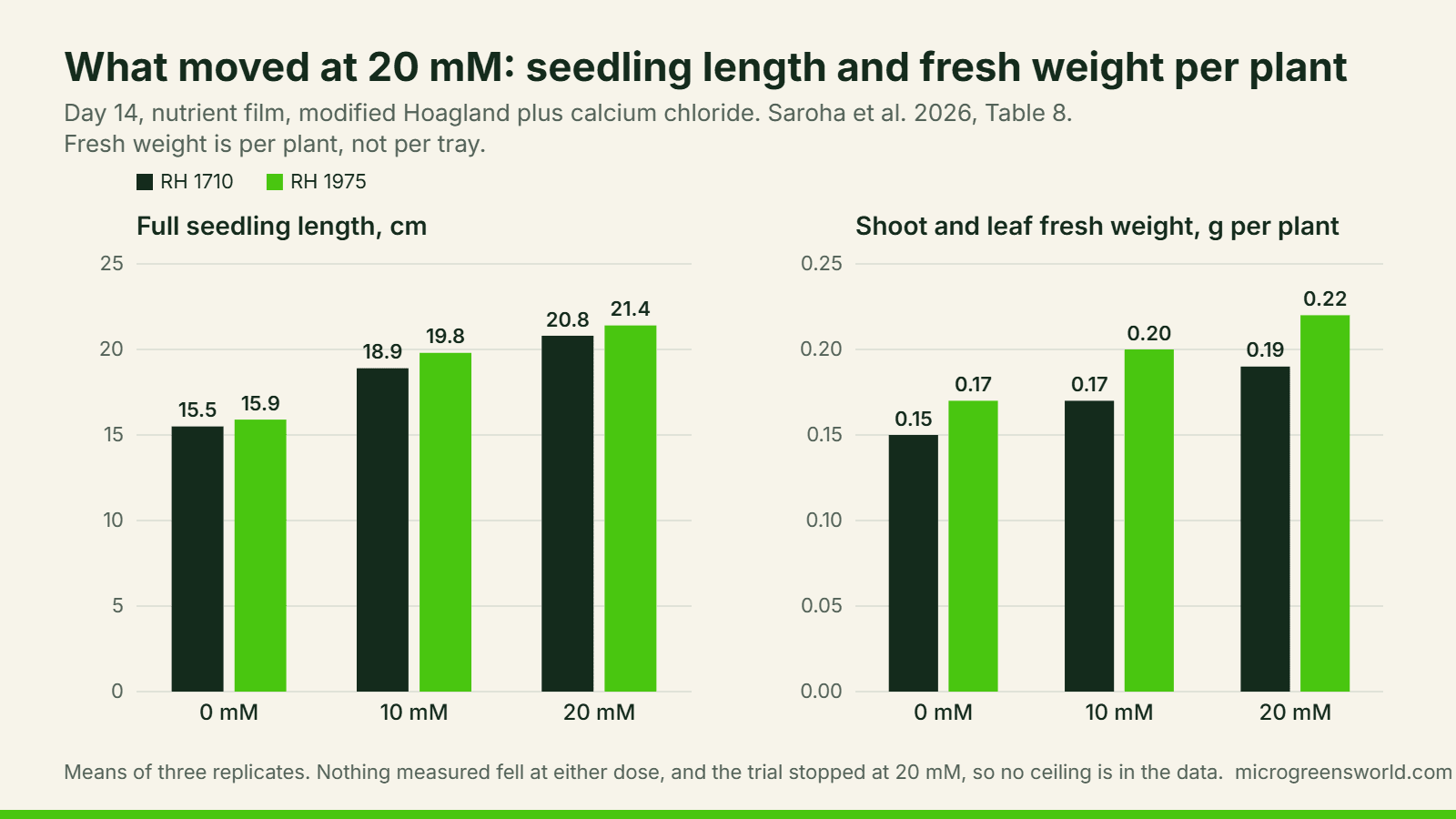
In this trial it moved almost everything, and in the same direction in both genotypes. At 20 millimoles, full seedling length at day 14 went from 15.5 to 20.8 centimetres in RH 1710 and 15.9 to 21.4 in RH 1975, about a third longer. Fresh weight per plant rose from 0.15 to 0.19 grams and 0.17 to 0.22, a gain of roughly 27 to 29 per cent on figures the paper rounds to two decimals, so hold the percentage loosely. That is per plant, not per tray, because tray yield was never measured.
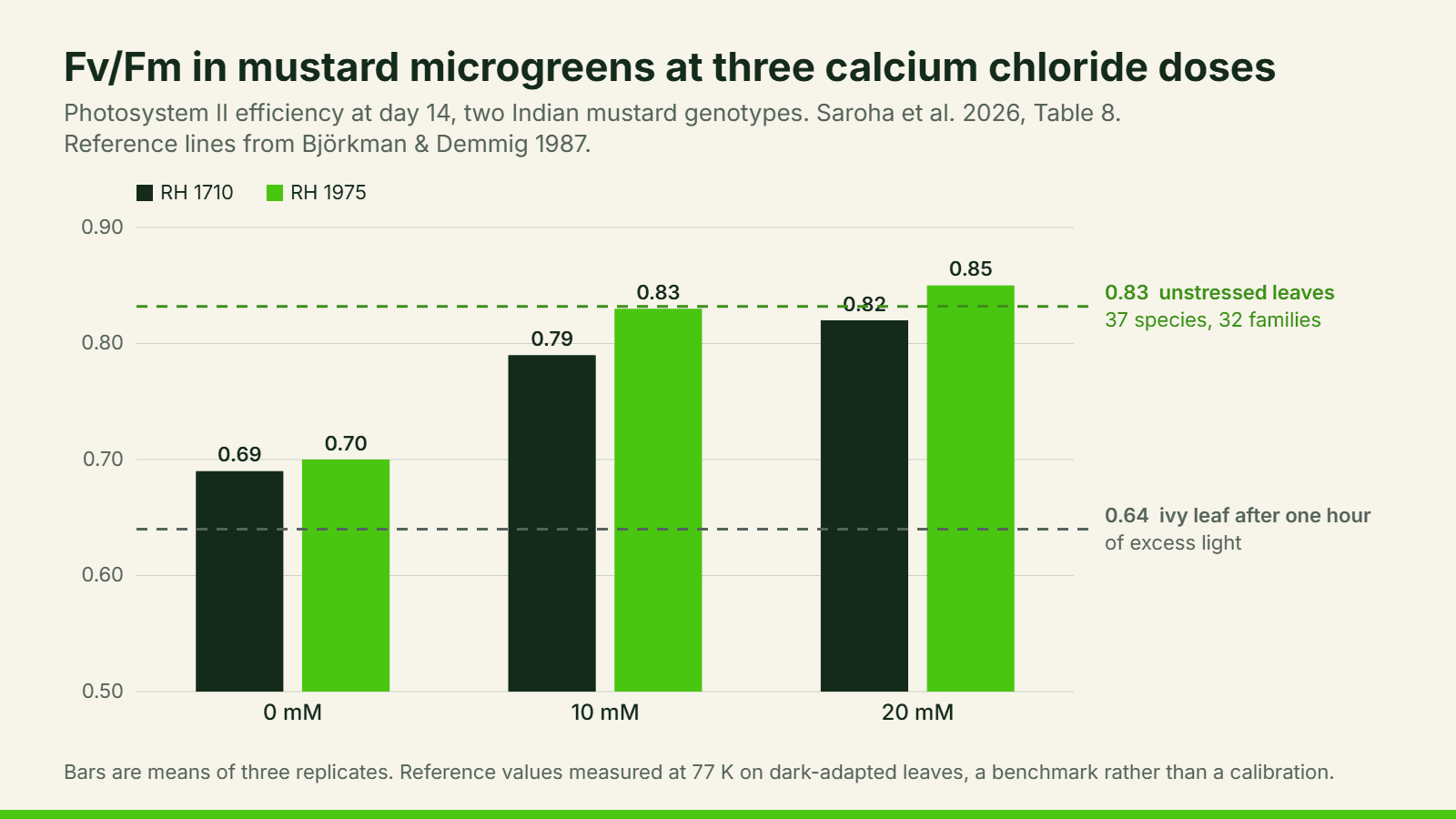
Chlorophyll climbed 37 per cent in both, as reported, on a basis the table does not name. Fv/Fm, a fluorescence reading of how much of the light-capturing machinery is in working order, rose from 0.69 to 0.82 and 0.70 to 0.85. Total glucosinolates, the sulphur compounds that give mustard microgreens their bite, went up 22 and 30 per cent as reported. Tissue calcium rose 32.55 and 21.23 per cent on a dry-weight basis (Saroha et al., 2026).
Phenolics, flavonoids, ascorbic acid and antioxidant capacity all moved up too, most in RH 1710. Every one of those is a measurement of the plant. The evidence register I keep for this site says mineral figures track the feed, and this is not the first time the feed has been the lever: a Penn State-led team put zinc into a half-strength Hoagland under red mustard microgreens and tissue zinc rose between 75 and 281 per cent with no loss of yield (Di Gioia et al., 2019).
What are the downsides of calcium chloride for microgreens?
None that the trial measured, and that is the finding that made me sit up. It is also the reason to be careful. In the mustard microgreens, germination held between 92.5 and 93.1 per cent across every treatment. Relative water content, crude protein and crude fibre did not move. Nothing the team measured fell at either dose, and 20 millimoles was the top of the range tested, so there is no ceiling anywhere in the data (Saroha et al., 2026).
Now the caution. Two things a grower would want were never measured: how the trays tasted, and what the added calcium chloride did to the conductivity of the solution. Twenty millimoles is a real salt load, and the paper gives no EC or pH reading before or after. My own estimate from textbook conductivity values, not a measured figure: 20 millimoles of calcium chloride adds somewhere around 4 to 5 millisiemens per centimetre on its own. For scale, the half-strength Hoagland used in a Florida microgreens trial read 1.25 dS per metre in total, the same unit (Di Gioia et al., 2019).
Then there is the control. The reference value for unstressed leaves comes from a 1987 survey of 37 species across 32 families, dark-adapted and measured at liquid-nitrogen temperature: a mean Fv/Fm of 0.832, with almost no spread (Björkman & Demmig, 1987). In that same paper, one hour of excessive light took an ivy leaf from 0.85 to 0.64 and cut its photosynthetic yield by 28 per cent, by my arithmetic on their Table 6. These control microgreens read 0.69 and 0.70, closer to the stressed leaf than the healthy one, on a method the Hisar paper does not fully describe. My read, not theirs: part of the gain may be relief of whatever the control trays were suffering rather than a lift above healthy. The direction holds either way. The size is what I would hold loosely.
How do you grow mustard microgreens without soil?
The Hisar setup is one working answer: seed in net pots of clay balls, a shallow film of feed moving past the roots, harvest at day 14. What the paper does not tell you is most of what you would need to copy it. Light and temperature, for a start. Neither is reported, which for a polyhouse trial across a Haryana winter is a large gap, because both shift composition on their own. Solution EC and pH are missing. Tray density is missing, so per-plant weights cannot become yield. The trial ran two doses and stopped, so nobody knows whether 30 millimoles keeps climbing or starts to burn. Minerals in a feed do burn. In the Florida trial, iron at 40 milligrams per litre cut red mustard yield from 1,810 to 234 grams per square metre and stunted every species from germination (Di Gioia et al., 2019). The cliff exists; this paper just never walked far enough to find calcium’s.
The abstract floats shelf life, visual quality and market value as things calcium chloride “may contribute” to, and none was tested. The authors’ own conclusion is more careful, naming “a limited range of CaCl2 concentrations” and saying commercial performance “remain[s] to be investigated” (Saroha et al., 2026).
Two earlier trials point the same way on microgreens other than mustard, both by spray rather than feed. A 2014 USDA study reported that a daily 10 millimole spray raised broccoli microgreen biomass by more than half and tripled tissue calcium (Kou et al., 2014). A 2026 Iranian trial found daily calcium chloride sprays lifted beet microgreen colour, phenolics and antioxidant capacity through cold storage (Mirabadi et al., 2026). I have read the second in full and only the abstract of the first, so both are direction, not numbers.
What is the best fertilizer for microgreens?
The one you have tested against your own control, and nobody can name it for you from a distance. What this paper gives you is not a recipe but a method: change one thing and measure it, which is the discipline the Hisar team used on mustard microgreens and the one most growers skip. The trial’s own structure is the template: a treated channel and an untreated one, matched on seed, sowing day and position, read at a fixed harvest age, with the salt as the only difference.
What makes a paired test worth running is the set of numbers this paper left out. Your channels can carry an EC reading before and after the calcium chloride goes in, a per-tray weight rather than a per-plant one, and a taste your customers would recognise. Those three fill the gaps the paper cannot, and they are yours rather than Hisar’s.
What the test is not is a system-wide change. One reservoir on 20 millimoles is a question. Every reservoir on 20 millimoles is a bet placed on a paper that did not report its light or its temperature, on microgreens grown in a system that may not be yours.
And keep the words calcium, mineral and nutrient off any label until a lab has given you a milligrams-per-100-gram figure on your own crop. The number in this paper describes a polyhouse in Hisar, not your room.
Wrap-up: do mustard microgreens grow better with calcium chloride?
In one trial, on mustard microgreens of two genotypes, yes on every measure taken, with the higher dose winning and nothing falling. That is worth a channel of your own. It is not worth a system-wide change, a label claim or a sentence to a customer, because the light, the temperature, the EC, the taste and the tray yield are all missing, and the control trays may have been stressed.
A grower’s edge is rarely one input. It is the habit of testing inputs one at a time, calcium chloride included, and reading your own microgreens’ numbers before anyone else’s. If that habit is one you are building into a business rather than a hobby, the microgreens business hub is where the rest of the pieces sit.
The Edible Plant Catalog for Growing Microgreens
Mustard is one crop. The catalog holds more than 200.
Every entry carries the light, temperature and watering the species wants, so the next channel starts from a spec rather than a guess.
Get the catalog$27, one payment, yours to keep.
Mustard microgreens and calcium chloride: frequently asked questions
Is calcium chloride the same as the calcium already in Hoagland solution?
No. A standard Hoagland solution takes its calcium from calcium nitrate, which also carries nitrogen. Calcium chloride adds calcium with chloride instead, so the Hisar trial raised calcium without raising nitrate. That is one reason the result cannot be read as “more calcium is good” in general. It is more calcium, delivered one particular way, on top of a full feed.
Does this apply to microgreens grown on mats or in soil?
Nobody has tested it. Roots in a clay-ball net pot and a moving film of water are a long way from a coir mat that gets watered from below, and a mat holds no calcium of its own. A grower on coir, hemp or soil is outside every trial in this post, and the honest answer is a paired tray of your own.
Which mustard genotype grew better, RH 1710 or RH 1975?
Both responded the same way, and the authors split the prize: RH 1975 for growth, RH 1710 for quality (Saroha et al., 2026). Neither is a name you will find on a microgreen seed rack outside India; they are oilseed lines from the university’s own breeding programme. The transferable point is that genotype changed the size of the gain, not its direction.
What grade of calcium chloride should I use for a food crop?
Food grade, which is sold as a firming agent and cheese-making salt, and never the de-icing or dust-control grades, which can carry contaminants nobody has tested on a crop you eat raw. Look for “food grade” or “FCC” on the bag. Buy it dry and keep it sealed, because calcium chloride pulls water out of the air and a damp bag no longer weighs what the label says.
Does calcium chloride change the pH of a nutrient solution?
The paper does not report pH before or after, so nobody knows what it did in this trial. Calcium chloride dissolves to a near-neutral solution, so the direct effect on pH should be small, but the shift in ionic balance can move a buffered feed in either direction. Read pH on both channels and let the meter settle it.
Does more glucosinolate in mustard microgreens mean more heat?
Not by itself. The trial measured total glucosinolates, which are the precursors. The hot compounds form when tissue is crushed and an enzyme meets the precursor, and how much forms depends on conditions at that moment rather than on the precursor count alone. A higher total is a higher ceiling, not a stronger bite you can promise.
References
Björkman, O., & Demmig, B. (1987). Photon yield of O2 evolution and chlorophyll fluorescence characteristics at 77 K among vascular plants of diverse origins. Planta, 170(4), 489–504. https://doi.org/10.1007/BF00402983
Di Gioia, F., Petropoulos, S. A., Ozores-Hampton, M., Morgan, K., & Rosskopf, E. N. (2019). Zinc and iron agronomic biofortification of Brassicaceae microgreens. Agronomy, 9(11), 677. https://doi.org/10.3390/agronomy9110677
Kou, L., Yang, T., Luo, Y., Liu, X., Huang, L., & Codling, E. (2014). Pre-harvest calcium application increases biomass and delays senescence of broccoli microgreens. Postharvest Biology and Technology, 87, 70–78. https://doi.org/10.1016/j.postharvbio.2013.08.004
Mirabadi, Z. T., Khalili, F., & Motalebipour, E. Z. (2026). Effects of preharvest calcium chloride and postharvest UV-B irradiation and cyanocobalamin treatments on storage quality and bioactive properties of beet microgreens. Food Science & Nutrition, 14(7), e72137. https://doi.org/10.1002/fsn3.72137
Saroha, A., Kumari, N., Duhan, J., Sushil, & Tokas, J. (2026). Impact of exogenous calcium chloride on quality of mustard microgreens. Plant Science Today, 13(2), 1–15. https://doi.org/10.14719/pst.11874