“Do I need a license to sell microgreens?” I get this question more than almost any other. My answer is always the same: yes, in most jurisdictions, and the list is longer than most people expect. A business license, seller’s permit, food handler certification, and possibly a food service establishment permit are all on the table before you make your first sale.
At jPure Farms, we went through this process from the start. Getting it right early kept us out of trouble later. The growers who skip licensing either get away with it for a while or learn an expensive lesson at a farmers’ market when someone asks for their permit, and they do not have one.
The good news is that the licensing path is well-documented. Most jurisdictions follow a similar sequence. The complications come from state-specific rules, cottage food exemptions, and what happens when you cross state lines or sell wholesale.
This post covers the full licensing framework for the US, Canada, and key international markets, what food safety compliance actually requires, and the alternatives available for small-scale growers not yet ready for full commercial licensing. One important note: licensing requirements change. Consult a business advisor or attorney in your area before filing anything.
Key Takeaways
Most microgreens businesses require a business license, seller’s permit, food handler permit, and food safety certification before selling. In the US, the FDA’s Food Safety Modernization Act (FSMA) applies to growers selling across state lines. Requirements vary by state, county, and sales channel. Cottage food exemptions exist in many states for small-scale home-based growers. Always verify with your local authority before starting.
Stop Guessing
Enter your zip code and income goal. The tool pulls local market data and calculates
the exact number of customers you need to hit your income target in your specific market.
LEGAL, PERMITS & LICENCES

As part of your microgreens business plan, obtaining a business license should be a part of your startup checklist and cost structure. A business license is one of the most common licenses required for any business selling microgreens. Whether you operate from a greenhouse or a home-based business, this license is often required. A business license typically involves registering your business with the state or local government and paying an annual fee.1
Suppose you are operating as a sole proprietorship. In that case, you may not need any special licenses or permits beyond a general business license from your state or local government.
However, if you plan on using a trade name (also known as a DBA or “doing business as”) instead of your own name, you may need to file an assumed business name or fictitious business name registration with your local government.
This registration type allows you to use a name other than your own for your business, but registration does not provide any legal protection for your business name. 2
Fairfax County in Virginia requires all businesses to obtain a business license and file a DBA if they use a trade name instead of their own. In addition, businesses that sell products or services in the county must also obtain a seller’s permit and file for a state EIN (employer identification number).
Suppose you plan on operating as a limited liability company (LLC) or corporation. In that case, you must register with the state where you plan on doing business. This process typically involves filing articles of incorporation or organization and paying a fee.
If you are a farmer who produces and sells microgreens, you may also need to obtain additional licenses or permits depending on their location and specific farming practices. 3 For example, if you plan on using pesticides or other chemicals on your crops, you may need to obtain a pesticide applicator’s license.
Understanding your business model’s licensing requirements can help you avoid legal issues. Failure to comply with licensing requirements can result in fines, penalties, and even legal action against your business.
It is also important to note that licensing requirements vary depending on where you sell your microgreens. If you plan on selling at farmers’ markets or other events outside your home base, those venues may require additional permits.
The requirements may be more stringent if you plan to sell your microgreens in a retail setting, such as a grocery store or restaurant. In some states, you may need a food handler’s permit or a food service establishment license to sell microgreens to the public.
What Are the Licensing Requirements for Selling Microgreens in the US?

It is always better to err on the side of caution when complying with licensing regulations.
Microgreens Licensing in the United States
In the United States, the regulation of microgreens falls under the jurisdiction of the Food and Drug Administration (FDA) and the United States Department of Agriculture (USDA). The FDA has guidelines for producing all fruits and vegetables, including microgreens. 4
Microgreens sellers may also need to comply with federal regulations if they plan on shipping their products across state lines. The Food Safety Modernization Act (FSMA) requires businesses that grow, harvest, pack, or hold produce – including microgreens – for human consumption to register with the FDA.
To comply with FSMA regulations, sellers must implement specific safety measures, such as using clean water sources and ensuring workers follow proper hygiene practices while handling produce. They must also keep detailed records of their growing and harvesting processes if an outbreak occurs and traceback is necessary.
Therefore, to sell your microgreens to the public, you must comply with the FDA guidelines, including growing and harvesting practices, packaging, labeling, and sanitation.
However, because microgreens are considered an agricultural product, their sale is primarily regulated at the state and local levels.
Licensing requirements for selling microgreens vary by state and locality. Depending on the location, you may need a permit or license from the local health department.
California Example
One example of state-specific licensing requirements for selling microgreens can be found in California. According to the California Department of Public Health, anyone who sells sprouts or microgreens must obtain a permit from their local health department. This permit requires an inspection of the facility where the sprouts are grown and packaged and regular testing for pathogens such as E. coli and Salmonella. In addition, you will need a Certified Producer Certificate to sell your microgreens at a farmers’ market, but you may not need a permit. 5
While licensing requirements for selling microgreens can seem overwhelming at first glance, as a microgreens seller, you need to remember that these regulations are implemented for public safety reasons. By complying with these regulations, you can ensure your products are safe for consumers while avoiding potential legal issues.
For instance, some cities require special business licenses for home-based businesses or farmers’ market vendors.
Microgreens Licensing in Other Parts of the World
All governments, state or local, are interested in promoting commerce. However, most of the world has similar regulations regarding selling food to consumers publicly. The focus is on health and food safety. But there are also rules to ensure businesses are legitimate.
The Canadian Food Inspection Agency (CFIA) regulates microgreens’ production, packaging, labeling, and advertising in Canada. If you plan on selling your microgreens, you must comply with CFIA regulations, including obtaining a selling license. The licensing requirements for growing and selling microgreens also vary by province. In Ontario, for instance, you must adhere to the Food Safety and Quality Act, 2001 requirements. 6,7
In South Africa, microgreens are not yet regulated by the Department of Agriculture, Forestry, and Fisheries. Still, it’s essential to comply with local food safety regulations.
Germany and Holland have strict regulations on selling microgreens, and microgreens growers must comply with the European Union’s regulations for organic agriculture and food production.
In Germany, microgreens fall under the Novel Food category, and a license is required to sell them.
Holland has some of the world’s most rigorous food safety regulations, and microgreens growers must comply with their regulations before selling.
In the United Kingdom, microgreen growers must comply with the General Food Law Regulation and the Food Safety Act. Growers must register with their local authority and follow strict food safety standards. 8,9
Why Do Local Regulations Matter More Than Federal Rules for Microgreens?
Local regulations for selling microgreens vary by state and city. As a microgreen grower, it is essential to understand these regulations to avoid fines or legal issues.
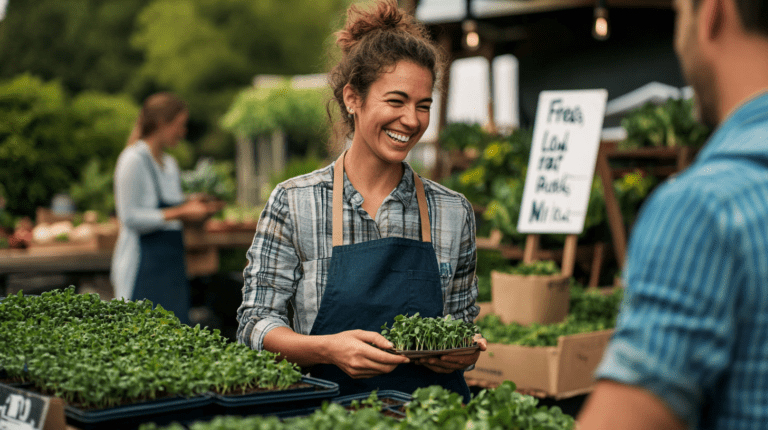
Farmers’ markets are a popular venue for selling microgreens. These markets provide an excellent opportunity for growers to connect with customers and sell their products. However, each farmers’ market may have its rules and requirements for vendors, including a license or permit to sell microgreens.
Researching and complying with all local regulations before selling microgreens at farmers’ markets is important.
For example, in Florida, growers cannot sell certain types of watercress due to concerns about the spread of non-native species.
What Food Safety Standards Apply to Microgreens Sellers?

Growing and selling microgreens have become increasingly popular in recent years as more people are looking for fresh, healthy, and locally sourced produce.
However, like any food product sold to the public, vendors must follow specific food safety requirements to ensure their microgreens are safe for consumption.
Clean and Safe Environment
Microgreens need to be grown in a clean and safe environment to prevent contamination. This means that growers should use clean water sources and avoid using fertilizers or other chemicals that could harm human health. Keeping the growing area clean and free from pests like rodents or insects.
Food Handler’s Permit
Suppose you plan on selling your microgreens at a farmers market or other public venue. In that case, you may be required to have a food handler’s permit or other certifications related to food safety. These permits typically require vendors to complete a training course on safe food handling practices. They may involve periodic inspections of their facilities.
Harvesting and Storage
Proper harvesting and storage techniques are crucial for maintaining microgreens’ freshness and preventing harmful bacteria growth. Microgreens should be harvested when young and tender, typically within 10-14 days of planting. After harvesting, they should be refrigerated immediately at temperatures between 32-41°F (0-5°C) until sold.
Labeling Requirements
Labeling your microgreens with information about the variety, date of harvest, and any potential allergens, such as nuts or soybeans, is essential. This information can help consumers decide what they buy and avoid potential health risks.
Regular Monitoring
Vendors should regularly monitor their microgreens for signs of spoilage or contamination and dispose of unsuitable products. Signs of spoilage can include discoloration, wilting, or the presence of mold or other fungi. If you notice any of these signs, removing the affected plants immediately is vital to prevent the spread of harmful bacteria.
For example, in New York City, vendors must obtain a Mobile Food Vending License from the Department of Health and Mental Hygiene before selling food items on public streets or sidewalks. This license requires vendors to follow specific guidelines regarding food preparation, storage temperatures, and handwashing facilities.

What Additional Rules Apply When Selling Microgreens Commercially?
In addition to obtaining a license or permit, microgreens businesses may also need to follow specific labeling requirements when selling their products. For example, they may need to include information about the product’s origin, ingredients, and nutritional content on the label.
Packaging requirements are another area that microgreens businesses need to consider when selling their products commercially. Some states may require specific types of packaging materials or sizes for certain types of produce.
Wholesale buyers may also require proof of regulation compliance before purchasing microgreens from a business. This means that it is essential for microgreens businesses to have all necessary licenses, permits, and documentation in order before approaching potential wholesale customers.
It is worth noting that regulations can change as new laws are introduced, or existing ones are updated. Therefore, as a microgreens business, you must stay informed about any changes that could affect your operations.
One way to do this is by joining industry associations or organizations that provide updates on regulatory changes affecting the industry. These groups can also provide valuable networking opportunities and access to resources such as training programs and certification courses.
Another way for microgreens businesses to stay updated with regulations is by working closely with local health departments or other regulatory agencies. These agencies can provide guidance on how best to comply with current regulations and offer advice on any upcoming changes that could impact the business.
In addition to complying with regulations, microgreens businesses can also take steps to ensure the safety and quality of their products. For example, they can implement good agricultural practices (GAPs), such as using clean water sources and avoiding harmful pesticides.
How Do You Get Licensed to Sell Microgreens Step by Step?
Suppose you plan on growing microgreens indoors or in a greenhouse on your property. In that case, checking with your local zoning board is essential to ensure this activity is allowed in your area. Some municipalities have restrictions on commercial farming activities within city limits.
Suppose you plan on selling your microgreens online or at farmers’ markets. In that case, you will likely need a seller’s permit from your state’s Department of Revenue. This permit allows you to collect sales tax from buyers and remit it back to the state.
In addition to obtaining any necessary licenses or permits, microgreens businesses need to stay current on regulations related to food safety and labeling requirements. Depending on your location, your microgreens business may also be subject to inspections by health departments or other regulatory agencies.
There are several benefits to obtaining the licenses and permits for your microgreens business. First, it helps ensure you operate legally and avoid fines or legal consequences. Second, it can help protect your customers by ensuring your microgreens are safe and meet relevant food safety regulations.
Finally, obtaining licenses and permits can help establish credibility with potential buyers or partners. It shows that you have taken the time to do things right and are committed to operating a legitimate business.
What Are Your Options If You Are Not Ready for Full Licensing?
If you’re interested in growing microgreens but don’t want to go through obtaining a license, alternatives are available.
Partner with a Licensed Grower or Distributor
Another alternative to obtaining a full license for selling microgreens is partnering with licensed growers or distributors. This approach allows you to sell their microgreens under their license, so you won’t have to go through the licensing process yourself.
Partnering with licensed growers or distributors can be beneficial because they already have established relationships with buyers and may have access to larger markets than you would on your own. Additionally, they may have more experience and knowledge about growing and selling microgreens, which could help improve the quality of your product.
Sell Your Microgreens at Local Farmer’s Markets or Community Events
If you’re looking for ways to sell your microgreens without obtaining a full license, consider participating in local farmer’s markets or community events that may not require one. These events allow small-scale growers like yourself to showcase their products and connect with potential customers.
Selling at farmer’s markets and community events also provides an excellent opportunity for networking and building relationships within the local community. By connecting with other growers and vendors, you may find new opportunities for partnerships or collaborations.
In Georgia, for example, “communities around the state have various events, programs, fairs, and festivals sponsored by nonprofit organizations involving food service. The local health department does not regulate food vendors at these events.” 11
Explore Online Marketplaces That Allow Small-Scale Sales
Another alternative is exploring online marketplaces that allow individuals to sell small quantities of produce without a license. These platforms provide an excellent opportunity for small-scale growers to reach a wider audience and sell their products without going through the licensing process.
Some popular online marketplaces for selling microgreens include Etsy, eBay, and Amazon. However, it’s important to note that each platform has its own rules and regulations for selling fresh produce, so be sure to research before getting started.
Sell Your Microgreens to Restaurants or Other Businesses
If you’re interested in selling your microgreens on a larger scale but don’t want to obtain a full license, consider selling them to restaurants or other businesses that may have their own licenses. Many restaurants and cafes are interested in sourcing locally-grown produce, including microgreens. They may be willing to purchase from unlicensed growers.
Selling directly to businesses can also provide an opportunity for building relationships within the local community and establishing yourself as a reliable supplier of high-quality microgreens.
Join a CSA
CSA stands for Community Supported Agriculture. CSA programs are selling plans that connect farmers to local customers directly. These programs secure income for the farm, while customers get fresh produce during harvest season. Their licensing and permit restrictions may be more amenable.12
Check with Your Local Government for Exemptions or Special Permits
Finally, if you’re unsure whether you need a license to sell your microgreens, check with your local government. Some areas, like microgreens, many have exemptions or special permits available for small-scale fresh produce sales.
Some states have “Cottage Food Products” under which microgreens may fall. 13
- While there are some regulations, ensure no local ordinances prevent you from legally operating a home-based business.
- Suppose you’re on well water (private well). In that case, you must first “have your water tested by the Georgia Department of Agriculture.”
- The next step is obtaining FOOD SAFETY TRAINING accredited by American National Standards Institute (ANSI).
- Get a Cottage Food License
- Get a one-time inspection.
Many opportunities are available to share your passion for these nutritious greens with others. By researching and exploring all available alternatives, you can find ways to sell your microgreens without having to go through the process of obtaining a full license.
Is a Microgreens Business Still Profitable After Licensing Costs?

Microgreens are high-value crops that can be profitable if grown and sold correctly. They have a quick turnaround time; some varieties are ready for harvest in a week. Microgreens are also in high demand, especially in the culinary world. They are used as a garnish or a nutritious dish addition.
According to a report by Market Research Future, “the global microgreens market is projected to reach $2.48 billion by 2030 from $1.02 billion in 2022. This indicates that there is a high demand for microgreens, which could translate to a profitable business.” 14
Urban farming, including microgreens, accounts for 15 to 20 percent of the world’s food. The benefits of city-based agriculture go far beyond nutrition.
The profitability of growing microgreens depends on various factors, including the cost of production, marketing, and sales. To maximize your profits, you must keep your production costs low by growing your microgreens efficiently and cost-effectively. Additionally, marketing your microgreens to the right audience, such as chefs, health enthusiasts, or local farmers’ markets, can help increase your profits.
Do I Need Insurance to Sell Microgreens?
While it’s not a legal requirement to have insurance to sell microgreens, it’s essential to protect your business from unforeseen circumstances. Microgreens are a perishable crop; if they spoil or become contaminated, it can result in a significant financial loss for your business.
You can purchase insurance policies to protect your business, such as liability and crop insurance.
Liability insurance can protect your business from lawsuits related to property damage, personal injury, or foodborne illnesses. Crop insurance, on the other hand, can protect your business from crop loss due to natural disasters, such as floods, droughts, or pest infestations.
Microgreens Sales Licenses and Permits: Frequently Asked Questions
Is a microgreens business still profitable after paying for licenses and permits?
Yes. Licensing costs are a one-time or annual fixed expense and do not change the per-tray economics of the business. A basic home setup running 25 trays at $32 per tray generates $800 in revenue per harvest cycle. Licensing fees in most states run $50 to $500 per year total. The bigger variable is whether you have committed buyers before you scale — not what you paid to register the business.
Do licensing requirements change what sales channels you can use?
Yes, significantly. Selling at a farmers market, to a restaurant, and online each carry different permit requirements. A farmer’s market vendor permit does not cover wholesale restaurant sales. Selling across state lines triggers FDA FSMA registration. Build your licensing stack around the channel you plan to use first, then add permits as you expand to new channels rather than applying for everything at once.
Can you sell microgreens without a license at farmers markets?
In some jurisdictions, yes. Several states have cottage food exemptions or nonprofit event rules that allow small-scale sales without full licensing. Georgia, for example, does not regulate food vendors at nonprofit community events. California requires a Certified Producer Certificate for farmers market sales but may not require a separate health permit. Check your specific state’s Department of Agriculture before assuming an exemption applies to you.
What licenses do you need before approaching a restaurant account?
At minimum, a business license and seller’s permit. Most restaurants and food service buyers want proof that you are operating a registered food business before they place their first order. Some will ask for your food safety certification or a copy of your food handler permit. Having these in place before your first sales call removes the most common objection wholesale buyers use to delay or decline new suppliers.
Does licensing affect how you price microgreens to wholesale buyers?
Licensing costs are real but small relative to total production cost. The more important pricing factor is your cost floor. Radish microgreens cost around $23 per tray to produce at a 30% margin target and need a $32.53 selling price. Licensing does not change that number materially. Where compliance does affect pricing is in packaging and labeling requirements — commercial buyers often require specific label information that adds a small per-unit cost.
When should you get licensed relative to finding your first customers?
After you have validated demand, not before. Confirm that committed buyers exist in your local market first. Once you have two or three accounts ready to order, get licensed and compliant before your first delivery. Getting licensed before you have any buyers is a cost with no return. Getting licensed after you already have orders waiting is straightforward and pays for itself in the first harvest cycle.
Stop Guessing
Enter your zip code and income goal. The tool pulls local market data and calculates
the exact number of customers you need to hit your income target in your specific market.
Wrap-up: Microgreens Sales Licenses and Permits
Selling microgreens can be a profitable business venture. Still, it is crucial to understand the licensing and permit requirements before starting. The rules and regulations for selling microgreens commercially vary from country to country and state to state. It is essential to research local regulations thoroughly.
While obtaining a full license may seem like a daunting task, there are alternatives available. For example, selling directly to consumers through farmers’ markets or community-supported agriculture (CSA) programs may not require a full license. However, it is still essential to comply with food safety requirements and obtain necessary permits.
It is also worth noting that even if you are not legally required to obtain a license or permit, it is still advisable. Obtaining the necessary licenses and permits can provide peace of mind and protect your business from potential legal issues in the future.
References
- “Obtaining a license in the City of Vancouver, Canada. Under License By-Law No.4450, a valid business license is required to operate a business in the City of Vancouver.” Business licenses — the City of Vancouver Open Data Portal
- “There is no filing requirement in 13 states (Alabama, Alaska, Arizona, Delaware, Florida, Hawaii, Kansas, Maryland, Mississippi, Nebraska, Ohio, Wisconsin, and Wyoming). Firms in these states may need to register their assumed name at the local level instead.” DBA by State, Filing Requirements, Trade Name Registration | File a DBA (Doing Business As) | Fictitious Business Name | All States (dbafilingonline.com)
- To operate a food handler business in DeKalb County, Georgia, you need to apply for a permit to operate a food service establishment. FS-Application-2021-2022.pdf (dekalbhealth.net)
- “Standards for the Growing, Harvesting, Packing, and Holding of Produce for Human Consumption: Guidance for Industry. U.S. Department of Health and Human Services, Food and Drug Administration, Center for Food Safety and Applied Nutrition,” October 2018. (80 FR 74353) (Produce Safety Rule). https://www.fda.gov/media/117414/download
- University of California, Agriculture, and Natural Resources, Agriculture Ombudsman: Selling Locally Grown Produce. https://ucanr.edu/sites/CESonomaAgOmbuds/Produce_Farming/#:~:text=Organic%20Registration,handling%20of%20raw%20organic%20products.
- Overview of food safety for sprouts and microgreens, Ontario Ministry of Agriculture, Food and Rural Affairs, Canada, has information about Starting a food-selling business and other food and food safety resources. https://www.ontario.ca/page/overview-food-safety-sprouts-and-microgreens
- Ontario, Canada, Food Safety and Quality Act, 2001, S.O. 2001, c. 20. https://www.ontario.ca/laws/statute/01f20
- Anyone starting a new food business, or taking over an existing one, must register it with the local authority at least 28 days before opening. A food business prepares, cooks, stores, handles, distributes, supplies, or sells food. https://www.fwi.co.uk/business/diversification/so-you-want-to-sell-food-to-the-public
- K. government’s Fresh fruit and vegetable marketing standards. https://www.gov.uk/guidance/comply-with-marketing-standards-for-fresh-fruit-and-vegetables#mixed-types-of-produce
- Regulations for Specific Products, Fact Sheet $51: Selling Sprouts and Microgreens, Washington State Department of Agriculture. https://cms.agr.wa.gov/WSDAKentico/Documents/DO/RM/RM/51_SellingSproutsAndMicrogreens.pdf
- Each year in Georgia, communities around the state have various events, programs, fairs, and festivals sponsored by nonprofit organizations involving food service. Food vendors are not regulated by the local health department at these events. https://dph.georgia.gov/document/document/nonprofitfoodservicefaq/download
- CSA Program & Details. Farm Doc microgreens offers a subscription community support agriculture (CSA) service. https://farmdocmicrogreens.com/microgreen-community-supported-agriculture-program/
- Cottage Food Laws. https://cottagefoodlaws.com/
- Global Microgreens Market Overview, 2023-2030, Market Research Future. https://www.marketresearchfuture.com/reports/microgreens-market-10804