The first time Stephen and I grew mustard microgreens at JPure Farms, the nutrition data surprised us. At 258 µg of Vitamin K per 100g, this small green delivers more than double the daily requirement. The chef we were hoping to sign that week didn’t care about the numbers. She chewed a leaf. Then looked up. “What is that heat?”
That question is what mustard microgreens are really about. The heat comes from allyl isothiocyanate. That is, the compound sinigrin converts into the moment myrosinase activates. It is the same sharp chemistry behind wasabi. And it comes with 78% of your daily Vitamin C in that same 100g serving.
The USDA numbers and the research are both below. Scan the nutrition table, and you will see why mustard moves fast at farmers’ markets.
Key Takeaways
Mustard microgreens deliver 258 µg of Vitamin K per 100g (215% DV) and 70 mg of Vitamin C (78% DV), per USDA FoodData Central. Their primary glucosinolate, sinigrin, converts to allyl isothiocyanate on myrosinase contact during chewing. Rahman et al. (2024) and Xiao et al. (2012) confirm antioxidant and anti-inflammatory properties in Brassicaceae mustards at the microgreen stage.
Mustard Microgreens Work.
But Only for Certain Patterns.
In the Microgreens Method, mustard targets chronic inflammation, bone density concerns, and oxidative stress. If those are not your pattern, a different variety matches your concern more precisely. Five questions tells you which one.
Find My PatternWhat are mustard microgreens, and when are they harvested?
Mustard microgreens belong to the Brassicaceae family — the same botanical clan that gives us broccoli, cabbage, and kale — and they’re harvested surprisingly early, typically just 7–10 days after germination.
Mustard microgreens are ready to harvest in just 7–10 days — remarkably fast for something so nutritionally dense.
You’re cutting them at the cotyledon stage, before true leaves even appear, which sounds almost impatient — but there’s real logic behind that timing.
That early harvest window is exactly when mustard microgreens nutrition peaks. The plant has germinated, mobilized its stored energy, and concentrated nutrients before redirecting resources toward leaf development.
What you get is a small green that punches well above its size in vitamins, antioxidants, and bioactive compounds.
Among brassica microgreens, mustard is one of the fastest to reach harvest, making it a practical starting point for anyone new to growing microgreens at home or commercially.
What does the USDA data say about mustard microgreens nutrition?
Knowing *when* mustard microgreens are harvested explains a lot — but the more interesting question is what’s actually inside them at that point.
Dedicated mustard microgreens USDA data is limited, which makes a landmark 2012 study from the University of Maryland particularly useful. Researchers Xiao et al. measured nutrient concentrations across 25 commercially grown microgreens — mustard among them — giving us one of the clearest windows into what these tiny greens actually deliver nutritionally.
The table below shows key values per 100g fresh weight, drawn from that research and USDA records. You’ll notice the numbers tell a compelling story right away: mustard microgreens are especially notable for their vitamin C and vitamin K content, two nutrients that show up in meaningful, measurable amounts.
| Name | Amount | Daily Value | % Daily Value |
|---|---|---|---|
| Water | 90.7 g | 3546 g | 2.56% |
| Energy | 27 kcal | ||
| Energy | 114 kJ | ||
| Protein | 2.86 g | 68 g | 4.21% |
| Total lipid (fat) | 0.42 g | 62 g | 0.68% |
| Carbohydrate, by difference | 4.67 g | 315 g | 1.48% |
| Fiber, total dietary | 3.2 g | 38 g | 8.42% |
| Sugars, total including NLEA | 1.32 g | 50 g | 2.60% |
| Calcium, Ca | 115 mg | 1000 mg | 11.50% |
| Iron, Fe | 1.64 mg | 18 mg | 9.11% |
| Magnesium, Mg | 32 mg | 420 mg | 7.62% |
| Phosphorus, P | 58 mg | 0.7 g | 8.29% |
| Potassium, K | 384 mg | 3400 mg | 11.29% |
| Sodium, Na | 20 mg | 1500 mg | 1.33% |
| Zinc, Zn | 0.25 mg | 11 mg | 2.27% |
| Copper, Cu | 0.165 mg | 900 mcg | 18.33% |
| Selenium, Se | 0.9 µg | 55 mcg | 1.64% |
| Vitamin C, total ascorbic acid | 70 mg | 90 mg | 77.78% |
| Thiamin | 0.08 mg | 1.2 mg | 6.67% |
| Riboflavin | 0.11 mg | 1.3 mg | 8.46% |
| Niacin | 0.8 mg | 16 mg | 5.00% |
| Pantothenic acid | 0.21 mg | 5 mg | 4.20% |
| Vitamin B-6 | 0.18 mg | 1.3 mg | 13.85% |
| Folate, total | 12 µg | 400 mcg | 3.00% |
| Choline, total | 0.5 mg | 0.55 g | 0.09% |
| Vitamin A, RAE | 151 µg | 900 mcg | 16.78% |
| Carotene, beta | 1790 µg | ||
| Carotene, alpha | 10 µg | ||
| Cryptoxanthin, beta | 40 µg | ||
| Vitamin A, IU | 3020 IU | ||
| Lutein + zeaxanthin | 3730 µg | 6000 mcg | 62.17% |
| Vitamin E (alpha-tocopherol) | 2.01 mg | 15 mg | 13.40% |
| Vitamin K (phylloquinone) | 258 µg | 120 mcg | 215.00% |
| Fatty acids, total saturated | 0.01 g | ||
| Fatty acids, total monounsaturated | 0.092 g | ||
| Fatty acids, total polyunsaturated | 0.038 g |
How do the macro and micro nutrients break down?
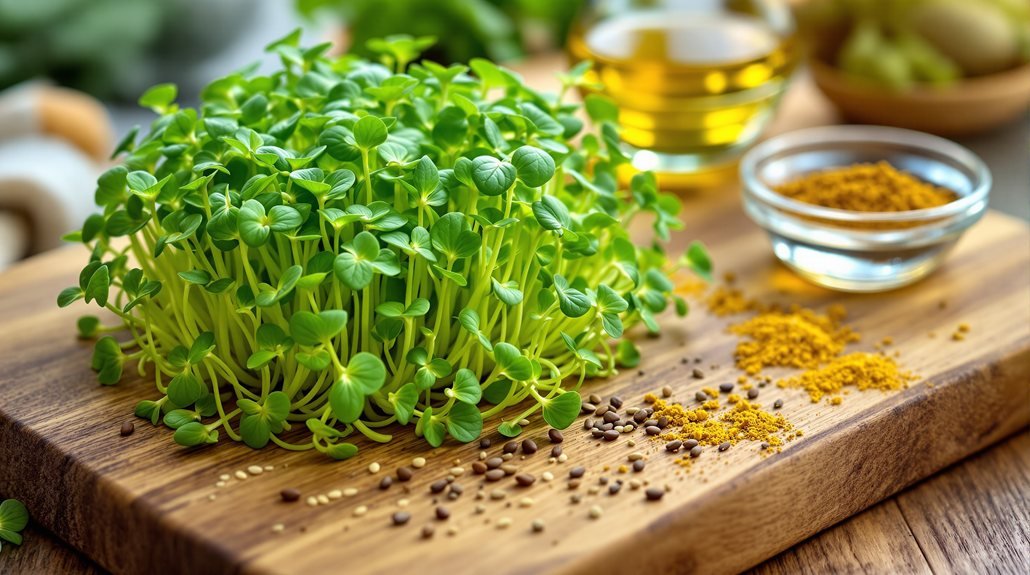
Breaking the nutrition down into categories makes it easier to see where mustard microgreens actually earn their reputation.
Breaking nutrition into categories reveals exactly where mustard microgreens earn — and deserve — their impressive health reputation.
On the micronutrient side, mustard microgreens vitamins are where the story gets interesting — vitamin K leads at 215% of your daily value per 100g, supporting blood clotting and bone density.
Vitamin C follows at 78% DV, helping your immune system function and enabling collagen production (the protein that holds connective tissue together).
Vitamin E contributes antioxidant protection, neutralizing unstable molecules before they damage cells.
Then there’s sinigrin — the primary glucosinolate in mustard — which converts into allyl isothiocyanate when you chew it.
Isothiocyanates are the compounds producing that familiar heat and driving most of mustard microgreens studied health effects.
What are the researched health benefits of mustard microgreens?
The health case for mustard microgreens rests primarily on their glucosinolate content — specifically sinigrin, which converts to allyl isothiocyanate (AITC) when you chew it. Researchers have studied AITC for antiproliferative properties, and mustard glucosinolates broadly appear in anti-inflammatory research. You’re joining a growing community of people who eat intentionally — and mustard microgreens fit that well.
Their vitamin C (78% DV) and vitamin E (13% DV) contribute meaningful antioxidant capacity, helping neutralize oxidative stress. Rahman et al. (2024) confirmed this phytochemical profile across Brassicaceae mustards.
One honest caveat: most mustard microgreens health benefits research targets mustard compounds generally, not microgreens specifically. Xiao et al. (2012) and Turner et al. (2024) are notable exceptions studying microgreens nutrition directly. The evidence is promising — not conclusive.
Are mustard microgreens spicy? What do they taste like?
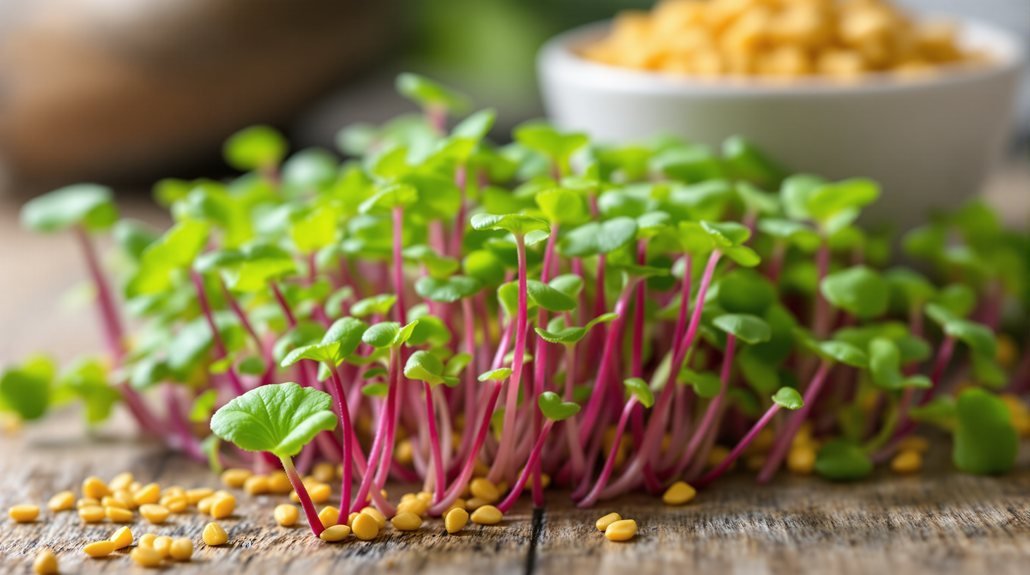
Mustard microgreens are spicy — not in a chili-pepper way, but in that sharp, nose-clearing way that makes you sit up a little straighter. When you chew them, broken cell walls release isothiocyanates, the compounds responsible for that peppery heat. Think arugula crossed with horseradish: peppery up front, with a slow-burning finish.
Mustard microgreens taste varies noticeably by variety:
| Variety | Heat Level |
|---|---|
| Yellow Mustard | Mild |
| Southern Giant Curled | Medium-sharp |
| Red Frills | Sharp |
| Wasabina | Wasabi-like intensity |
| Black Mustard | Strong, pungent |
Chefs prize them precisely because you get heat without adding bulk — a few leaves transform a dish. You’ll feel like you’re part of something intentional when you cook with them.
Which mustard microgreen variety should you grow?
That peppery bite you just read about comes down to more than just the mustard family — variety makes a real difference, both in flavor and in how well your crop sells.
Southern Giant Curled offers mild heat and ruffled leaves, making it a natural fit for salad mixes. Yellow mustard germinates fastest and tastes mildest, so it’s a smart starting point if you’re still finding your rhythm. Wasabina brings intense, wasabi-like heat from its Japanese origins — and commands premium pricing to match. All four varieties germinate within 7–10 days and thrive in standard trays using coco coir or hemp grow mats.
If you’re targeting restaurants, start with red frills mustard microgreens — their purple-red color and sharp flavor create the kind of visual drama that chefs actually remember.
How do you use mustard microgreens in meals?
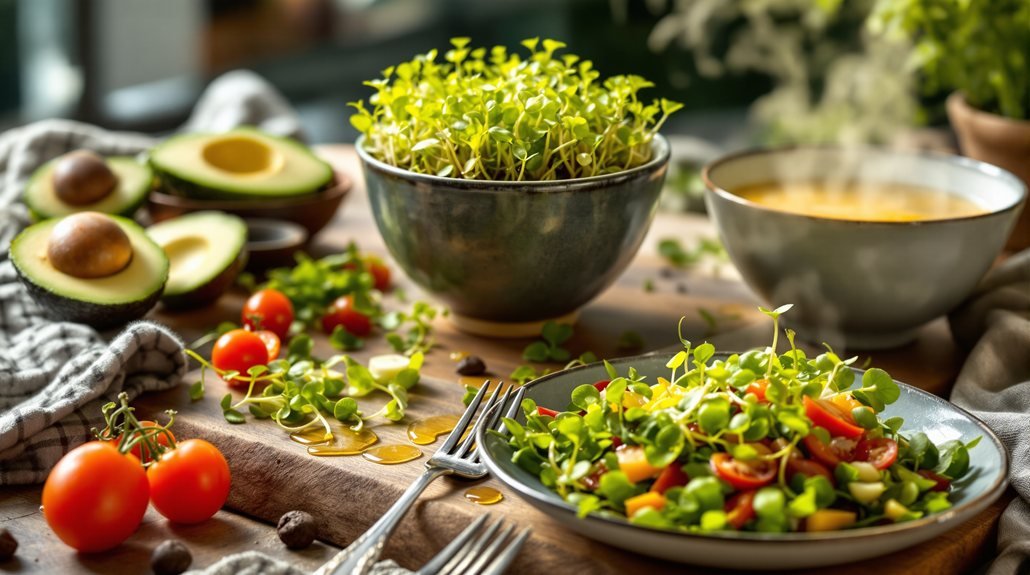
Most of the flavor work happens when mustard microgreens stay raw — heat breaks down the myrosinase enzyme responsible for converting sinigrin into allyl isothiocyanate, which means cooking quietly strips away both the peppery punch and the bioactive compounds you’re eating them for.
Tuck them into grain bowls, wraps, or sandwiches where they add sharp contrast without wilting.
Unlike mustard microgreens vs mature mustard leaves, these tiny shoots pack concentrated heat, so a small handful goes far.
They pair especially well with rich proteins — salmon, pork belly, charcuterie — where the spice cuts cleanly through fat.
Employ them as a finishing garnish on warm plates; the residual heat softens the edges slightly without destroying the enzymes.
For a grounded weeknight idea, try the [mustard microgreens and string beans recipe] and see how well they hold their own.
How do you grow mustard microgreens at home?
Growing mustard microgreens at home is genuinely one of the easier projects you can take on — they’re forgiving, fast, and don’t require much equipment to get right. You don’t need to pre-soak the seeds, though a few hours in water does speed germination if you’re impatient.
Spread roughly 1–1.5 oz of seeds across a 10×20 tray filled with coco coir or a hemp mat, then cover them for 2–3 days during the blackout phase. Once revealed, give them 12–16 hours of light daily and water from the bottom — this keeps the canopy dry and reduces mold risk.
You’ll harvest around day 7–10 at the cotyledon stage, right before true leaves emerge, when sinigrin mustard microgreens compounds are well concentrated. Mustard is genuinely one of the most beginner-friendly brassica varieties you can grow.
Mustard Microgreens: Frequently Asked Questions
Are mustard microgreens good for you?
Yes. Mustard microgreens provide 215% of the daily Vitamin K requirement and 78% of daily Vitamin C per 100g, per USDA FoodData Central. They also contain sinigrin, a glucosinolate that converts to allyl isothiocyanate during digestion, a compound studied for anti-inflammatory and antiproliferative properties. People on blood thinners should consult their doctor before eating them regularly, given the high Vitamin K content.
Are mustard microgreens spicy?
Yes, noticeably so. The heat comes from allyl isothiocyanate, released when the cell walls break during chewing. The intensity varies by variety — wasabina is the sharpest, yellow mustard the mildest, with red frills and southern giant curled sitting in between. The flavor is closer to horseradish than chili pepper: sharp, nose-clearing, and short-lived.
How long do mustard microgreens take to grow?
Mustard microgreens are ready to harvest in 7–10 days from seeding. They are among the fastest-growing brassica microgreens available. Harvest at the cotyledon stage, before true leaves develop, when sinigrin concentration is at its peak. A 3-day blackout period followed by 12–16 hours of light daily produces the best results.
What are the health benefits of mustard microgreens?
The main benefits come from three sources: glucosinolates (specifically sinigrin and its conversion to allyl isothiocyanate), high Vitamin K supporting bone density and blood clotting, and Vitamin C supporting immune function and collagen synthesis. Lutein and zeaxanthin are present at 3,730 µg per 100g, contributing to eye health. Most research covers mustard compounds broadly rather than microgreens specifically, so the evidence is promising rather than conclusive.
How do you eat mustard microgreens?
Raw is best. Cooking deactivates myrosinase, the enzyme that converts sinigrin to allyl isothiocyanate, which removes both the heat and most of the studied bioactive benefits. Add them to salads, grain bowls, wraps, or sandwiches. They pair well with rich proteins like salmon or pork belly, where the spice cuts through fat.
Do mustard microgreens taste like mustard?
They share the same heat chemistry as prepared mustard, but taste more like a cross between arugula and horseradish than the condiment in your fridge. The peppery bite is upfront and lingers briefly. Variety affects flavor significantly — wasabina is closer to wasabi than traditional mustard, while yellow mustard microgreens are mild enough for everyday salad use.
Wrap-up: mustard microgreens nutrition
Mustard microgreens pack a lot into a small package — meaningful vitamin C and vitamin K levels, a heat that’s backed by real chemistry, and variety options that let you match flavor intensity to your market. That heat comes from sinigrin breaking down into isothiocyanates, compounds with genuinely studied health properties.
| Variety | Heat Level | Best Use |
|---|---|---|
| Yellow Mustard | Mild | Salad blends |
| Southern Giant Curled | Medium | Retail bags |
| Red Frills | Sharp | Restaurant plating |
| Wasabina microgreens | Intense | Premium menus |
| All varieties | Variable | Market-dependent |
You’re choosing more than a crop — you’re choosing a flavor profile and a customer. If you’re thinking about growing mustard microgreens to sell, discover where your local market is (Growth Path Tool) before you plant your first tray.
Mustard Microgreens Work.
But Only for Certain Patterns.
In the Microgreens Method, mustard targets chronic inflammation, bone density concerns, and oxidative stress. If those are not your pattern, a different variety matches your concern more precisely. Five questions tells you which one.
Find My Pattern
References
The sources below support the nutritional claims, phytochemical data, and growing research referenced throughout this article — you won’t find padded citation lists here, just the studies and databases that actually informed the content.
Whether you’re learning how to grow mustard microgreens or evaluating their nutritional profile, these references give you a community of researchers who’ve done the heavy lifting.
Zhao, X., Yu, X., Di, H., Zhou, A., Guan, Z., Shi, P., Wang, S., & Sun, B. (2025). Melatonin Enhances Growth and Glucosinolate-Associated Nutritional Quality of Mustard Sprouts Under Moderate Salinity Stress. Plants, 14(23), 3553–3553. https://doi.org/10.3390/plants14233553
Rahman, M., Khatun, A., Liu, L., & Barkla, B. J. (2024). Brassicaceae Mustards: Phytochemical Constituents, Pharmacological Effects, and Mechanisms of Action against Human Disease. International Journal of Molecular Sciences, 25(16), 9039. https://doi.org/10.3390/ijms25169039
Zhou, A., Tang, J., Li, Y., Cheng, W., Yao, X., Escalona, V. H., Qian, G., Ma, J., Yu, X., Li, H., Huang, Z., Tang, Y., Zhang, F., Chen, Z., & Sun, B. (2024). Combination of light quality and melatonin regulates the quality in mustard sprouts. Food Chemistry X, 23, 101560–101560. https://doi.org/10.1016/j.fochx.2024.101560
Frazie, M., Kim, M., & Ku, K.-M. (2017). Health-Promoting Phytochemicals from 11 Mustard Cultivars at Baby Leaf and Mature Stages. Molecules, 22(10), 1749. https://doi.org/10.3390/molecules22101749
Kartik Kannan, Shanumugam Palani Swamy, (2025), “Bioactive Compound of Fenugreek Mustard Coriander Radish Broccoli Microgreens, and their Health Benefits and Growing Techniques”, International Journal of Science and Research (IJSR), 14(7), 1149-1158. https://dx.doi.org/10.21275/MR25715052545
Wardhana, Luna Aprilia, et al. “Consumer Preferences and Physical-Nutritional Properties of Mustard Green ( Brassica Juncea ) Microgreens in Yogyakarta.” BIO Web of Conferences, vol. 192, 1 Jan. 2025, pp. 02004–02004, https://doi.org/10.1051/bioconf/202519202004
Dokkada, A. K. (2025). Phytochemical content and antioxidant defense in emerging microgreens: fenugreek, horse gram and mustard. International Journal of Zoology and Applied Biosciences, 10(6S), 298–301. https://doi.org/10.55126/ijzab.2025.v10.i06.sp065
Uzma Waqas, Khan, F. A., Hussain, S., Narayan, D. S., & Nindiya Bharti. (2025). Effect of nutrient strength and Trichoderma bio-priming on the nutritional composition of hydroponically grown mustard microgreens. International Journal of Research in Agronomy, 8(9), 131–136. https://doi.org/10.33545/2618060X.2025.v8.i9b.3738
Silva, Marta and Machado, Joana and López-Ruiz, Rosalía and Marín-Sáez, Jesús and Viegas, Olga and Faria, Miguel and Romero-González, Roberto and Garrido Frenich, Antonia and Carvalho, Susana Pinto and Ferreira, Isabel M. P. L. V. O., Hormetic Effect of Uv-C Radiation on Red Mustard Microgreens Growth and Chemical Composition. Available at SSRN: https://ssrn.com/abstract=4920901
Alpatova, N V, et al. “Adaptation of the Method for Identification and Quantification of Sinigrin in Mustard Seeds.” New Technologies, vol. 18, no. 4, 22 Feb. 2023, pp. 17–25, https://doi.org/10.47370/2072-0920-2022-18-4-17-25
Tesfay Teklehaymanot, Wang, H., Liang, J., Wu, J., Lin, R., Zhou, Z., Cai, X., & Wang, X. (2019). Variation in Plant Morphology and Sinigrin Content in Ethiopian Mustard (Brassica carinata L.). Horticultural Plant Journal, 5(5), 205–212. https://doi.org/10.1016/j.hpj.2019.07.005
Rizvi, A., Kumar, S., Singh, G., Kumar, D., & Saxena, S. (2026). Metabolic Characterization of Methanolic Extract of Indian Mustard Microgreens Using High-Resolution 800 MHz NMR Spectroscopy and LC–MS. Applied Magnetic Resonance, 57(3-4). https://doi.org/10.1007/s00723-026-01835-x