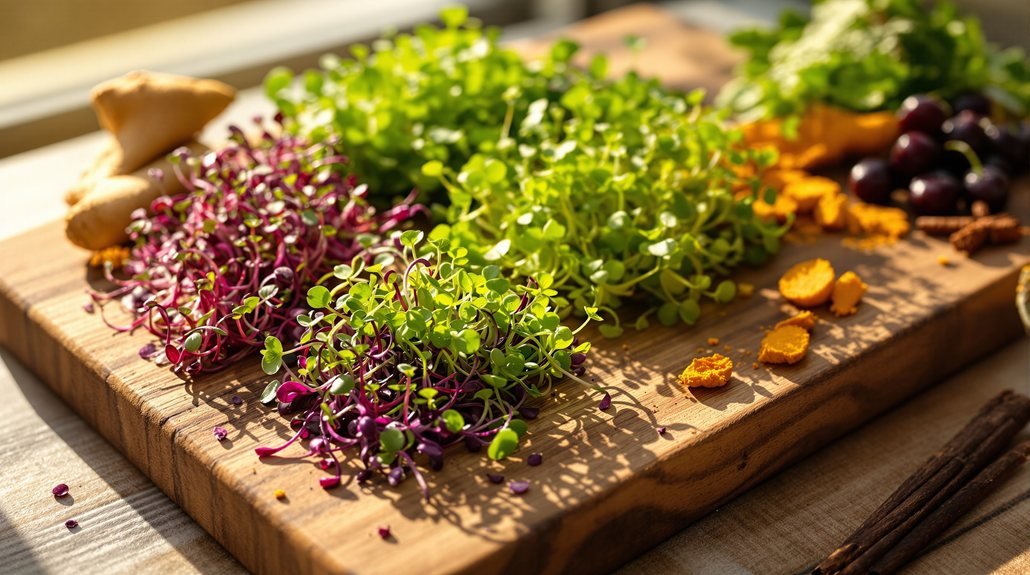
A reader named Constance from our email list wrote in after her rheumatologist told her to look at her diet. She had been dealing with joint inflammation for three years. She asked me one question: “Which microgreens actually help?”
Chronic inflammation does not announce itself. It shows up in blood work — elevated CRP, IL-6, TNF-alpha — long before you feel it as pain or fatigue. Research on sulforaphane, quercetin, and kaempferol shows these compounds work directly on the NF-kB pathway, the signaling switch that keeps inflammation running when it should stop. Broccoli, kale, mustard, red cabbage, and radish microgreens contain the highest concentrations of these compounds at the cotyledon stage.
This post covers which varieties move the needle and why. Not all of them do.
Key Takeaways
Chronic inflammation drives cardiovascular disease, type 2 diabetes, arthritis, and cancer through NF-kB pathway activation. Broccoli microgreens suppress NF-kB via sulforaphane, per Zhang et al. (1992) and Fahey et al. (1997). Kale and radish microgreens deliver quercetin and kaempferol, flavonoids that inhibit COX-2 enzyme activity. Consistent daily intake of 30–60g over 4–12 weeks is the research-supported threshold for measurable changes in inflammatory markers.
Chronic Inflammation Affects Everyone Differently.
So Does the Fix.
The Microgreens Method matches varieties to specific inflammatory patterns. Five questions identify which microgreens your concern actually calls for, and which ones you can skip.
Find My PatternWhat is chronic inflammation and why does it matter?
When your immune system stays switched on after the threat is gone, that’s chronic inflammation. Think of it like a car alarm that won’t stop — useful at first, damaging over time.
Chronic inflammation is your immune system stuck in alarm mode — still firing long after the threat has passed.
Unlike the swelling you get from a cut, chronic inflammation runs quietly in the background. You often can’t feel it. But research links it to heart disease, type 2 diabetes, arthritis, cancer, and neurodegenerative conditions like Alzheimer’s.
Doctors measure it through markers like CRP, IL-6, and TNF-alpha — proteins your body releases when inflammation is active.
Here’s the good news. What you eat influences those markers. That’s where microgreens chronic inflammation research gets interesting.
Certain microgreens contain compounds that directly target the pathways driving this low-grade immune response. Knowing which microgreens reduce inflammation means you can make smarter choices at the table.
Small shifts. Real biology. That’s what we’re working with here.
How do microgreens address inflammation at the cellular level?
Before getting into specific varieties, it helps to understand what microgreens are actually doing inside your body when you eat them.
Microgreens work through two main pathways. First, they’re loaded with antioxidants that reduce oxidative stress — think of oxidative stress as the spark that kindles inflammatory signaling. Less spark means less fire.
Second, specific compounds directly interfere with the processes that keep inflammation running. Sulforaphane is the big one. It’s a compound found in broccoli and mustard microgreens that blocks a protein called NF-kB — essentially the switch that tells your body to produce inflammatory chemicals.
Adding microgreens to a microgreens anti-inflammatory diet isn’t about one magic meal. It’s about a consistent daily intake over weeks. That’s when sulforaphane inflammation research shows measurable changes in markers like CRP and IL-6.
Small, repeated actions. That’s the whole idea.
Which microgreens have the strongest anti-inflammatory compounds?
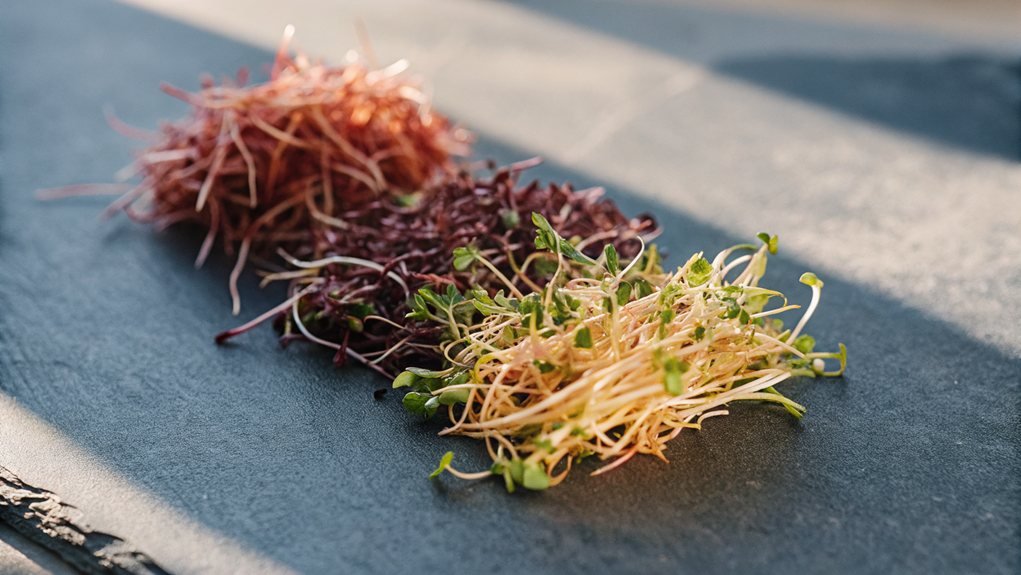
Not all microgreens are created equal. If you’re employing microgreens anti-inflammatory benefits as a real health strategy, variety selection matters.
Here’s where to focus your energy:
Broccoli leads the pack. It contains the highest concentration of sulforaphane precursors among common varieties. Sulforaphane directly suppresses the signaling pathway that triggers inflammation.
Red cabbage delivers anthocyanins — the pigments in purple plants linked to lower CRP levels. CRP is a blood marker your doctor uses to measure inflammation.
Mustard packs vitamin K at 215% daily value and lutein at 62% daily value. Both connect to reduced inflammatory markers in research.
Kale brings quercetin and kaempferol — compounds that block COX-2, the same enzyme targeted by ibuprofen.
Radish rounds out the group with its isothiocyanates and vitamin C.
You don’t need all five. Start with two.
What does the research say about microgreens and inflammatory markers?
The research here is promising — but let’s be honest about what it actually shows.
The research is promising. But promising isn’t the same as proven — and that distinction matters.
Most studies on microgreens for inflammation aren’t done on humans eating microgreens. They’re done on isolated compounds — like sulforaphane or quercetin — in lab settings or animal models. That’s a significant distinction.
What we do have is strong evidence that those compounds reduce inflammatory markers when consumed consistently. Studies on sulforaphane show measurable drops in NF-kB activation. NF-kB is basically an “on switch” for inflammation. Turn it down, and your body produces fewer inflammatory signals.
Research on microgreens and CRP levels is still emerging. CRP (C-reactive protein) is a marker your doctor can test to gauge inflammation. Population studies on diets rich in these phytochemicals consistently show lower CRP.
The science is building. It’s just not finished yet.
How much do you need to eat to see an effect?
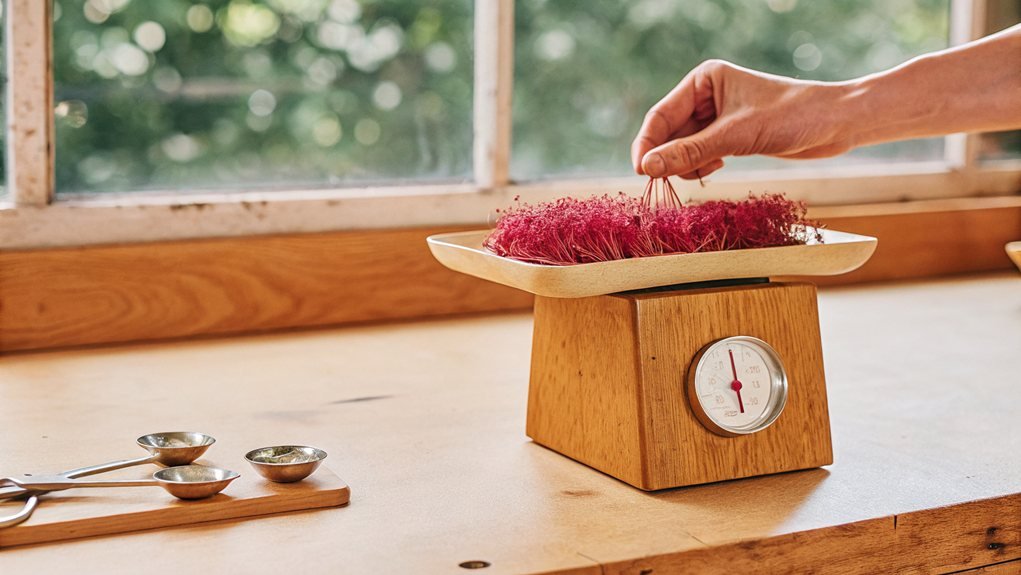
Most research on dietary compounds like sulforaphane and quercetin employs consistent daily intake over 4–12 weeks before measurable changes in inflammatory markers show up. Consistency beats intensity here.
A realistic daily target is 30–60g of anti-inflammatory microgreens. That’s roughly two small handfuls.
| Variety | Daily Serving | Key Compound |
|---|---|---|
| Broccoli microgreens | 30–60g | Sulforaphane |
| Mustard microgreens | 30–60g | Vitamin K, Lutein |
| Red Cabbage | 30–60g | Anthocyanins |
| Kale | 30–60g | Quercetin, Kaempferol |
| Radish | 30–60g | Isothiocyanates |
Knowing how much you need to eat to see an effect makes the habit feel manageable. No huge bowls. No complicated prep.
Rotate varieties weekly. That’s how you cover multiple anti-inflammatory pathways without overthinking it.
—
The Microgreens Method covers the 90-day system for incorporating microgreens into a cellular health protocol, including specific variety recommendations by health goal.


How do you add anti-inflammatory microgreens to daily meals?
Knowing the target amount is one thing. Actually consuming it every day is another.
The good news? The best microgreens for inflammation are easy to incorporate into meals you’re already making. You don’t need a new diet. You need a new habit.
Start simple. Add a handful of broccoli or radish microgreens to a sandwich or wrap. Toss them into a smoothie. Employ them as a salad base. Pile them on eggs in the morning.
If you’re dealing with microgreens and joint pain as your main concern, prioritize broccoli and kale varieties daily. They’re dense in sulforaphane and quercetin — compounds that directly dial down inflammatory signaling.
The key is consistency. A 30–60g daily serving works best when it’s a routine rather than occasional.
Find two or three meals where microgreens just fit. Build from there. That’s how the habit sticks.
Chronic Inflammation Affects Everyone Differently.
So Does the Fix.
The Microgreens Method matches varieties to specific inflammatory patterns. Five questions identify which microgreens your concern actually calls for, and which ones you can skip.
Find My PatternWrap-up: microgreens and chronic inflammation
What you’ve read here isn’t a cure. It’s a starting point. Microgreens work by reducing microgreens oxidative stress — the cellular damage that triggers your immune system to stay on high alert. They also interrupt the microgreens NF-kB pathway, which is basically the switch that turns on chronic inflammation. Flip that switch off more often, and your body gets a break.
This is a real, food-based approach. And this is one that actually has science behind it.
Start simple. Add 30–60 grams of broccoli, kale, or red cabbage microgreens daily. Be consistent. Four to twelve weeks is where research shows measurable changes.
You don’t need to overhaul everything overnight. You just need a system. *The Microgreens Method* covers exactly that — a 90-day cellular health protocol built around variety-specific recommendations. [Find it on Amazon.]
Anti-inflammatory microgreens: frequently asked questions
Which microgreens are best for reducing inflammation?
Broccoli microgreens rank first for sulforaphane precursor concentration, which directly suppresses NF-kB signaling. Kale and radish microgreens are high in quercetin and kaempferol content, both of which inhibit COX-2 enzyme activity. Red cabbage adds anthocyanins linked to lower CRP levels. Mustard microgreens contribute vitamin K at 215% daily value and lutein at 62% daily value, both associated with reduced inflammatory markers in research.
How do microgreens reduce inflammation?
Two mechanisms are relevant. First, antioxidant compounds, including vitamin C, vitamin E, and carotenoids, reduce oxidative stress, which fuels inflammatory signaling. Second, specific phytochemicals directly inhibit the NF-kB pathway, the cellular switch that keeps inflammation active. Sulforaphane activates the Nrf2 pathway simultaneously, upregulating the body’s own antioxidant enzyme production. Both pathways work together rather than independently.
How long does it take for anti-inflammatory microgreens to work?
Most studies showing measurable reductions in inflammatory markers use consistent daily intake over 4–12 weeks. A single serving does not produce detectable changes in CRP or IL-6. The evidence supports steady daily consumption of 30–60g rather than larger occasional portions. Think of it as cumulative signaling rather than a single intervention.
Can microgreens help with joint pain?
Quercetin and kaempferol in kale and radish microgreens inhibit COX-2, the enzyme targeted by common anti-inflammatory medications like ibuprofen. Sulforaphane from broccoli microgreens suppresses pro-inflammatory cytokine production through the NF-kB pathway. Research on isolated compounds is promising. Studies testing microgreens specifically on joint pain outcomes are limited, so the evidence is supportive rather than conclusive. Anyone managing a diagnosed inflammatory condition should consult their doctor before making dietary changes.
Are microgreens better than anti-inflammatory supplements?
Not necessarily better — different. Supplements deliver isolated, concentrated compounds at controlled doses. Microgreens deliver lower concentrations of multiple compounds alongside fiber, vitamins, and minerals that supplements do not provide. The food matrix also affects bioavailability. For most healthy adults eating a varied diet, microgreens are a practical daily source. Supplements may be appropriate under clinical guidance for specific conditions at therapeutic doses.
How much microgreens should you eat daily for anti-inflammatory benefits?
Research points to 30–60g daily as the practical threshold for accumulating meaningful phytochemical exposure over time. That is roughly two generous handfuls. Consistency over weeks matters more than any single large serving. Rotating between broccoli, kale, mustard, and red cabbage covers more compound diversity than eating one variety exclusively.
References
Tallei, T. E., Kapantow, N. H., Niode, N. J., Sailah, I., Savitri, M., Lahay, M. Y., & Barasarathi, J. (2025). The therapeutic potential of red radish microgreens in modulating inflammation and cancer pathways. CyTA – Journal of Food, 23(1). https://doi.org/10.1080/19476337.2025.2467410
Chandel, A., Parmar, S. S., Kumar, H., Pandey, D., & Das, K. (2026). Amaranthaceae Microgreens: Nutrient-Dense Microgreens. Microgreens: Production, Processing and Utilisation, 205–228. https://doi.org/10.1007/978-3-032-14975-6_9
Jambor, T., Goc, Z., Tokarova, K., & Lukac, N. (2025). Potential Effect of Trigonella Microgreens on Functional Parameters of HUVEC Cells in vitro. Physiological Research, 74(6), 1027–1031. https://doi.org/10.33549/physiolres.935643
Dorota Sosnowska, Małgorzata Zakłos-Szyda, Dominika Kajszczak, & Podsędek, A. (2025). Bioactive Properties and Phenolic Profile of Bioaccessible and Bioavailable Fractions of Red Radish Microgreens After In Vitro Digestion. Molecules, 30(14), 2976–2976. https://doi.org/10.3390/molecules30142976
Gunathilake, S., Aluthge, S., Farahnaky, A., Jafarzadeh, S., & Majzoobi, M. (2025). Cereal and pseudocereal microgreens: Emerging functional foods for human health and sustainability. Journal of Cereal Science, 125, 104259. https://doi.org/10.1016/j.jcs.2025.104259
Huang, H., Jiang, X., Xiao, Z., Yu, L., Pham, Q., Sun, J., Chen, P., Yokoyama, W., Yu, L. L., Luo, Y. S., & Wang, T. T. Y. (2016). Red Cabbage Microgreens Lower Circulating Low-Density Lipoprotein (LDL), Liver Cholesterol, and Inflammatory Cytokines in Mice Fed a High-Fat Diet. Journal of Agricultural and Food Chemistry, 64(48), 9161–9171. https://doi.org/10.1021/acs.jafc.6b03805
Choe, U., Yu, L. L., & Wang, T. T. Y. (2018). The Science behind Microgreens as an Exciting New Food for the 21st Century. Journal of Agricultural and Food Chemistry, 66(44), 11519–11530. https://doi.org/10.1021/acs.jafc.8b03096