Disclosure: We’re reader-supported. When you buy through links on our site, we may earn a commission. Full Disclosure.
You can buy a bag of pea shoots at the store, look up what is in them, and find three nutrition tables that do not agree. One of them is almost certainly describing a snow pea pod.
That is not a guess. The figures that circulate for pea microgreens (60 mg of vitamin C, 2.08 mg of iron, 42 µg of folate and 25 µg of vitamin K per 100 g) match one record in the USDA’s FoodData Central to the digit. That record is number 170010, “Peas, edible-podded, raw.” It is the pod you get in a stir-fry. It is not the shoot.
This page used to print those numbers. They are gone now, along with a vitamin C headline that was wrong and a research claim that the paper it cited does not make. What follows is what labs actually measured in pea shoots, how far apart the labs landed, and what that leaves in a handful.
Key takeaways
- FoodData Central holds no record for pea shoots, pea leaves or pea tendrils. The numbers in circulation belong to the edible-podded pod.
- Vitamin C ran from 31 to 154 mg per 100 g across five labs. That is a gap of nearly five times in the same vegetable.
- Protein came in at about 4 g per 100 g in two independent labs, which is under a gram in a 20 g handful.
- Ninety-nine tasters gave pea the highest mean scores for flavor and overall liking out of six microgreens, in a top group with broccoli and red cabbage.
- No person and no animal has been fed pea shoots in a study, for any outcome.
The pea evidence page
Every number on this page, plus the ones that did not survive checking. The measured record and the six answers a stall gets asked, in one place.
What are pea shoots, and are pea microgreens the same thing?

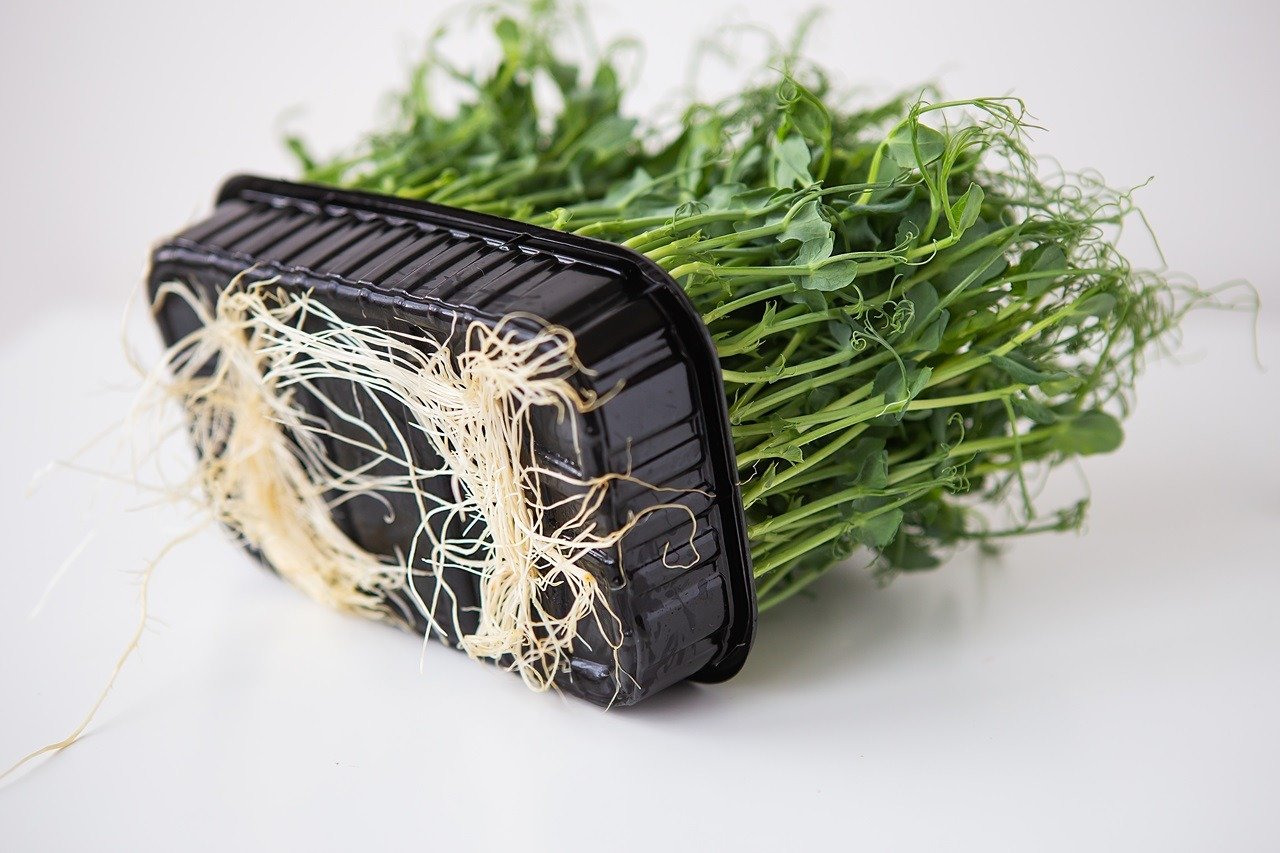
Yes. Same plant, same cut, two names. Growers and chefs usually say pea shoots. Seed catalogues and research papers say pea microgreens, pea tendrils, tendril pea, green pea microgreens or pea seedlings. In Japan the crop is toumyou. All of it is Pisum sativum, harvested a week or two after sowing.
What you are eating is worth knowing, because pea does something no other tray crop on the shelf does. Pea germinates hypogeally, which is a formal way of saying the seed halves stay underground. They never come up. What pushes through the surface is the stem, and after that come the small leafy stipules, the paired leaflets and the tendrils.
So there are no seed leaves in a pea shoot. Most microgreens you buy are mostly seed leaves. Pea has none above ground at all. If a photo of “pea microgreens” shows a tray of little paired oval seed leaves on thin stems, that is a different crop wearing pea’s name.
The plant behind it is an old one. Pisum sativum is one of the founder crops of Near Eastern farming, turning up in Fertile Crescent villages from roughly 10,500 years ago (Weiss & Zohary, 2011). It is not native to China, and it was not first grown there, whatever you may have read on this site before.
What does the research actually measure in pea microgreens?
Start with what is not there. FoodData Central has an entry for the pea pod, one for the green seed and one for sprouted mature seed. It has nothing for the shoot, the leaf or the tendril. There is no official table to fall back on, which is exactly why a pod table has been passing as a shoot table for years.
So the honest version is a record of what individual labs found, with the spread left in view rather than averaged away. Everything below is per 100 g of fresh shoots, with a 20 g handful beside it.
| What | Across the labs | In a 20 g handful |
|---|---|---|
| Dry matter | 7.3 to 12.7%, 14 datasets | not applicable |
| Vitamin C | 31 to 154 mg, 5 labs | 6.9 to 34.2% DV |
| Protein | about 4 g, 2 labs | under 1 g, 1.5% DV |
| Vitamin K | 3.1 µg/g, one lab only | 62 µg, 51.7% DV |
| Iron | about 1 mg, 6 labs | 1 to 2% DV |
| Beta-carotene | 1.9 to 13.9 mg | 3.5 to 15.2% DV as vitamin A |
| Lutein | 7.2 to 13.0 mg, 3 labs | not applicable |
Look at the vitamin C row for a moment. One farm’s shoots read 31 mg per 100 g. Another’s read 154. That is nearly five times, in the same vegetable, measured by careful people. Dry matter moves by a factor of 1.7 across fourteen datasets. The range is the fact here. Anyone quoting one vitamin C number for pea shoots is quoting one farm.
Two rows need a warning label. The vitamin K figure comes from a single laboratory, one grower, one summer, and no one has published a second. Take it at face value and a handful carries about half a day’s vitamin K, which is worth knowing if you take warfarin: the NIH advises keeping your vitamin K intake from food and supplements about the same from day to day rather than avoiding it (NIH Office of Dietary Supplements, 2021). The beta-carotene range leans on one unusually high reading, so treat its top end as a ceiling rather than a typical result.
Are pea sprouts the same as pea shoots?
No, and the difference decides which numbers apply to what is in your hand.
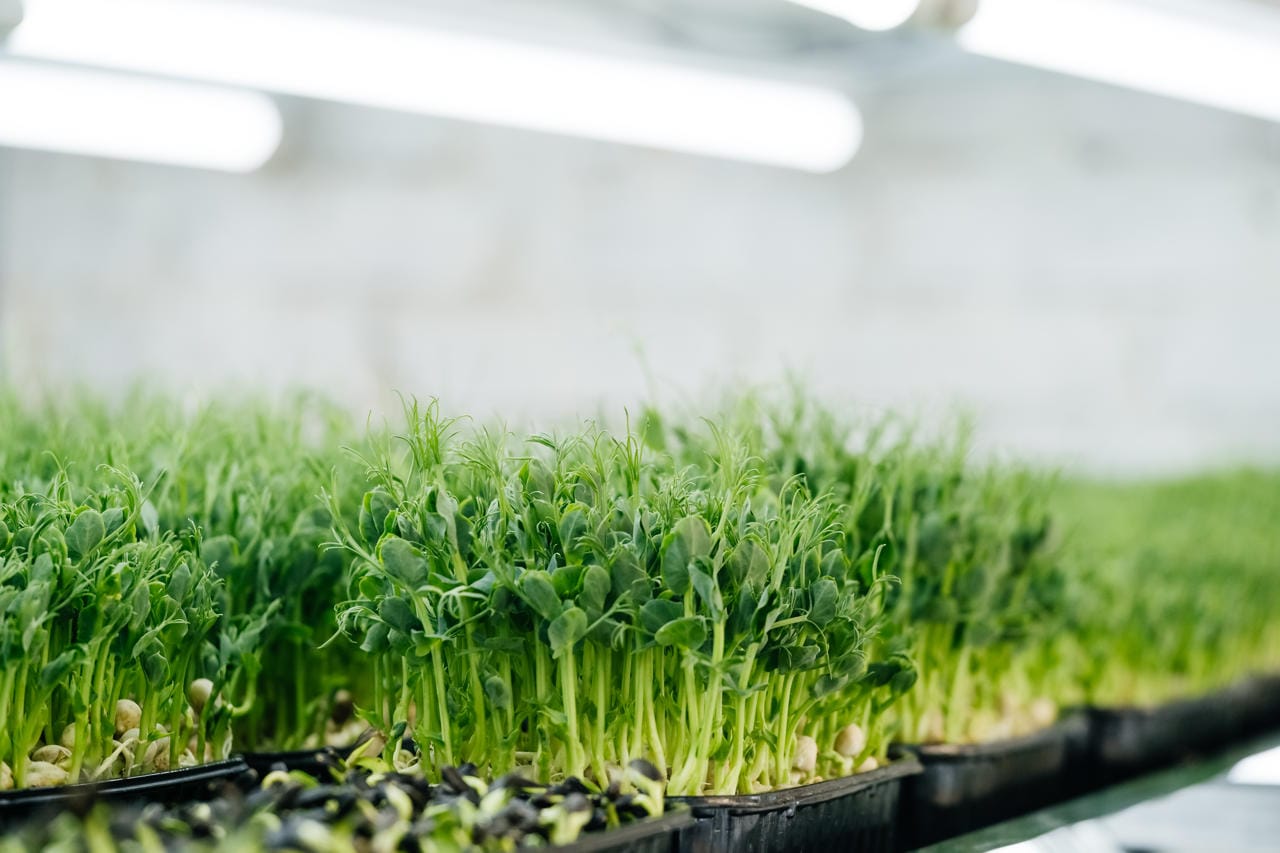
A pea sprout is a germinated seed. You soak it, rinse it for a few days, usually in the dark and without soil, and you eat the whole thing, root and seed included. A pea shoot is grown on past that, in the light, and cut above the growing medium once the stem and leaves are up. Different stage, different plant part, different food.
Light is the reason this is not a technicality. The 2012 survey that first put microgreens on the map happened to buy two pea tendril products from the same grower, grown from the same seed, one under ambient light and one in the dark. Side by side, the light-grown one carried more than four times the vitamin K, about fourteen times the beta-carotene and twice the vitamin C of its dark-grown twin (Xiao et al., 2012). The solid matter was nearly identical. Everything that depends on light was not.
So a figure measured on a dark-grown product tells you very little about a light-grown one, and the reverse holds too. When a table says “pea sprouts” and quotes vitamin numbers, it is worth asking which one the lab actually had.
What are the benefits of eating pea microgreens?
I want to be plain about this part, because most pages are not.
No person has ever been fed pea shoots in a study. Neither has an animal. Not for heart health, not for blood sugar, not for inflammation, not for anything. Two separate searches through PubMed and Crossref in September 2026 turned up nothing of any design, for any outcome. The nearest human data are two taste panels.
That leaves two things anyone can honestly report: what is in them, which is the table above, and how they taste, which turns out to be where this crop actually wins.
Ninety-nine consumers in Colorado tasted six microgreens side by side. Tendril pea took the highest mean score for flavor, 7.8 out of 9, and the highest mean for overall liking, 7.9. The study’s own statistics put broccoli and red cabbage level with it on both, so it shared the top group rather than sitting alone at the top (Michell et al., 2020). A second panel, fifty volunteers in Sri Lanka tasting ten microgreens as single-species salads, scored green peas 6.42 and placed them in the top statistical group there too (Senevirathne et al., 2019). Two panels, two continents, the same answer.
The same honesty cuts the other way. On laboratory antioxidant tests pea finishes last of six in one panel and lowest of five microgreens in another (Balik et al., 2025; Wojdyło et al., 2020). Those are test-tube assays, and they say nothing about what happens in a body in either direction. The Colorado tasters also gave pea the lowest mean score of the six for looks, tied with arugula. It is a plain-looking green that people liked eating.
If you are choosing between varieties on what the research covers, my post on the nine microgreens with the most published nutrition data is a useful next stop, and how chefs pair microgreens with proteins is the practical end of a taste result like this one. For the wider picture on what microgreens have and have not been measured for, see what the research does and does not show about microgreens.
How much protein is in pea shoots?
This one gets asked at every farmers market stall, because pea protein is on every shelf in the supplement aisle. The answer is smaller than people expect.
Two independent labs measured protein in pea shoots and landed within seven percent of each other: 3.73 g per 100 g in a Thai survey of fourteen microgreens, and 4.0 g per 100 g in a Portuguese lot of packed retail shoots (Kowitcharoen et al., 2021; Santos et al., 2014). At a 20 g portion, the two-lab figure comes to under a gram, which is about 1.5 percent of the Daily Value. A single retail sample in Latvia read higher, 6.4 g per 100 g, but that is one bag analyzed once (Lubina et al., 2025).
Pea protein powder is a different product made from a different part of the plant. It is extracted from the dried mature seed after cleaning, dehulling and milling (Asen et al., 2023). The shoot is a vegetable, and it is fine to treat it as one.
Nothing I read supports calling pea shoots a “complete protein.” No full amino acid profile has been published for them. Five amino acids have been measured, in one UK retail sample, and that is a dietary-management analysis rather than a nutrition claim.
Pea microgreens: frequently asked questions
What do pea microgreens taste like?
Fresh and grassy, like raw peas, with a light sweetness. The Colorado panel scored pea the sweetest of the six microgreens it tasted, tied with broccoli, and even then the score sat on the mild side of the scale. Bitterness was the lowest of the six. There is no peppery heat to speak of: the panel scored its heat near the bottom of the scale (Michell et al., 2020).
Is a pea shoot the same as a sweet pea?
No, and this is the one naming mix-up worth taking seriously. The food crop is Pisum sativum. Sweet pea is Lathyrus odoratus, a different genus grown in gardens for its flowers. Grass pea, chickpea, cowpea, black-eyed pea, pigeon pea, butterfly pea and rosary pea are different plants again. Every one of them was kept out of the research behind this page, because none of them tells you anything about what is in a pea shoot. If a photo, a seed packet or a supplier just says “pea,” the thing to check is the species. Do not eat something out of a flower bed on the strength of a name.
Can you cut pea shoots more than once?
Sometimes. Pea carries buds at the base of the small scale leaves on its first two nodes, so a cut plant can push out fresh growth. One team bought shop pea shoots that had already been cut, regrew them for ten days, and found the antioxidant compounds in the second growth swung widely depending on whether the tray sat in sunlight, under a fluorescent lamp or in the dark (Tsuruoka & Hosoya, 2024). What nobody has done is compare a first cut and a regrowth from the same tray for nutrition. So you can often get a second cut. Whether it is the same food is an open question.
Are there any side effects from eating pea microgreens?
Nothing turned up in the research I read that applies to pea shoots as they are sold. The antinutrient point this page used to make was not supported: the one study that compared phytic acid in seed and shoot never tested the difference statistically. Non-protein amino acids have been reported in pea seedlings, but nobody has measured them in light-grown shoots at the amounts a person eats, so neither a warning nor a reassurance is printable here. Two dietary-management labs did find pea shoots at or near the top of their panels for phenylalanine, which matters if you are managing PKU and does not otherwise.
How long do pea microgreens last after harvest?
No study gives a sell-by day, so anyone quoting one is guessing. Three storage studies exist and they describe three setups. One washed and packed commercial lot held its color and its vitamin C for 10 days at 3 °C (37 °F). Sealed shoots kept cold and dark showed only slight yellowing by around 28 days. Shoots left in open punnets at 5 °C (41 °F) lost every compound the researchers measured over 10 days. Cold and closed is the pattern. The “5 to 7 days” this page used to give had no source behind it.
Can you cook pea microgreens or should you eat them raw?
Raw is how they are sold, how they are usually eaten and how both taste panels served them. As for cooking, I am not going to tell you what heat does to the numbers, because only one study has looked and I have not been able to read past its abstract. That is a real gap rather than a dodge. If you do use them hot, treat them as a finishing green and stir them in off the heat.
The pea evidence page
Every number on this page, plus the ones that did not survive checking. The measured record and the six answers a stall gets asked, in one place.
Wrap-up: what the labs measured in pea shoots
Pea shoots are one of the three crops American microgreen growers name most often, and in the one large panel that tasted them beside five others, they came out in the top group for flavor alongside broccoli and red cabbage. That part is measured, and the same result turned up again on a second continent.
The nutrition record underneath is thinner than the internet suggests. Vitamin C swings fivefold between farms. The one vitamin K figure belongs to one grower in one summer. Protein is about four grams per 100 g in the two labs that measured it, which is under a gram in a handful. On lab antioxidant tests they finish near the bottom. And nobody has fed them to anybody in a study.
None of that is a reason to skip them. It is a reason to buy them for the first bite rather than for a number, and to ask any table you meet where its figures came from. Every crop in the Variety Library gets the same treatment.
References
- Asen, N. D., Aluko, R. E., Martynenko, A., Utioh, A., & Bhowmik, P. (2023). Yellow field pea protein (Pisum sativum L.): Extraction technologies, functionalities, and applications. Foods, 12(21), 3978. https://doi.org/10.3390/foods12213978
- Balik, S., Elgudayem, F., Yildiz Dasgan, H., Kafkas, N. E., & Gruda, N. S. (2025). Nutritional quality profiles of six microgreens. Scientific Reports, 15, 6213. https://doi.org/10.1038/s41598-025-85860-z
- D’Imperio, M., Bonelli, L., Mininni, C., Renna, M., Montesano, F. F., Parente, A., & Serio, F. (2024). Soilless cultivation systems to produce tailored microgreens for specific nutritional needs. Journal of the Science of Food and Agriculture, 104(6), 3371–3380. https://doi.org/10.1002/jsfa.13222
- Eldridge, B. M., et al. (2026). Addressing vitamin B12 deficiency through aeroponic fortification of a salad crop (Pisum sativum). Communications Biology, 9(1), 544. https://doi.org/10.1038/s42003-026-09764-y
- Ford, S., Ilgaz, F., Hawker, S., Cochrane, B., Hill, M., Ellerton, C., & MacDonald, A. (2023). Amino acid analyses of plant foods used in the dietary management of inherited amino acid disorders. Nutrients, 15(10), 2387. https://doi.org/10.3390/nu15102387
- Klopsch, R., Baldermann, S., Voss, A., Rohn, S., Schreiner, M., & Neugart, S. (2018). Bread enriched with legume microgreens and leaves. Frontiers in Chemistry, 6, 322. https://doi.org/10.3389/fchem.2018.00322
- Kowitcharoen, L., Phornvillay, S., Lekkham, P., Pongprasert, N., & Srilaong, V. (2021). Bioactive composition and nutritional profile of microgreens cultivated in Thailand. Applied Sciences, 11(17), 7981. https://doi.org/10.3390/app11177981
- Lubina, O., Daly, A., Auzenbaha, M., Gailite, L., Laktina, S., & Macdonald, A. (2025). Nutritional profiling of foods for phenylketonuria. Scientific Reports, 15, 22538. https://doi.org/10.1038/s41598-025-06633-2
- Michell, K. A., et al. (2020). Microgreens: Consumer sensory perception and acceptance of an emerging functional food crop. Journal of Food Science, 85(4), 926–935. https://doi.org/10.1111/1750-3841.15075
- National Institutes of Health, Office of Dietary Supplements. (2021, March 22). Vitamin K: Fact sheet for consumers. https://ods.od.nih.gov/factsheets/VitaminK-Consumer/
- Santos, J., Herrero, M., Mendiola, J. A., Oliva-Teles, M. T., Ibáñez, E., Delerue-Matos, C., & Oliveira, M. B. P. P. (2014). Assessment of nutritional and metabolic profiles of pea shoots: The new ready-to-eat baby-leaf vegetable. Food Research International, 58, 105–111. https://doi.org/10.1016/j.foodres.2014.01.062
- Selelepoo, O. K., Mpai, S., & Sivakumar, D. (2025). LED spectral light combination during production preserves the phytonutritional composition of green pea shoots (Pisum sativum L.) at postharvest storage. Scientia Horticulturae, 349, 114270. https://doi.org/10.1016/j.scienta.2025.114270
- Senevirathne, G. I., Gama-Arachchige, N. S., & Karunaratne, A. M. (2019). Germination, harvesting stage, antioxidant activity and consumer acceptance of ten microgreens. Ceylon Journal of Science, 48(1), 91–96. https://doi.org/10.4038/cjs.v48i1.7593
- Tsuruoka, Y., & Hosoya, T. (2024). Effect of growing environment on the antioxidant activity of recultivated pea seedlings (Pisum sativum L.). Journal of Food Science, 89(12), 9179–9185. https://doi.org/10.1111/1750-3841.17552
- U.S. Department of Agriculture, Agricultural Research Service. FoodData Central, FDC ID 170010: Peas, edible-podded, raw (SR Legacy). https://fdc.nal.usda.gov/food-details/170010/nutrients
- Weiss, E., & Zohary, D. (2011). The Neolithic Southwest Asian founder crops: Their biology and archaeobotany. Current Anthropology, 52(S4), S237–S254. https://doi.org/10.1086/658367
- Wojdyło, A., Nowicka, P., Tkacz, K., & Turkiewicz, I. P. (2020). Sprouts vs. microgreens as novel functional foods. Molecules, 25(20), 4648. https://doi.org/10.3390/molecules25204648
- Xiao, Z., Lester, G. E., Luo, Y., & Wang, Q. (2012). Assessment of vitamin and carotenoid concentrations of emerging food products: Edible microgreens. Journal of Agricultural and Food Chemistry, 60(31), 7644–7651. https://doi.org/10.1021/jf300459b