

Disclosure: We’re reader supported. When you buy through links on our site, we may earn a commission: Full Disclosure.
I cut my broccoli on day ten. I have done this for years, because day ten is when the tray finally looks like something worth selling. The cotyledons have opened, the stems have some length, and the whole surface goes that dense green you want to photograph.
Then I read a study that weighed what was actually in those leaves, day by day, from germination onward. By day four, most of the glucoraphanin had already gone.
I want to be careful here, because the obvious conclusion is the wrong one. This is not an argument for cutting on day four. It is an argument for knowing what day ten costs you, which is a different thing and a considerably more useful one.
Key Takeaway
Broccoli microgreens are usually cut at eight to twelve days. Glucoraphanin, the compound sulforaphane is made from, falls 71 to 84 percent in the first four days (Guo et al., 2014). That is not an argument for cutting early. A four-day tray has almost no yield and no shelf life, so the real question is what the extra week is worth to you.
From Andrew
Twelve days of tray time, and then what?
By the time you cut, you have already done the hard part. Twelve days of seed, blackout, watering and waiting, for one handful of leaves.
What you do in the next two minutes decides how much of that work you keep. Almost nobody writes about it, because it happens at the chopping board rather than in the grow room, and the grow room is the part that photographs well.
So I wrote the handling down. The serving, the two-minute prep, a seven-day plan, and a fridge checklist that gets you every day the tray has left in it.
Eleven pages, seventeen dollars, and your money back if it does not earn its keep.
Educational only, and not a substitute for medical advice.
How do you grow broccoli microgreens, and how long does it take?
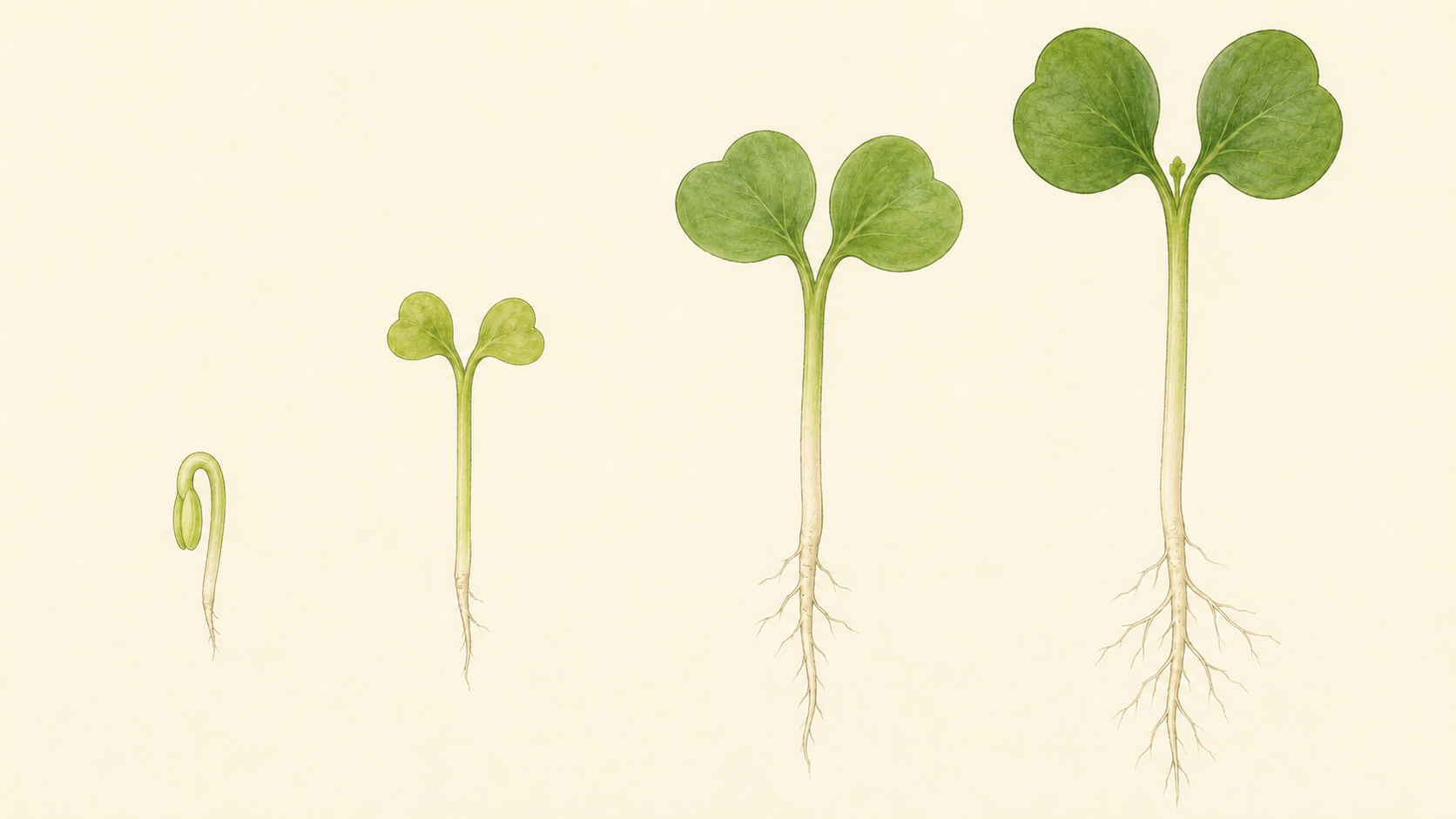
The whole argument of this post is in that strip, if you watch the stems rather than the leaves.
Broccoli is Brassica oleracea var. italica, in the Brassicaceae family alongside radish, cabbage and mustard. It is most people’s second crop after radish, and there are good reasons for that.
It does not need soaking. It is not sensitive to day length, so an ordinary indoor schedule works without any thought about the season outside. It germinates in three to four days, and it is ready to cut inside a fortnight. Very little goes wrong that cannot be fixed on the next tray, which matters more than it sounds when you are learning.
The flavor is grassy and earthy with a bitter edge. That edge is the appeal for some people and the objection for others, so it is worth tasting your own before you build a market stall around it.
Cut and cooled properly, my broccoli trays hold seven to ten days before they start to go. Yours will move with your handling, so take that as a starting point rather than a specification.
That is the whole crop in four paragraphs, and it genuinely is easy. Which is why the rest of this post is not about mechanics at all. The seeding rate, blackout duration, light level, and pH range live in the grow guide. What follows is the part nobody tells you, and it is the part that decides what you actually end up holding.
When should you cut broccoli microgreens?
Two papers have tracked this properly, and they agree with each other.
Guo and colleagues measured broccoli sprouts every day from germination through to day seven. Glucoraphanin, the compound sulforaphane is made from, fell 71 to 84 percent in the first four days, depending on growing temperature. Sulforaphane formation fell 85 to 93 percent by day seven.
The highest sulforaphane reading in that study was the ungerminated seed, not the sprout at any age.
Pereira and colleagues found the same shape over a longer window. Total glucosinolates dropped 56 percent between day six and day eleven in their warmest regime, on a dry weight basis.
So the compound is leaving while the crop is arriving. That is uncomfortable, and it is also just what the numbers say.
Here is why it does not mean cut on day four. A four-day tray is barely a tray. No leaf, no stem worth cutting, no yield to speak of, and no shelf life at all. Follow the logic the whole way, and it tells you to skip growing entirely and eat the seed. Nobody recommends that, which should tell you the logic was never the whole answer. The eight-to-twelve-day window exists because it is the window where you get a crop.
What the research gives you is the price of that window, stated honestly, so you can choose where inside it to sit. Cutting at eight rather than twelve is a real decision with a real effect. It is also part of why sprouts and microgreens differ on this compound, since sprouts are eaten so much earlier.
Does it matter where you cut broccoli microgreens?
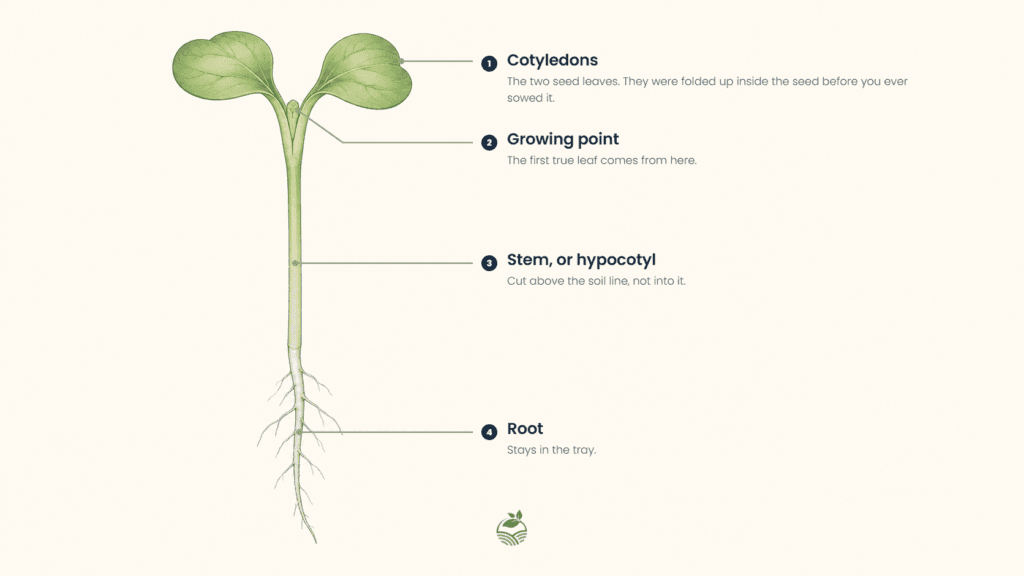
- CotyledonsThe two seed leaves. They were folded up inside the seed before you ever sowed it.
- Growing pointThe first true leaf comes from here.
- Stem, or hypocotylCut above the soil line, not into it.
- RootStays in the tray.
This is the part that surprised me most.
Guo’s team separated broccoli sprouts into cotyledon, hypocotyl, and root and measured each part on its own. Ninety-three to ninety-seven percent of the glucoraphanin sat in the cotyledons. The three-day cotyledon carried nearly eighteen times what the stem below it did, and sixty-six times what the root did.
Then they measured the enzyme, and it runs the other way. Myrosinase is what converts glucoraphanin into sulforaphane, and the hypocotyl carried about four times the myrosinase of the cotyledon. The root carried more than the cotyledon too.
The root makes the point better than either of the others. It is rich in the enzyme and holds almost no precursor, and it produced sulforaphane at just over one percent of its breakdown products. An enzyme with nothing to work on produces nothing at all. That is the clearest demonstration in this literature that holding the compound and holding the machinery are two separate things, and that you need both in the same mouthful.
So the compound lives up in the leaves, the machinery that acts on it lives in the stem below, and a harvest cut runs somewhere between them.
Nobody has tested whether cutting lower changes what you end up with. It is a reasonable thing to wonder about. It is not a reasonable thing to claim, and I am not going to claim it. If you want to run it on your own trays, that is a genuinely open question, and I would like to hear what happens.
What temperature should you grow broccoli microgreens at?
Every guide gives you a number. The research cannot currently support one, and the reason is more interesting than the answer would have been.
Pereira grew broccoli sprouts at five constant temperatures from 11.3 to 33.1°C (52.3 to 91.6°F), taking every tray to the same size before measuring. Glucoraphanin came out lowest in the comfortable middle, rising 72 percent at the hot end and 51 percent at the cold end.
Guo grew them at 20, 25, and 30°C (68, 77, and 86°F) and sampled at fixed ages instead. They found the opposite shape. Glucoraphanin and sulforaphane both peaked at 25°C (77°F), with 20 and 30 lower and not different from each other.
Inside the range where they overlap, those two results disagree. The reason is almost certainly not that either lab was careless. Pereira held size constant and let the growing time vary. Guo held age constant and let the size vary. On a crop that loses most of its precursor in four days, those are not the same experiment.
A third finding complicates it further. Púčiková and colleagues separated temperature from light in red cabbage and found light was the driver. Lower light and shorter days shifted the chemistry, and lower temperature on its own did not.
One thing the research does say clearly. Pereira’s own authors warn against warm sprouting, in their words, because of “the enhanced potential for development of undesirable bacterial flora at these elevated temperatures.” Sprouts and microgreens carry a real contamination risk. Whatever the chemistry eventually settles on, do not chase it with heat.
So what actually moves the needle?
Default
Default
