Microgreens World Knowledgebase
- Advanced Research
- Business
- General
- Growing
- Health
- Nutrition
- Science
- Trends
Brix measurement quantifies dissolved sugars and minerals in your microgreens using a refractometer—a handheld device that bends light through a drop of plant juice to reveal nutritional density invisible to the eye.
You’ll find that readings between 8–12° Brix indicate premium-quality greens with elevated flavor and nutrient concentration, far surpassing what appearance alone suggests.
The measurement tracks more than sweetness; it captures amino acids, vitamins, and phytonutrients that determine market value. Understanding the factors that influence these numbers—from light intensity to harvest timing—transforms your growing approach entirely.
Key Takeaways
- Brix measures dissolved sugars and solids in plant juice using a refractometer, indicating nutritional density and sweetness levels.
- Refractometers bend light through juice samples; higher Brix readings (8-12%) correlate with better flavor and nutrient content.
- Only a drop of pressed plant juice is needed for measurement; calibrate weekly with distilled water for accuracy.
- Seed vigor, light intensity, water stress, temperature, and harvest timing all significantly influence Brix readings.
- Optimize Brix by harvesting at cotyledon expansion, managing light exposure, and using foliar nutrients like kelp solutions.
Understanding Sugar Content in Microgreens
How do you measure the sweetness in a plant barely taller than your fingernail? Brix readings—typically taken with a refractometer—quantify dissolved sugars in microgreens, revealing nutritional density that standard appearance won’t show.
Seed vigor directly influences initial sugar accumulation, since robust germination establishes stronger photosynthetic capacity from day one.
Harvest timing becomes critical here; wait too long and sugars convert to structural compounds, but harvest too early and you’ll miss peak sweetness.
Commercial growers targeting premium markets often test multiple trays daily, chasing that optimal 8-12% Brix range where flavor intensity meets tender texture—your ticket to commanding higher prices.
Tools and Techniques for Measuring Brix Levels
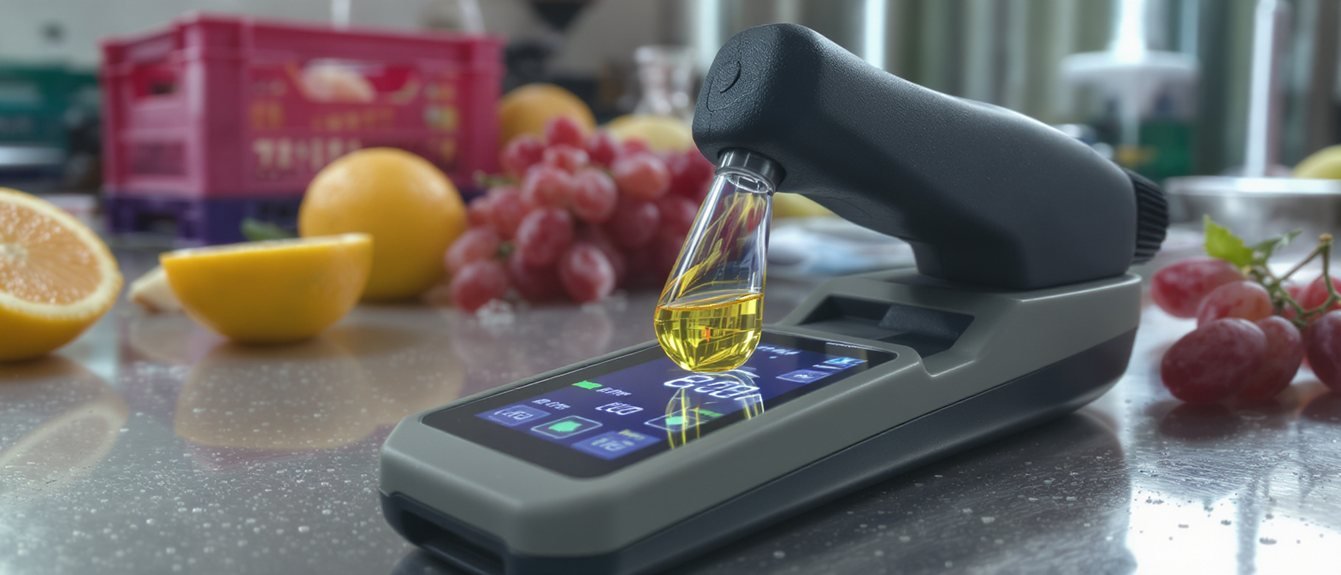
Grab a refractometer—the industry standard for Brix measurement—and you’re holding what amounts to a tiny prism that bends light through your microgreen juice sample.
A refractometer is essentially a compact prism that measures sugar by bending light through your plant juice sample.
Handheld refractometers deliver quick readings without batteries, making them perfect for growers who value simplicity and independence from power sources.
Digital refractometers offer precision with automated temperature compensation (critical because heat skews results), though they’ll cost you more upfront.
Both types require just a drop of pressed plant juice.
Calibrate weekly using distilled water, wipe the prism clean between samples, and you’ll track sugar content patterns that reveal exactly when your crops hit peak flavor.
Factors That Influence Brix Readings in Plants
Although you’ve excelled at the mechanics of Brix measurement, your readings won’t mean much unless you understand what’s actually driving those numbers up or down in your microgreens. Water stress—whether too little or excessive—directly impacts sugar concentration, since moisture dilutes or concentrates dissolved solids.
Leaf age matters significantly: younger leaves typically show lower Brix levels than mature ones, as photosynthetic activity increases over time. Light intensity, nutrient availability, and temperature fluctuations all play roles in determining final readings. You’re essentially tracking your plants’ metabolic state—their ability to convert environmental inputs into measurable sweetness and nutritional density.
Optimizing Growing Conditions for Higher Brix Values
Maximizing Brix values in your microgreens starts with understanding that you’re not just feeding plants—you’re orchestrating a metabolic symphony where every environmental input either strengthens or undermines sugar production. Light intensity directly drives photosynthesis (your sugar factory), while proper harvest timing captures peak accumulation—typically when cotyledons fully expand but before true leaves dominate resource allocation.
Foliar feeding with kelp or mineral solutions bypasses root limitations, delivering nutrients straight to photosynthetic tissue. Temperature management matters too: moderate stress triggers protective sugar compounds without stunting growth, giving you sweeter crops and complete autonomy over your cultivation outcomes.
The Relationship Between Brix and Nutritional Quality
While higher Brix readings signal increased sugar content, they’re simultaneously documenting a broader spectrum of dissolved solids—minerals, amino acids, vitamins, and phytonutrients—that travel together through a plant’s vascular system.
You’re essentially getting a snapshot of nutritional density, which directly influences consumer perception of flavor and quality. This correlation has pushed breeding programs to select varieties that naturally concentrate these beneficial compounds.
When you measure 12° Brix versus 8° Brix in identical microgreen varieties, you’re not just tasting sweeter greens—you’re experiencing plants that’ve efficiently mineralized nutrients into bioavailable forms your body actually recognizes and employs.
Related Questions
Can Brix Levels Be Measured in Dried or Frozen Microgreens?
You can’t accurately measure Brix levels in dried or frozen microgreens because dry preservation causes sugar crystallization, while frozen storage leads to cellular rupture. These processes alter the plant’s liquid content, making reliable refractometer readings impossible for you.
How Does Brix Measurement Compare to Laboratory Nutritional Analysis Costs?
You’ll find Brix measurement dramatically cheaper than lab analysis, costing just dollars versus hundreds per sample. The cost comparison favors Brix since you’ll avoid sampling logistics hassles like shipping fresh samples and waiting weeks for results.
Do Different Microgreen Varieties Require Different Target Brix Ranges?
Yes, you’ll find that different microgreen varieties have unique varietal targets for optimal Brix levels. Understanding cultivar specifics lets you customize your growing approach, giving you the freedom to maximize each variety’s flavor and nutritional potential independently.
Can Consumers Measure Brix at Home Before Purchasing Microgreens?
You can’t measure Brix before purchasing, but you’re free to evaluate microgreens through taste testing and color grading. These hands-on methods let you independently assess quality and freshness without relying on specialized equipment or vendor claims.
How Quickly Do Brix Levels Change After Harvesting Microgreens?
Brix levels drop rapidly after harvest as respiration rate accelerates sugar drift. You’ll notice decline within hours due to postharvest physiology. Perfect harvest timing matters—consume your microgreens fresh to capture peak sweetness and nutritional freedom from degradation.
Wrap-up
You’ve now got the knowledge to raise your microgreens through Brix measurement—a straightforward process that’ll transform how you grow. By tracking sugar content, adjusting your environmental controls, and maintaining optimal conditions (light, temperature, and nutrients), you’ll consistently produce microgreens with superior flavor and nutrition. Start measuring today, make incremental improvements based on your readings, and you’ll soon grow microgreens that outperform anything you’ve grown before.