
Microgreens World
Your weekly source for microgreens science, business & growing news
Policy
A State Government Just Put Microgreens in Its Budget. That Has Never Happened Before.
On Thursday, August 6, the government of Tamil Nadu, home of one of the leading universities in microgreens research, presented its 2026 Agriculture Budget in the state Assembly and announced something no government has done at this scale: a dedicated Tamil Nadu Micro Greens Scheme. Officials described it as a first-of-its-kind programme built to popularise microgreens at the household level. Not as a garnish. As nutrition policy.
The scheme sits inside a broader push called Vetri Illatharasi Veetu Thottam, a home garden initiative aimed at household nutrition and chemical-free food production. Agriculture and Farmers’ Welfare Minister Vinoth presented both programmes as part of a package that also includes a Rs 600 crore Soil Fertility Mission to restore farmland health, and a five-year mission targeting self-sufficiency in pulses and oilseeds. Microgreens were not a footnote in that package. They got their own line.
A second initiative widened the reach. The Vetri Vaanmagal Scheme, a women-focused programme better known for training a new cadre of drone operators, also carries a household microgreens component, with the budget explicitly citing nutrient-rich microgreens grown at the household level. Fifty small-scale units were proposed alongside it. Put together, the state is treating a tray of seedlings on a windowsill as a piece of public health infrastructure.
Why this matters outside India: every grower who has ever tried to explain microgreens to a skeptical buyer has been fighting the perception that these are a restaurant flourish. A state agriculture budget line changes that argument. It moves microgreens from chef’s trim into the same conversation as pulses, oilseeds and soil health. When a government of roughly 76 million people writes microgreens into its nutrition strategy, the crop stops being a novelty and starts being a category.
Watch what follows. Programmes like this create demand for seed, trays, growing media and, crucially, training. They also create a benchmark. If Tamil Nadu can show household-level adoption and measurable nutrition outcomes, other states and other countries will copy the template. Growers in North America and Europe should be paying attention, not because the subsidy reaches them, but because the story does. The next time you tell a buyer microgreens are a serious nutrition crop, you have a government budget to point at.
DT Next · dtnext.in · August 6, 2026
Postharvest
Blue Laser Light Before Harvest Deepens Red Amaranth Colour and Extends Shelf Life
Researchers exposed red amaranth microgreens to blue diode laser irradiation at 450 nm for three hours before harvest, then tracked what happened in storage. Betalain biosynthesis went up, antioxidant responses strengthened, and postharvest quality held longer. Light-based treatments have been getting attention as a chemical-free way to hold quality in leafy crops, and this is one of the cleaner demonstrations. For growers, the practical read is that the last few hours before cutting may matter more than anyone assumed.
Postharvest Biology and Technology · sciencedirect.com · August 1, 2026
Food Safety
Auburn Thesis Ties Fertigation Choices to Both Antioxidants and Salmonella Survival
Nazneen Begum’s 2026 Auburn University research looked at how fertigation practice shapes postharvest quality and microbial safety across microgreen species. Species and fertilizer treatment both significantly influenced growth. In beet microgreens, anthocyanins, phenolics and antioxidant activity rose by 8 percent and 14 percent depending on the measure. The study also tracked Salmonella enterica survival, which is the part every commercial grower should read twice. Your nutrient program is also a food safety decision.
Auburn University · etd.auburn.edu · August 3, 2026
Lighting
New Review Maps LED Effects on Microgreens From Molecule to Market
Sobhanan, Meena, Prajapati, Kumar and colleagues published a review in the International Journal of Vegetable Science pulling together what is known about LED-mediated modulation of growth and phytochemicals in vegetable microgreens. The framing is deliberate: microgreens suit sustainable intensification because of their short cycle and small footprint, and light is the cheapest lever a grower has to change what ends up in the tray. If you have been guessing at spectrum, this is the current map.
International Journal of Vegetable Science · tandfonline.com · August 1, 2026
Crop Trials
Cabbage Microgreens Tested Head to Head Under Different LED Spectra
An Indonesian team led by R. A. Laksono evaluated growth rate and chlorophyll content in cabbage microgreens under varying LED light spectra, publishing through the Gunung Djati Conference Series. The authors frame microgreens as high-value horticultural commodities whose demand keeps climbing on the strength of nutrient density and a short harvest window, with lighting the critical variable in cultivation. Species-specific spectrum data like this is exactly what small growers lack when they buy fixtures.
Gunung Djati Conference Series · conferences.uinsgd.ac.id · August 3, 2026
Nutrition
Mung Bean at Three Stages: Grain, Sprout and Microgreen Compared Directly
Herath, Gamage and Dissanayaka ran a comparative analysis of nutritional and functional properties across mung bean grains, sprouts and microgreens. The motivation is blunt. Malnutrition remains a major concern in developing regions, and interest in nutrient-dense, ready-to-eat functional foods keeps rising. Studies that hold one species constant and vary only the growth stage are rare and useful, because they answer the question buyers actually ask: is the microgreen version worth the extra cost?
CABI Digital Library · cabidigitallibrary.org · August 3, 2026
Growing Media
Pine Nut Shell Biochar Tested as a Peat Replacement for Arugula
Ponomarev and colleagues, writing in the Journal of Plant Nutrition and Soil Science, evaluated how biochar activation state, particle size and dose change peat substrate properties and arugula microgreen performance. Peat-reducing components are needed across horticulture, but the combined effect of those three variables had not been resolved. If you are hunting for a substrate that lowers peat use without costing you yield, this is the first study to separate the variables cleanly.
Journal of Plant Nutrition and Soil Science · onlinelibrary.wiley.com · August 1, 2026
Vertical Farming
80 Acres Farms Announces Closure of Its Hamilton, Ohio Operation
80 Acres Farms confirmed it is closing its Hamilton facility. The company, founded in Cincinnati in 2015 by veteran food industry executives, produces salad kits, blends and microgreens and had been one of the more visible names in American vertical farming. Another indoor operation winding down a site is a sobering data point for anyone modelling a scale-up. Capital-heavy indoor produce keeps proving that growing the crop was never the hard part. Selling it profitably is.
Journal-News · journal-news.com · August 4, 2026
Grower Profile
Wisconsin Farmer Narrowed His Whole Business Down to Microgreens and It Worked
Casey Buhr runs Folkvangr Farms in Algoma, Wisconsin. He started with a broader produce operation, then pivoted hard into microgreens and found his market with high-end restaurants and retail stores. The Green Bay Press-Gazette piece is a straightforward account of focus beating breadth. Buhr’s path is the one most successful small microgreen businesses actually take, and it rarely starts with a business plan built around microgreens from day one.
Green Bay Press-Gazette · greenbaypressgazette.com · August 1, 2026
Subscription Models
Hyderabad Startups Are Delivering 200 Boxes a Week on Subscription
The Hindu profiled a cluster of home growers and startups across Hyderabad, including Microgreens de Manikonda, which runs a subscription model delivering close to 200 boxes of broccoli, pink radish, sunflower, turnip and red cabbage. Shweta Darbarwar of ZeroHarm Sciences told the paper hygiene is the deciding factor in the category. Recurring revenue plus a hygiene story is a repeatable formula, and it travels well beyond India.
The Hindu · thehindu.com · August 5, 2026
Consumer Demand
In the Mojave, a Steel Rack Beats a Backyard Garden
Las Vegas Weekly walked through Lela Sherdon’s home microgreens setup, where heavy-duty steel wire racks hold trays of vegetable seedlings in a climate where a conventional backyard garden barely stands a chance. The piece makes the case that beginners can start with pea shoots, broccoli and radish without any particular skill. Stories like this quietly do more for retail demand in hot, dry markets than any trade advertising ever will.
Las Vegas Weekly · lasvegasweekly.com · August 6, 2026
Farmers Markets
National Farmers Market Week Arrives With Markets Booming and Rules Misunderstood
Coverage ran all week. Connecticut officials urged residents to buy local for Farmers’ Market Week, the 18th America’s Farmers Market Celebration opened with prizes, and West Virginia markets reported adding vendors and activities. Running alongside the celebration was a more useful thread: shoppers, and plenty of vendors, do not know which market rules are actually law and which are simply habit. Worth a read before your next market day.
CBS19 News · cbs19news.com · July 31, 2026
Market Access
Federal SNAP Cuts Hit Hawaiʻi Outlets and the Farmers Who Supply Them
Civil Beat reported that federal moves abruptly cut a set of Hawaiʻi markets from the food stamps programme. The immediate effect falls on customers who use SNAP and now have less access to fresh food. The second-order effect lands on growers: those stores can no longer buy as much product from the local farms that supply them. If a meaningful share of your revenue passes through nutrition benefit programmes, this is your warning to diversify channels.
Civil Beat · civilbeat.org · July 31, 2026
Audit Your Nutrient Program
The Auburn fertigation work links fertilizer choice to both antioxidant levels and Salmonella survival. Write down exactly what you feed, at what rate, on which species. You cannot troubleshoot a food safety issue you never documented.
Test One Spectrum Change
Two studies this week point at lighting as the cheapest quality lever you have. Pick one crop, run a single tray under a different spectrum, and weigh the result. One variable, one tray, real numbers.
Price Your Colour
Blue laser light raised betalains in red amaranth. Colour intensity is what chefs pay for. Before you chase the technology, confirm your buyers will actually pay a premium for a deeper red.
Trial a Peat Reduction
The biochar substrate study gives you a starting point for cutting peat without gambling your yield. Start at a low dose on arugula only, and keep an untreated control tray beside it.
Check Your Channel Risk
The Hawaiʻi SNAP cuts show how fast a sales channel can vanish. Tally what share of your revenue depends on any single programme, store or restaurant group, then start building the next one.
Learn Your Market Rules
Reporting this week found that much of what feels like farmers market etiquette is actually law, and much of what is enforced is just habit. Ask your market manager for the written rules before Saturday.
Aug 1–9
National Farmers Market Week · Peak visibility window for direct sales, with celebration events running in multiple states.
Sept 1
Brattleboro Winter Farmers Market · Vendor application deadline for new vendors, 2026–27 season.
Approaching
NY Tariff Relief Program · Governor Hochul reminded New York farmers and producers of the deadline to apply for the $30 million programme.
Now Open
Cool-Season Sowing Window · Radish, cress, mizuna, pak choi, mustard, rocket, kale blend and sunflower head a current grower shortlist.
Aug 8
New Restaurant Openings · Chef-driven openings continue to plate micro greens and edible flowers. Good week to walk in a sample tray.
Ongoing
Tamil Nadu Micro Greens Scheme · Rollout begins under the 2026 state Agriculture Budget. Watch for implementation detail and seed demand.
The best week of the year to show up
The Montclair market runs more than 40 vendors now, spread across two parking lots on either side of the train tracks. It grew into that.
Markets had a week. Connecticut officials urged residents to buy local. The American Farmland Trust opened its 18th America’s Farmers Market Celebration. Gaston County, North Carolina invited everyone out for tomato season, and West Virginia reported markets adding vendors and shoppers.
Here is the part worth knowing before Saturday. A surprising amount of what feels like market etiquette is actually law, and plenty of vendors do not know which rules are real. Ask your market manager for the written list.
Go early for the best selection, or late when vendors clear the table. Either way, the person who grew your food is standing right there. That is the whole point of the place.
Selling at one is harder than growing for one. Two writers published market post-mortems this week, including one titled “I was a farmers market failure.” If you have a table this Saturday, go watch how the busy ones work.
One market this week sold fresh microgreens beside seeds, grow kits and supplies. Take home dinner and the means to grow your own.
One more thing. Federal cuts pulled some Hawaiʻi outlets out of the food stamps program, and the farms supplying them lost sales. Markets taking benefit programs have earned your business.
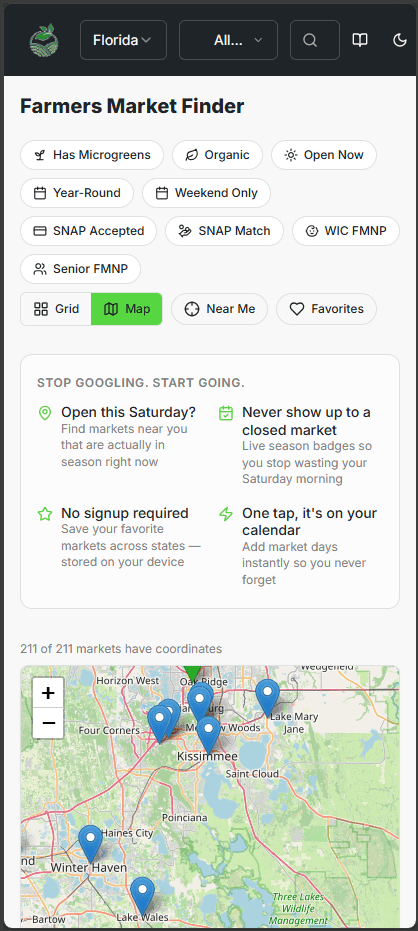
Find yours. The Market Finder maps markets near you and flags the ones carrying microgreens. No signup, no account. Pick one and go.
 Find My Local Markets
Works on your phone
Not on the list yet?
Every week I round up the best microgreens news, growing tips, and research — straight to your inbox. No fluff. Just the good stuff.
Sign Me Up for the Digest
