
Microgreens World
Your weekly source for microgreens science, business & growing news
Industry
GoodLeaf Farms Says All Three Canadian Vertical Farms Have Reached Profitability
For most of the last decade, the vertical farming story has been a story about money going out. Companies raised, built, scaled, and then quietly closed. So when a grower says the opposite out loud, it is worth stopping on. GoodLeaf Farms told Retail Insider this week that all three of its Canadian vertical farms have reached profitability, and that revenue has grown another 31 percent in 2026 on the back of rising demand for its baby greens, microgreens and salad blends.
The number that matters there is not really the 31 percent. It is the word “all three.” Single-site profitability has happened before in controlled environment agriculture, usually at a flagship facility that gets the best equipment, the best staff, and the most forgiving accounting. Repeating it across a whole network is a different proposition, because it means the unit economics survived being copied.
That is the test almost every failed vertical farm did not pass. One caveat belongs right next to it, though. McCain Foods is GoodLeaf’s single largest shareholder at more than $65 million, and it led a $150 million raise alongside Power Sustainable Lios. Strategic corporate money runs on a longer clock than a venture fund does, so surviving the climb to scale is partly a question of who is funding the climb.
GoodLeaf describes itself as Canada’s largest and only national microgreens producer, and as a global leader in microgreens innovation. Set aside the marketing language for a second and there is a real structural point underneath it. A national footprint means shorter runs to each retail distribution centre, and shorter runs mean less shrink on a product whose entire value proposition is freshness. Microgreens punish distance harder than almost anything else in the produce aisle. Building close to the customer is not a nice-to-have. It is the model.
One line in the coverage deserves a caution flag, though, and small growers should read it carefully before borrowing it. The company says its microgreens contain up to 166 times more nutrients than mature greens. Multiples like that get repeated on stall signs and websites within days, and they are almost always doing quiet work in the phrase “up to.” That figure typically describes a single compound, in a single variety, measured per gram of dry weight, against one particular mature counterpart. It is not a claim about the tray in front of your customer.
So take the profitability news for what it is: evidence that a microgreens-led business can carry real infrastructure costs and still come out ahead, which is genuinely good news for everyone selling this crop. Take the nutrient multiple as a reminder that the marketing gets ahead of the science whenever the science is inconvenient to summarise. You can be delighted by the first and skeptical of the second in the same week. In fact, you probably should be.
Retail Insider · retail-insider.com · 19 August 2026
Crop Inputs
How You Apply a Biostimulant Changes the Result, Not Just Which One You Use
A team led by Beppe Benedetto Consentino tested non-microbial biostimulants on pea and arugula microgreens in Frontiers in Plant Science, and varied the application method as well as the product. Yield, antioxidant activity and nutritional value all shifted with the method. That is a useful finding for anyone who has bought a bottle, followed the label, and seen nothing. The product may have been fine. The delivery may not have been.
Frontiers in Plant Science · frontiersin.org · 16 August 2026
Nutrition
Sunflower Microgreens Profiled at Household Scale for Minerals and Antioxidants
A study in the International Journal for Multidisciplinary Research evaluated sunflower microgreens grown at household scale, measuring proximate composition, mineral profile, antioxidant constituents and antioxidant activity. Sunflower is the workhorse of most trays and the crop least often measured properly, so a dedicated profile is welcome. It also puts numbers behind the kitchen-counter setup rather than the research greenhouse.
Int. Journal for Multidisciplinary Research · ijfmr.com · 15 August 2026
Postharvest
UV-B and PAR Light After Harvest Move Flavonoids Differently in Broccoli and Red Cabbage
Liu, Ji, Pöhnl and Neugart report in Postharvest Biology and Technology that UV-B and PAR radiation during storage drive flavonoid metabolism in ways that depend on the species. Brassicas lose market value fast in storage through weight loss, yellowing and nutrient decline. If light during storage can be tuned per crop rather than applied uniformly, that is a lever most small growers have never touched.
Postharvest Biology and Technology · sciencedirect.com · 16 August 2026
Phytochemistry
Doctoral Work Screens Brassica Microgreens for Polyphenols and Flavonoid Content
Ida Paolillo’s doctoral thesis on bioactivity screening of natural compounds includes Brassica microgreens grown fifteen days in a controlled growth chamber, with antioxidant capacity, total polyphenols and total flavonoids measured in the extracts. The framing is pharmaceutical and nutri-cosmetic rather than culinary, which is a reminder that the buyer for this crop is not always a chef.
University of Naples Federico II · fedoa.unina.it · 16 August 2026
Microbiology
Root Bacteria From Brassicas Screened for Antidiabetic Activity
Kusmiati and colleagues, writing in the Journal of Genetic Engineering and Biotechnology, evaluated exopolysaccharides produced by endophytic bacteria living in Brassicaceae roots, testing whether they inhibit carbohydrate-hydrolyzing enzymes. It is early-stage in silico and in vitro work, not a health claim. But it points at the root zone of your brassica trays as a place where something interesting is happening.
J. Genetic Engineering & Biotechnology · sciencedirect.com · 14 August 2026
Market Research
Thesis Measures What Shoppers Will Actually Pay for Added Vitamin C
Carlos A. T. Toca’s 2026 work examines consumer demand for lettuce biofortified with vitamin C, framed against micronutrient deficiency, or “hidden hunger,” in the United States and globally. Microgreens are sold on almost exactly this premise. Any hard data on whether shoppers will pay a premium for a nutrient message, rather than just nod at it, is worth a grower’s attention.
ProQuest Dissertations · proquest.com · 18 August 2026
Grower Profile
A Montana Couple Turned a Home Experiment Into Canyon Roots Company
Jordan and Megan started growing microgreens at home in Cascade, Montana, largely to see whether they could. That experiment is now Canyon Roots Company, selling at farmers markets in Great Falls and around the region. It is the most common origin story in this industry and still the most instructive one: nobody set out to build a microgreens business. They set out to grow a tray.
KTVQ Montana Ag Network · ktvq.com · 20 August 2026
Market Channels
Vermont Farmers Markets Cannot Recruit Enough Farm Vendors
Valley News reports that Vermont markets are struggling to attract farm vendors, with average agricultural sales at those markets down nearly 60 per cent between 2022 and 2025. Read that as a warning and an opening at once. Foot traffic that no longer converts is a problem for the market. A stall nobody else wants, at a market with a captive audience, is an opening for a grower with a high-margin crop.
Valley News · vnews.com · 15 August 2026
Market Rules
A Producers-Only Market in New Orleans Is Being Asked to Prove the Rule Still Holds
Verite News followed up on a March complaint in which Crescent City Farmers Market vendors accused a large new vendor of selling food it did not produce. Producers-only rules are the whole reason a grower can charge market prices instead of wholesale ones. When enforcement gets soft, the premium goes with it. Worth knowing exactly how your own market handles a challenge like this before you need to raise one.
Verite News New Orleans · veritenews.org · 20 August 2026
Fraud Alert
Georgia Warns Vendors That an Advertised Atlanta Market Event Is Not Real
Agriculture Commissioner Tyler Harper pointed to Facebook posts promoting a “2026 GATE Atlanta Vendor & Artisan Market” at the Atlanta State Farmers Market, and the state issued a warning that the event is fake. Vendor fee scams follow the same script everywhere: a real venue name, a plausible date, and a payment link. Confirm any new event directly with the venue before sending money.
11Alive · 11alive.com · 20 August 2026
Global
A Cebu Agritech Startup Is Wiring Growers Directly Into Buyers
Vertical Farm Daily reports that ARKA, working under a Philippine DOST research grant, supplies the NAMA farmer group with microgreens technology and training while also opening marketing channels for the harvest. The second half is the part most training programmes skip. Teaching someone to grow a crop they then cannot sell is not a business model, it is a hobby subsidy.
Vertical Farm Daily · verticalfarmdaily.com · 19 August 2026
Demand
Hyderabad’s Home Growers Have Turned Into a Startup Market
What began for many households as lockdown-era chemical-free growing has become a steady trend across Hyderabad, with home growers and small startups both expanding, according to Vertical Farm Daily. Five years of building awareness is the pattern worth noting. Microgreens demand does not arrive from advertising. It arrives when enough people have grown a tray themselves and understood what they were eating.
Vertical Farm Daily · verticalfarmdaily.com · 14 August 2026
Community
A Fifth Grader in Kerala Is Growing Microgreens for 480 Schoolmates
S. Sidhivinayak, a Class 5 student at Joseph UP School and an Ujjwala Balyam Award recipient, took a small home growing experiment and turned it into a supply of fresh produce for his school’s midday meals, feeding 480 classmates. He also wants to plant his own forest. Every grower reading this had a version of that first tray. Most were considerably older.
Onmanorama · onmanorama.com · 18 August 2026
Payments
Iowa City Retires Its $5 Market Token While Keeping EBT and Double Up
The Iowa City Farmers Market will discontinue its red $5 token programme beginning in September, while EBT and Double Up Food Bucks continue. If you sell at a market with a token system, this is your prompt to check what is changing locally before the September markets open. Payment friction at the stall costs more sales than most vendors ever measure.
City of Iowa City · icgov.org · 17 August 2026
Audit Your Nutrient Claims
Go through your stall signage, website and labels this weekend and find every nutrient multiple you have written. If you cannot name the compound, the variety and the study behind it, take the number down and describe the crop instead.
Change the Method, Not the Bottle
Before you replace a biostimulant that underperformed, try changing how you apply it. The pea and arugula work found application method shifted yield and antioxidant results. Run one tray each way and record the difference.
Look at Your Storage Light
Most growers treat postharvest storage as a dark box. The broccoli and red cabbage work suggests light during storage acts differently on different species. Note what light your cooler actually gets, then test one brassica crop against it.
Read Your Market’s Producers-Only Rule
Pull up your market’s vendor agreement and find the resale clause and the complaint process. Know both before you need them. A producers-only rule that nobody enforces is what erodes your price, quietly, over a season.
Verify Any New Market Event
Georgia had to publicly disown a fake vendor event this week. Before paying a stall fee for an unfamiliar market, call the venue directly using a number you found yourself, not one from the listing or the organiser.
Check Your Token and EBT Setup
Iowa City is retiring one token programme while keeping EBT and Double Up. Ask your own market manager what changes for September, and make sure you can still take every payment type your regulars use.
Now Open
Claremont Harvest Market Days · Claremont, New Hampshire is recruiting farmers and prepared-food vendors now.
Now Open
ISU Local Food Festival 2026 · Vendor and sponsor slots available for the Iowa State market-style festival.
September
Iowa City token change · Red $5 tokens end; EBT and Double Up Food Bucks continue as normal.
September 10
Rodent control webinar · Food Safety Magazine session on prevention measures for food facilities.
December 13
Holiday Farmers Market, Howell NJ · Vendor applications open now for the December holiday market.
Ongoing
Cyclospora outbreak coverage · Consumer attention is shifting toward indoor-grown greens. Have your food safety answer ready.
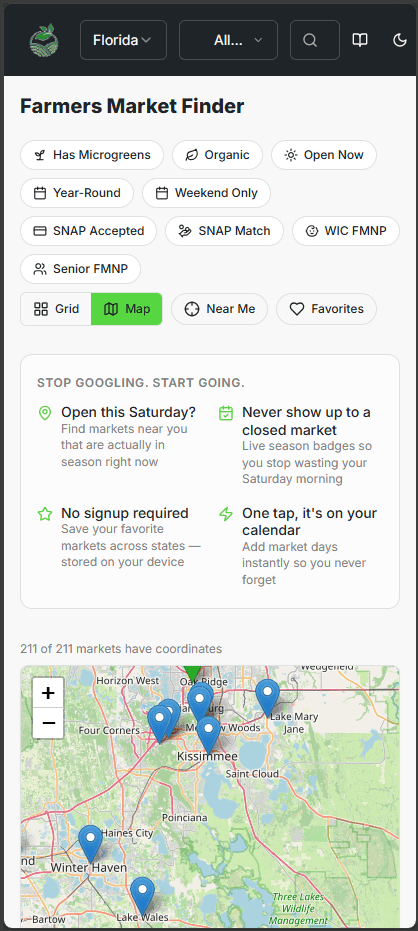
Find yours. The Market Finder maps markets near you and flags the ones carrying microgreens. No signup, no account. Pick one and go.
 Find My Local Markets
Works on your phone
Not on the list yet?
Every week I round up the best microgreens news, growing tips, and research — straight to your inbox. No fluff. Just the good stuff.
Sign Me Up for the Digest
