
Microgreens World
USDA Specialty Crop Money Lands on Three Hydroponic Microgreens Projects in Illinois, Kentucky and Mississippi
USDA put out its Specialty Crop Block Grant numbers on October 13: $86.6 million, about 609 projects, 56 states and territories. I read the press release twice. No microgreens. The seven example states run from Florida at over $4.3 million to Ohio at over $800,000, and the crops named are apples, blueberries, pecans, mushrooms and their cousins. So I opened the document the release points to. The Agricultural Marketing Service’s description of funded projects runs 118 pages, state by state, one paragraph per award. Microgreens show up three times.
Start with Illinois. The state Department of Agriculture is passing $50,000 to Southern Illinois University, which “will investigate the efficacy of a multi-hurdle food safety intervention strategy in hydroponic microgreen production systems.” In English? SIU will test several safety steps stacked on one crop. Results go out to Illinois growers as fact sheets, YouTube videos and demonstrations on campus, with a grower survey at the end. The document stops there. It never names the steps in the stack.
Kentucky is smaller and more hands-on. The state is passing $33,779 to 525 Kitchen, Inc. for “a compact hydroponic microgreens production model designed for beginning farmers, urban growers, and small-scale producers.” The money builds a 15-by-20 controlled-environment hoop structure. Inside it, 525 Kitchen will track production efficiency, food safety practices and what the document calls practical adoption strategies for year-round growing. Mississippi takes the long view. Its Department of Agriculture and Commerce is passing $57,211 to Mississippi State University and the Alliance of Sustainable Farms. They will use hydroponic microgreens “as a low-barrier model” to write controlled-environment protocols on nutrient management, climate control and soilless growing. The protocols then travel through a statewide peer-to-peer training network.
Add it up and you get $140,990. Inside $86.6 million, a rounding error. The size is not the story. Look at the job microgreens were handed in each state. Illinois treats the crop as a test bed for food safety. In Kentucky it is the starter crop for a brand-new grower. Mississippi wants it as a teaching crop, with methods meant to carry over to other specialty crops later. All three run hydroponic. Two of the three put food safety in scope, in the same week the FDA has two sprout outbreak investigations open, both traced back to seed lots. None of the three has a result yet. They are proposals with money attached.
My read: three state agencies decided this year that microgreens deserved public money, and the work they paid for is the hands-on kind. That matters more to you than the dollar figure. The document is public. Find your state’s section, read who won money and for what, then call your state department of agriculture. Ask when the next round opens. Ask whether a microgreens project would qualify. The press release skipped all of it. The list has it, and a phone call gets you the rest.
USDA · usda.gov · October 13, 2026 | USDA AMS, FY2026 Description of Funded Projects (PDF) · ams.usda.gov · Fiscal Year 2026
Selenium Pushed Mustard Microgreen Carotenes Up Fivefold Under One White LED and Cut Yield Under Another
Here is a study where the light bulb decided the result. A team at Lithuania’s Institute of Horticulture grew ‘Red Lace’ mustard microgreens hydroponically, with and without 2 mg per liter of selenium as sodium selenate. Three white LEDs: 3000, 3500 and 4000 K, all at 220 micromoles on an 18-hour day, harvest on day 10. Under 4000 K, selenium cut shoot fresh weight from 64.79 to 52.80 mg and nearly halved root fresh weight. Under 3500 K, biomass held. Shoot selenium came out highest there too. Summed alpha- and beta-carotene jumped from 0.33 to 1.83 mg per gram dry weight, measured phenolics rose about 26 per cent, and chlorogenic acid more than doubled. The antioxidant assays disagreed with each other: FRAP up at 3500 K, DPPH down, enzyme results scattered across the three lights. The authors float 3500 K plus selenium as a way to enrich shoots. They do not call it a yield setting. One cultivar, one dose, no dose curve, no absolute shoot selenium number in the text. Treat it as a lead. Published October 12 in Horticulturae.
Horticulturae · doi.org · October 12, 2026
Two-Season Mustard Trial Finds the Seed Density and Feed Strength That Worked in Spring, and a Winter Where Nothing Did
Four seed densities, four feed strengths, two seasons, one greenhouse in Porto Alegre, Brazil. Researchers at the Federal University of Rio Grande do Sul sowed mustard at 50, 100, 150 and 200 g per square meter and fed each density with solutions from plain water at 0.15 dS per meter up to 3.0. The trials ran through winter and spring of 2021. Winter failed outright. No combination reached commercial standard, and shoot fresh yield ran from 280 to 1,542 g per square meter. The authors point at low radiation and cold inside the structure. Spring was another crop entirely. Fresh yield hit about 4,000 g per square meter at the top density and strongest feed, and 2,301 g at 150 g of seed with a 2.0 dS per meter solution. Shoot height and the soluble solids index both climbed with density. Their spring recommendation: 2.0 dS per meter and at least 150 g of seed per square meter. Nobody tested supplemental light, so the paper stays silent on whether lamps would have saved winter. One more note. The data is from 2021 and the paper carries a collection date of October 5. Acta Scientiarum Agronomy, volume 48.
Acta Scientiarum Agronomy · doi.org · Vol. 48, 2026
Moderate Salt Raised Vitamin E and Phenolics in Quinoa Seedlings, and the Authors Call It a Candidate Microgreen
Quinoa as a microgreen? A Tunisian and Algerian team thinks so, with caveats. They germinated three quinoa seed lots, one ‘Regalona’ and two ‘Amarilla sacaca’, in 0, 300 and 500 mM sodium chloride and tracked growth and composition into early seedling stage. Salt slowed germination in every lot and the lots split hard. At 500 mM, radicle length dropped 83 per cent in the first lot, 38 in the second, 57 in the third. The moderate 300 mM dose did something else. Vitamin E rose 46 per cent in one lot and 21 in another. Total phenolics in the first lot rose 191 per cent over the unsalted control, with rutin up 174 per cent. Push to 500 mM and the gains reversed; vitamin E fell 60 to 82 per cent across lots. The authors label quinoa “a promising functional microgreen crop” and suggest a moderate salt soak as priming. Two cautions from the paper itself. They studied germinating seeds and seedlings, not a harvested tray. The two ‘Amarilla sacaca’ lots came from different fields, so some of the gap may be seed production rather than genetics. Published October 11 in Plants.
Plants · doi.org · October 11, 2026
How Investigators Tied 32 Illnesses to One Seed Lot, and What the Data Still Leaves Open
Growers keep asking me how an outbreak gets pinned on a seed lot. The broccoli sprout case shows the steps, and the CDC and FDA pages let you follow along. September 9: CDC counted 22 cases in four states. All 19 people interviewed had eaten sprouts, 17 of them broccoli sprouts. September 24: 32 cases in six states, 27 interviewed, 26 reporting sprouts or microgreens, 22 naming broccoli sprouts. Between those two dates the genetic testing widened from patient samples to food samples, and sprout samples from Washington State matched the outbreak strain. Then the FDA’s October 7 entry: a seed sample from the supplier matched too. My read: the seed match is the step that moves blame upstream, past the grower to the lot. Two limits, both from CDC. The real case count is likely higher, since many people recover without a test. Fresh cases can take three to four weeks to get linked. And neither page says how the seed got contaminated in the first place.
CDC · cdc.gov · Update of September 24, 2026 | FDA · fda.gov · Updated October 9, 2026
Two Sprout Outbreaks Are Open at the FDA, Each Tied to a Seed Lot, and Neither Supplier Has Been Named
Last week this page covered the broccoli seed recalls. Put the FDA’s two open sprout pages next to each other and a pattern shows. Two separate outbreaks, each traced to a named seed lot. Neither page names the supplier. The broccoli case stood at 32 illnesses in six states on October 9, three hospitalized, onsets July 7 to September 3. The lot is W4105. EAK Distribution recalled October 2, Eden Brothers October 7, and Gardeners Basics’ Waltham 29 sprouting seed sits on the list as well. The alfalfa case counted 76 illnesses in 16 states on October 1, six hospitalized, onsets May 31 to September 7. Its lot is SAL2-24JB. Berlin Seeds of Millersburg, Ohio recalled 950 pounds on September 23, sold since February 13. The lot code appears only on the 5- and 50-pound bags. The FDA says that supplier agreed to a recall on September 15 after not answering an August 31 recommendation. Food Safety News reported October 9 that the broccoli seed supplier is still unnamed. The alfalfa page tells growers holding the lot not to use or sell it. The broccoli page has no grower guidance at all. My read: write the lot code on every tray record. Today.
FDA · fda.gov · Updated October 9, 2026 | FDA · fda.gov · Updated October 1, 2026 | Food Safety News · foodsafetynews.com · October 9, 2026
Kochi Ex-Banker Reports ₹5 Lakh a Month From a Microgreens Business That Began in 80 Square Feet
Onmanorama profiles Ajay Gopinath, a former banker who runs Grow Greens in Kochi, Kerala. He first saw microgreens at a restaurant in Bengaluru, began small in 2017 to 2018, and spent about two years on research and market analysis before launching the brand. His first attempt, growing on tissue paper after online training, failed. A UK specialist then told him seed quality was critical, and he began buying premium seed from Bengaluru, Pune and Chhattisgarh, which the article credits for consistent yields. The first farm was a spare 80-square-foot room with two racks and a single tray. The business now grows radish, mustard and sunflower among more than 35 varieties, harvests about 5 kg a day, and is reported to sell through 140 retail outlets and branches. The ₹5 lakh monthly revenue is the company’s own figure and the article does not verify it. It gives no startup cost, price or margin. My arithmetic, if the 5 kg daily harvest and the revenue both hold over a 30-day month: about ₹3,300 per kilogram, a number the article never discusses.
Onmanorama · onmanorama.com · October 9, 2026
A Canberra Family Sells Every Egg Through an Unstaffed Farm Shop, and the Microgreens Went on the Same Shelf
Region Canberra visits Amberly Farm on Kambah Pool Road, where the Lilleyman family, new to farming in 2012, runs a self-service micro-market 100 meters from the farm gate. It began as a fridge at the gate in 2018 and became a shop in 2024. Restocked daily, open 7:30 am to 7:30 pm, 365 days a year. The shelves carry the family’s grass-fed Black Angus beef, pasture-raised eggs from a flock that grew from 500 hens to 5,000 across 100 acres, Ma’s Pantry preserves, produce from other regional businesses, and microgreens grown without sprays, mizuna and pea shoots among them, which Guy Lilleyman started in a heated tent during lockdown. The article gives no microgreens sales figures. The figure it does give is for eggs: Guy says 100 per cent are now sold through the micro-market, and “not having to sell them at wholesale prices has been a game-changer.” My read: the shop existed for beef and eggs first. Microgreens walked in as a third product onto a shelf with customers already standing in front of it. That is a cheaper start than building a sales channel for greens alone.
Region Canberra · region.com.au · October 11, 2026
Ohio Farm Sells Microgreens and Eggs on One Friday Delivery Route and at a Saturday Market
WTAP reports that Falling Rock Farm of Marietta, Ohio, run by Dakota and Mindy Walker, sells microgreens alongside eggs from its own chickens. The farm delivers every Friday to anyone interested and sells at the River City Farmers Market on Saturdays. A Walker is quoted calling broccoli the staple microgreen. The stated purpose of the business is to let customers know where their food comes from and what goes into their bodies. The piece leaves out prices, the delivery area, how ordering works and any order minimum, so you can’t judge the economics from it. Two sales channels are named, the Friday route and the Saturday stall, both direct to the customer. My read: the pairing gives a household two products for one weekly stop, which is a plain reason to keep a delivery day. It is the same eggs-plus-greens pairing the Canberra farm reached from the other direction. The article never touches seed sourcing. In a week of broccoli seed recalls, anyone growing broccoli microgreens has reason to keep lot codes on file, small farms included.
WTAP · wtap.com · October 11, 2026
An Ontario Market Moves Indoors This Saturday, and Its Manager Names the Microgreens Grower as a Winter Supplier
The North Bay Farmers’ Market in Ontario closed its outdoor season on Thanksgiving weekend with just under 100 vendors. Market manager Shannon Beaver told BayToday the summer brought “quite a few young farmers,” new to the industry or in their first or second year. The market does not pause. Its indoor season opens Saturday, October 17, on the lower level of the Kennedy building at 222 McIntyre Street West, 9 am to 1:30 pm, with about 35 to 40 vendors. Storage crops carry on for as long as they last. For fresh greens, Beaver named the growers who can produce through a northern Ontario winter: “Some of our farmers grow all year round, so our micro-greens farmer, our hydroponic greens growers, and anyone growing in a greenhouse will still have that for as long as they can.” The market draws from a 100-kilometer radius and is in its 26th year. The article names no grower and gives no sales figures. My read: once the field crops stop, a microgreens tray is one of the few local things left on the table. A market manager said so without being asked. If your market has an indoor season, that is your pitch.
BayToday · baytoday.ca · October 13, 2026
Two open FDA investigations come down to one question: can you show which seed lot went into which tray? The guide covers what GAP and FSMA each require, the records an inspector opens first, sanitation, seed handling and water, traceability for a one-person operation, and what to send a buyer who asks. Digital PDF.
Not ready to buy? The food safety hub answers the common buyer questions.
North Bay indoor market opens. Kennedy building, 222 McIntyre St. West, lower level, 9 am to 1:30 pm, about 35 to 40 vendors.
Riverton Saturday Farmers Market. Last market of 2026, at City Hall, 9 to 11 am.
Specialty Crop Block Grant project list. The FY2026 description of funded projects is on the Agricultural Marketing Service site, state by state.
Colorado intern grant applications close. Reimburses up to half of intern costs, capped at $5,000; indoor grower eligibility was unclear in the Oct 9 issue.
USDA SNAP retailer stocking standards take effect. Per the Oct 9 issue, most farms and markets qualifying on staple-food sales should see little change.
FDA sprout outbreak advisories. Both are listed as ongoing, and the FDA says it will update the broccoli page if more recalls follow.
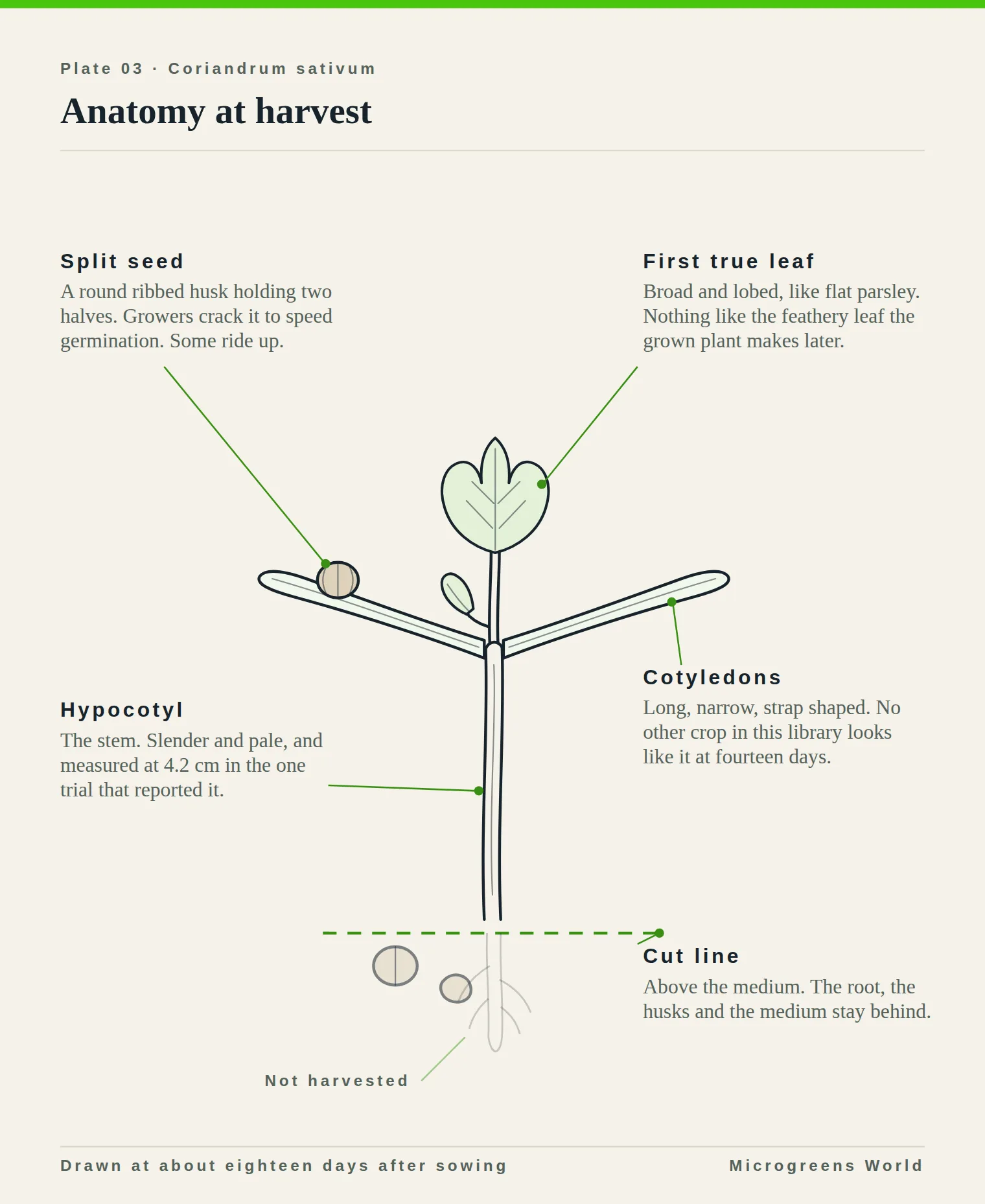
Fifty-four tasters rated twelve species side by side. Coriander took the joint highest score. It also finished twenty-first of twenty-five for vitamin C. Saying both halves out loud is what makes a buyer trust the first one.
Guide No. 05 gives you both halves, the six questions a buyer asks at a stall, and three printed sheets carrying your farm name.
Get my cilantro guideCommercial license $47. Personal edition $7. Every figure traced to a table in the source paper, and reissued when the research moves.
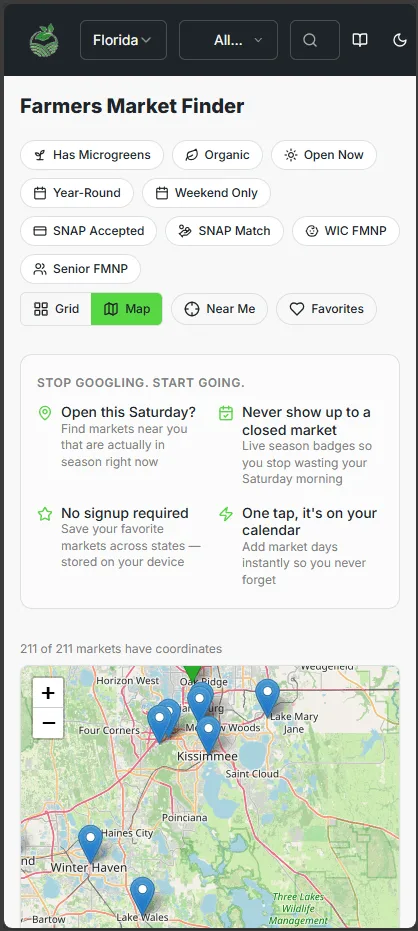
Find the markets near you that take SNAP, and the ones already carrying microgreens. The Market Finder maps them. No signup, no account. Pick one and go.
 Find My Local Markets
Every story is read at its source before it is written up. No daily emails and no sales sequences.
Get the Weekly Letter
