
Microgreens World
The weekly digest for growers, researchers and entrepreneurs
Industry & Business · Vertical Farming
All Three of GoodLeaf’s Farms Are Now Profitable. Its Chief Executive Names the Payroll Number That Sank the Americans.
Canada’s GoodLeaf Farms has reached profitability at all three of its facilities, in Ontario, Quebec and Alberta. Chief executive Andy O’Brien told Farmtario’s Jonah Grignon that the result is rare in controlled environment agriculture, and the piece sets it directly against the sector’s most recent casualty: 80 Acres Farms, which announced it was unable to continue business. Two companies growing similar crops under similar lights, and one of them is still here.
O’Brien’s explanation is about sequencing rather than technology. “Any startup, regardless of the sector, it’s a walk before you run, and I think a lot of companies started running, which means that you bring on a lot more cost before you have sales,” he said. Then the number that does the work in the whole interview: “Some of the companies that I’ve seen in the U.S. had 250 people in R and D, and that’s before you actually had sales. One other company in the U.S. had a payroll of 850 people and 20 million dollars in sales. Doesn’t work.”
The second half of his answer is how GoodLeaf runs the rooms. O’Brien, who previously worked at General Mills, Mars and Campbell’s, says the company treats its growing spaces more like food manufacturing plants than farms. “We’re looking at yields and waste and all things you would look at to optimize a typical factory.” He is blunt about what makes that hard: at a soup cannery there is a hundred-year playbook, and in vertical farming “there really isn’t.”
The timing figures are the part a small grower can actually use. O’Brien puts microgreens at roughly five to six days from sow to harvest and a head of indoor lettuce at fifteen, against fifty to sixty days outdoors, which in Canada buys two or three crops in a summer. That is the cycle-speed argument for microgreens stated by an operator running it at scale, and it is the same argument that makes a twenty-tray shelf in a garage viable. My read, not his: the rooms are different sizes but the arithmetic is the same one.
What the piece does not carry is a single financial figure. No revenue, no margin, no yield per square metre, no cost per tray, no headcount at any of the three sites, and no year in which any of them crossed over. O’Brien also credits a Canadian-brand tailwind from trade tensions with the United States, which is his claim about consumer behaviour rather than a measured one. Profitability here is a statement by the company about itself, and it is worth reading as exactly that.
Farmtario · farmtario.com · 11 September 2026
Yield · Vertical Farming
Seed Rate Beat Light Intensity in All Four Crops, and in Cabbage the Brightest Setting Cost Yield
A team at the Agronomic Institute in Campinas, Brazil, ran four separate trials, one per species, crossing four light intensities (50, 100, 150 and 200 µmol m⁻² s⁻¹) with three seeding densities. Ten-day cycles, 16-hour photoperiod, coconut fibre, sub-irrigated trays, three replicates.
Light moved fresh and dry mass in green cabbage only, peaking near 158 µmol at 3.8 kg m⁻². That is about a 10 per cent gain for a threefold increase in irradiance. Seeding density lifted fresh weight by 20 per cent in sunflower, 47 in radish, 51 in green cabbage and 32 in red cabbage.
More seed is not linearly better. Sunflower’s top density, 2,125 g m⁻², yielded 6 per cent less than 1,700, and red cabbage flattened between 180 and 235. Yield-to-seed conversion fell as density rose in every experiment. Crowding also cost quality: carotenoids down 13 to 44 per cent, anthocyanins down in three of four crops, chlorophyll a down 32 per cent in sunflower. Red cabbage was the exception, anthocyanins up 62 per cent. Potassium, calcium and magnesium fell in both cabbages.
The authors bound the finding to the range they tested, and note the light band was low by the standards of the wider literature.
Lima et al., Horticulturae · doi.org · Vol. 12, No. 9, 11 September 2026
Biofortification · Minerals
One Iron Source Raised Radish Iron 345 Per Cent. The Iron Oxide Nanoparticles Moved Nothing at All.
Penn State compared five iron sources at three rates in a greenhouse, fertigated into a tray reservoir, radish cut at day 7 and pea at day 10, three replicates against an untreated control.
Fe-EDTA won on both crops. Radish tissue iron reached 305 mg kg⁻¹ dry weight against a control of 92, a 345 per cent rise at 45 mg Fe L⁻¹; pea reached 289 against 112. On the authors’ own serving arithmetic, 50 g of that radish supplies 19.3 per cent of an adult male’s iron RDA and 8.6 per cent of an adult female’s, with pea at 22.9 and 10.2.
Iron oxide nanoparticles produced no enrichment in either crop. The authors put that down to the particles staying in suspension in a shallow reservoir with no circulation, and call it a limitation of the system rather than a verdict on nanoparticles.
The costs are worth as much as the gains. Ferric and ferrous sulfate cut tissue calcium by up to 43 per cent in radish and 62 per cent in pea. Both chelates reduced total phenols and antioxidant activity in pea. Fe-EDTA radish leaves showed necrotic spotting. Fe-EDDHA raised radish sodium roughly elevenfold, to 4,069 mg kg⁻¹. Iron bioavailability was not tested.
Ravichandran & Di Gioia, Biological Trace Element Research · doi.org · 12 September 2026
Farmers Markets · Enforcement
Vendors Were Trading in the Car Park by Saturday After a Fire Order Closed an Ontario Weekend Market
Trails End Market at 4370 Dundas Street in Thorndale, Ontario, trades every Saturday and Sunday with food, furniture and collectible vendors. On 8 September the Thames Centre Fire Department served an Order to Close on the building. Inspection Orders TC-26-007 and TC-26-008 were issued under section 21 of the Fire Protection and Prevention Act, 1997, reviewed and approved by the Office of the Fire Marshal, and posted at the premises. The building stays shut until the corrective actions are satisfied and a follow-up inspection authorises reoccupancy.
The department’s own release carries the hardest line in the story. A serious fire destroyed the previous building on that site, then the London Sales Arena, in 1993, and the department states the current structures “exhibit many of the same issues identified” then.
Inside this week’s window, two things changed. Vendors moved the market outdoors on Saturday 12 September, and CTV London’s Sean Irvine interviewed a vendor who has pulled his business out entirely, saying he did not know whether he would be locked out, fined, or the place would burn down.
Nobody has published the contents of the two orders, the vendor count, the remediation cost or timeline, or any response from the market’s ownership.
CTV News London · ctvnews.ca · 11 September 2026 | Municipality of Thames Centre · thamescentre.on.ca · 8 September 2026
Facilities · Minnesota
A $13.6 Million Indoor Farm Is Headed for Mankato, and One Outlet Has the Whole Story
Red River Farm Network reports that Verdant AgriTech will build a $13.6 million indoor farm in the Mankato, Minnesota area, growing organic microgreens and blue oyster mushrooms year-round on a site larger than a football field, aimed at the restaurant business. Construction could begin late this year or early in 2027.
That is the entire item. It runs about four sentences, carries no byline, quotes nobody, names nobody, and credits no originating outlet. We searched the Mankato Free Press, KEYC and the vertical farming trade press and found no other coverage.
What is missing is most of what a grower would want. No square footage, and no indication whether the football-field comparison is the building or the site. No headcount. No breakdown of where the $13.6 million comes from. No address, no permit or council record, no production volume, no varieties, no growing system, no named buyers, no organic certification status, no first-harvest date, and no energy or water figures.
None of that makes the project doubtful. It makes every number in circulation single-sourced and unattributed, which is a different thing, and worth remembering if it turns up in a market-size chart next quarter.
Red River Farm Network · rrfn.com · 17 September 2026
Product Announcement · Supplements
A New Microgreens Powder Names Five Species on the Label and No Amount for Any of Them
A customer who buys your trays asks whether a scoop of powder does the same job. That answer needs a number, and this launch has none.
Keystone NeoGreens of Hyderabad announced Daily Greens on 17 September through PRNewswire. PTI, which carried it, states it takes no editorial responsibility for the content. The blend names alfalfa, kale, broccoli, coriander and sunflower, then eight further ingredient categories with no species or quantities. ₹999 for a ten-day pack, ₹2,499 for a thirty-day pouch. Amarnath J is named chief executive, Dinesh Chanchala co-founder and chief operating officer.
The gaps are ordinary for a launch and worth listing anyway. No scoop weight, no nutrition panel, no amount for any of the five species and none for any vitamin or mineral, despite both being listed as ingredients. Batch testing for heavy metals and microbial safety is described, but no laboratory is named and the reports are promised for a future website posting. Science-backed, focus, sustained energy, gut health, immunity and detox all appear with nothing cited behind them.
To its credit the release makes no multiplier claim at all, which is rarer here than it ought to be. The four questions for any supplier: grams of each species per scoop, the assay behind that figure, the laboratory name and batch, and how the powder measures against a fresh tray.
PRNewswire via PTI, The Wire · thewire.in · 17 September 2026
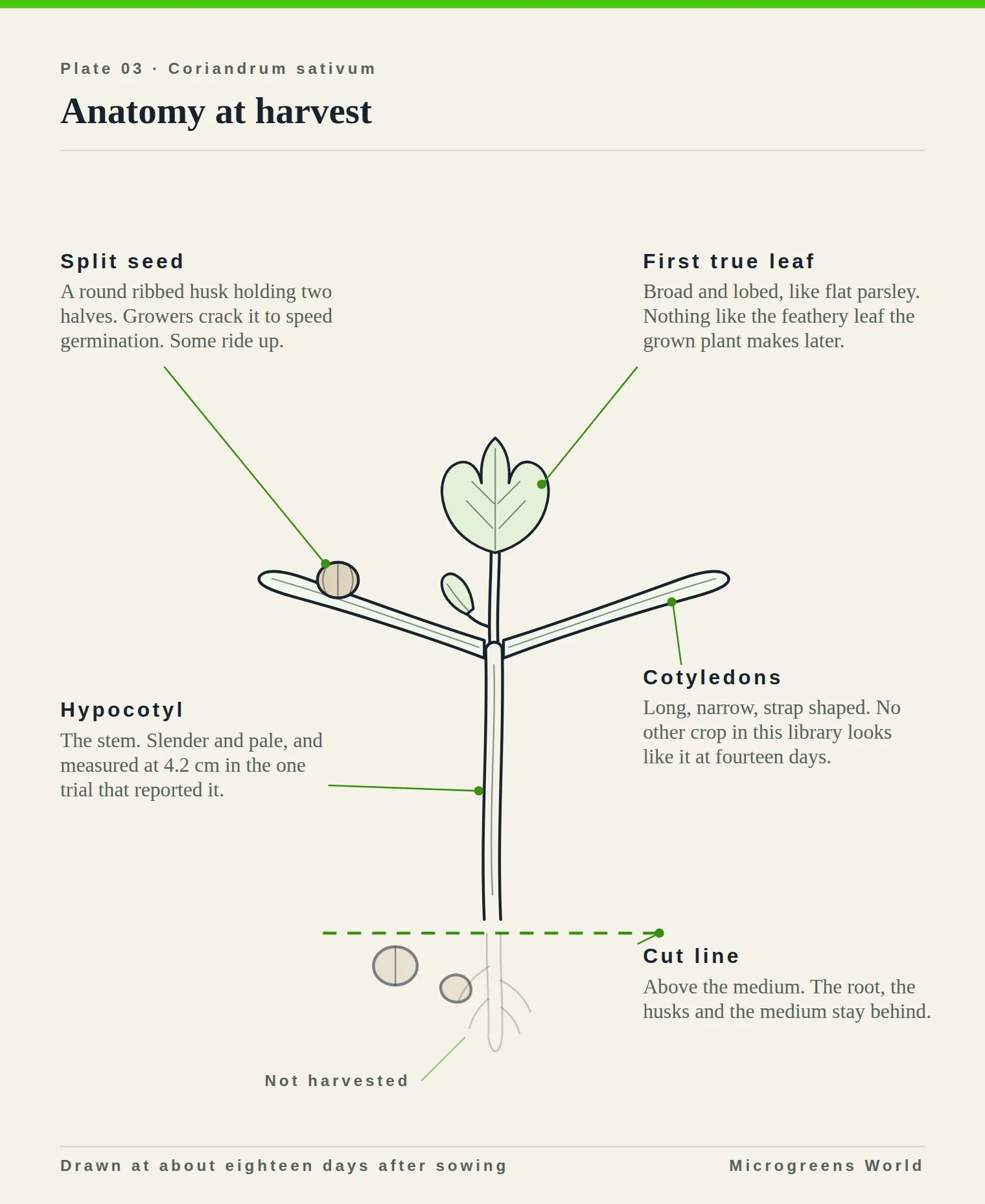
Cilantro won the taste panel. We printed the part it lost.
A customer picks up your punnet, checks the price, and asks what makes it worth seven dollars. You get about three seconds.
Fifty-four tasters rated twelve species side by side. Coriander took the joint highest score and the best looking tray of the lot. It also finished twenty-first of twenty-five for vitamin C. Saying the second half out loud is what makes the first half land.
Guide No. 05 hands you both halves, the six questions a buyer asks at a stall, and three printed sheets carrying your farm name.
Commercial license $47. Personal edition $7. Every figure traced to a table in the source paper, and reissued when the research moves.
GoodLeaf’s chief executive says the trouble starts when cost arrives before sales. A plan is how you see that coming.
You know your crop. You have probably never written down what a tray costs you, what a rack of them earns in a month, or how many months of rent you can cover before the first standing order lands. Most growers find that out by running out.
The Business Plan Builder walks you through it section by section: your crop mix and cycle times, your real cost per tray, channel pricing for restaurants, markets and subscriptions, a twelve-month cash view, and the lender-ready document at the end. You answer questions about your own operation. It does the arithmetic and the formatting.
One payment of $197, yours to keep, with no subscription behind it. Complete it or get your money back.
Educational only. Not financial or business advice. No income is promised.
Weigh What You Actually Sow
Across four crops, raising seeding density lifted fresh weight 20 to 51 per cent, while tripling light intensity moved only green cabbage and only by about 10 per cent. Put a scale under your next fill and write the grams per tray on the tray. You cannot tune a number you have never measured.
Find Your Own Turning Point
Sunflower at 2,125 g m⁻² came in 6 per cent under 1,700, and red cabbage flattened between 180 and 235. The peak is crop-specific and seed-specific. Run three densities on one crop, three trays each, weigh at harvest, and keep the sheet. One cycle buys you your own ceiling.
Price the Colour You Give Up
At the highest densities carotenoids fell 13 to 44 per cent and anthocyanins fell in three of four crops. Red cabbage went the other way, up 62 per cent. If colour is part of why your trays sell, cut a sample at the new density and set it beside the old one before you commit a full cycle.
If You Dose Iron, Test Calcium
Ferric and ferrous sulfate cut tissue calcium by up to 43 per cent in radish and 62 per cent in pea, and iron oxide nanoparticles moved nothing at all in a shallow tray reservoir. Whoever runs your iron panel should run calcium on the same sample. Ask for both, or you only see the good half.
Log Waste Like a Plant Manager
GoodLeaf’s chief executive says the company watches yield and waste in its growing rooms the way a factory would. Pick one number, trays discarded per hundred sown, and log it daily for a month. Nothing improves while it is invisible, and a month is long enough to see the pattern.
Ask About Your Market’s Fire File
An Ontario market went from order to padlock in days, and its vendors were trading in the car park by Saturday. Ask your market manager when the building was last inspected and what the outdoor contingency is. Ask this month, while it is a dull question rather than an urgent one.
Sept. 22, 2026
NourishMD FY27 Round Opens · Maryland. Roughly $3.67 million, grants of $25,000 to $150,000 for capital needs at food retailers and nonprofits in high fresh-food-gap areas.
Sept. 28, 2026
ʻUlu o Lele Vendor Applications Close · Lahaina, Maui. Three-acre interim marketplace, 25 to 50 vendors. Farmers and food vendors eligible, with priority to wildfire-affected businesses.
Nov. 2, 2026
NourishMD Eligibility Applications Due · Phase one of two. Approved applicants go on to a full project application. No date is stated for phase two.
Nov. 10, 2026
Farm Credit East Food Access Grant · 4 p.m. ET. Up to $50,000 for capital projects at food banks, food hubs and nonprofit distributors across eight Northeast states.
March 24–25, 2027
Indoor Ag-Con · Westgate Las Vegas. Fourteenth annual. Tracks announced for lettuce and herbs, vine crops, berries, mushrooms and food as medicine.
April 5, 2027
FSMA Pre-Harvest Water, Very Small Farms · Compliance date for the agricultural water assessment under Subpart E. Covers produce other than sprouts. Larger farms are already past theirs.
Find yours. The Market Finder maps markets near you and flags the ones carrying microgreens. No signup, no account. Pick one and go.
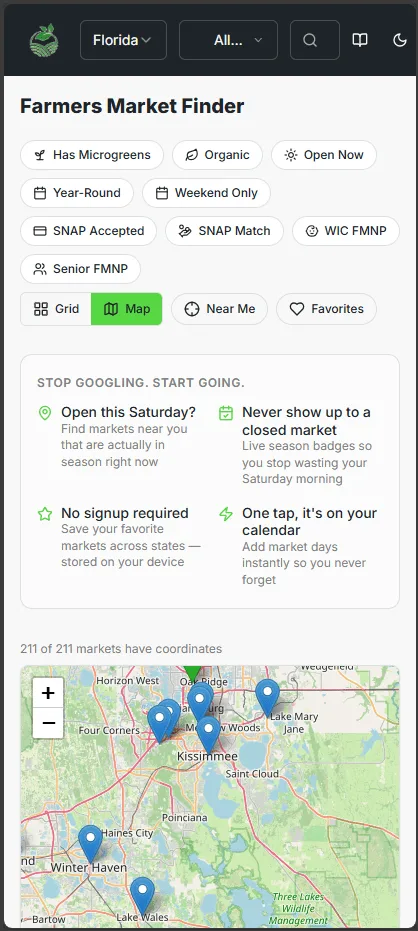
Works on your phone

