
Microgreens World
A Little Salt Raised Radish Microgreen Antioxidants 26 Percent. More Salt Cut Shoot Height by Over a Third
Can a little salt in the water make a ten-day crop richer in antioxidants? And what does the tray pay for it? Çağlar Kaya of Çanakkale Onsekiz Mart University in Türkiye put numbers on both. The paper came out October 24, 2026 in the International Journal of Innovative Approaches in Science Research (volume 10, article e10030), and I read it at the source. Kaya grew radish, broccoli, red cabbage and rocket at 0, 50, 100 and 150 mM sodium chloride. It’s a small journal, so judge the work on its method. The method is stated and you can check it. The author reports no outside funding.
Seeds came from an unnamed commercial supplier. Kaya sterilized them in 1 percent sodium hypochlorite for two minutes. Sowing went into a peat-based medium in 30 by 20 cm trays. Salt solutions went on from day 3 after germination, and harvest came 10 to 12 days after sowing, with cotyledons fully open. The growth chamber held 22°C (72°F) give or take 2°C (3.6°F), 65 to 70 percent humidity and 16 hours of light at about 200 µmol per square meter per second. Each species-and-salt combination had three replicates, one tray each. Kaya ran a two-way ANOVA with Tukey’s test at p below 0.05. By my math from those dates, the plants saw salt for roughly seven to nine days. The paper gives no solution volume and no schedule for applying it.
Start with the gain. At 100 mM, radish total phenolics went from 3.28 to 4.12 mg GAE per gram fresh weight. Flavonoids rose from 1.42 to 1.79 mg CE. DPPH antioxidant activity climbed from 34.6 to 43.5 µmol TE. Each is up about 26 percent. Broccoli phenolics went from 3.05 to 3.89. From the paper’s table, I calculate rocket phenolics up about 22 percent and flavonoids up 26 percent. Red cabbage is up 25 and 27 percent. Antioxidant compounds peaked at 100 mM and dipped slightly at 150, and radish responded most.
Now the bill. At 150 mM, shoot length fell about 35.6 percent in radish, 35.9 in broccoli, 43.3 in red cabbage and 43.8 in rocket, against unsalted controls. Fresh weight dropped from 0.91 g to 0.53 g in radish and from 0.73 g to 0.37 g in rocket. The paper doesn’t say whether those weights are per tray or per seedling. Sodium climbed and potassium fell. Rocket hit a sodium-to-potassium ratio of 1.33 at 150 mM. Chlorophyll and chlorophyll fluorescence (Fv/Fm) declined under heavy salt, and radish and broccoli held both better. All the weights I have sit at 150 mM. I found no fresh weights at 100 mM, the dose where antioxidants peaked.
What’s missing matters to a grower. No taste data. No food safety data. No minerals beyond sodium and potassium. It’s one chamber, one peat medium, three trays per cell and one harvest. Kaya concludes that radish and broccoli suit moderately salty production when antioxidant quality is the goal, and leaves enzymes, gene expression and shelf life for later work. My read: ask two questions before you copy this. What does a tray weigh at 100 mM on my mat? Will a buyer pay for a number they can’t taste? Salt in a reservoir is a separate worry for pumps and lines.
Int. J. of Innovative Approaches in Science Research · penpublishing.net · Oct 24, 2026
Broccoli Sprouts Look Promising for Metabolic Health, Says a Manitoba Review. Human Trials Are Still Few and Small
Rashmi Siribaddanage, Ruchira Nandasiri, Breanne Semenko and Miyoung Suh, all at the University of Manitoba, published a narrative review in the British Journal of Nutrition, online October 26. It starts with carotenoids and metabolic health, then turns to Brassicaceae microgreens, “particularly broccoli sprouts,” as a dietary source.
Broccoli sprouts run 162 to 224 mg β-carotene equivalents per 100 g dry weight. The review adds that about 83.3 percent of Brassica microgreens in the literature it covers count as very rich carotenoid sources, above 10 mg per 100 g. Blue or white LED light raised carotenoids 20 to 44 percent in broccoli and kohlrabi microgreens. Human work includes a four-week trial of broccoli sprout powder in 81 people with type 2 diabetes. Another ran 10 weeks, with 30 g a day of fresh sprouts in 40 overweight adults.
The authors are blunt about limits. Human microgreen trials are few, small and short. Dietary fat, which carotenoids need for absorption, often went unreported. No study compared differently enriched microgreens. My read: this is a map of what has been studied. It’s no basis for a health claim on a label.
British Journal of Nutrition · cambridge.org · Oct 26, 2026
Blue Light Gave Endive Microgreens the Most Phenolics. A Red-Blue Mix Scored Highest on Antioxidant Activity
Suzana Pavlović and six colleagues at the Institute for Medical Research in Belgrade published in Horticulturae, early access October 21. They grew endive microgreens under blue, red, blue-red, cool white and darkness, with 16 hours of light and 8 of dark. Then they measured shape, chlorophyll, phenolics, flavonoids and DPPH antioxidant activity.
Fresh weight peaked under the blue-red setting at 0.246 g. Blue gave the top phenolics at 4.497 mg GAE per gram. The red-blue mix gave the highest DPPH reading, 19.573 mg TXE per gram. Red light and darkness scored lowest on most traits.
The page I read gives no light intensity, cultivar, growth time or funding. It doesn’t say whether 0.246 g is per seedling or per tray. The paper is early access. Full text may fill some gaps. My read: no single spectrum won. Pick LEDs for endive and you trade weight against antioxidant score. Don’t copy these settings without the missing intensity.
Horticulturae · mdpi.com · Oct 21, 2026
One 10 g Serving of Selenium-Dosed Basil Microgreens Could Hit 250 Percent of the Daily Value, a Kentucky State Preprint Estimates
Adekunle Adeyeye and four colleagues at Kentucky State University posted a narrative review on Preprints.org on October 21. It hasn’t been peer-reviewed. The literature search was exploratory, with no risk-of-bias scoring.
For microgreens, it cites trays of coriander, green basil, purple basil and tatsoi on capillary mats, dosed with selenate at 0, 8 or 16 µM. At 16 µM, leaf selenium ran from about 26 to 150 µg per gram dry weight, depending on species. The review estimates green basil at 8 µM holds about 13.8 µg per gram fresh weight. That’s about 138 µg in a 10 g serving, roughly 250 percent of the U.S. RDA of 55 µg. The U.S. upper limit is 400 µg a day.
The authors suggest 15 to 30 µg per labeled serving as a design target. It isn’t a regulatory limit. The basil figure sits in a different table from the 16 µM data, and the review doesn’t reconcile them. My read: anyone selling “selenium-enriched” greens should do the math per serving, not per gram.
Preprints.org · preprints.org · Oct 21, 2026 (not peer-reviewed)
Every story is read at its source before it is written up. No daily emails and no sales sequences.
Get the Weekly LetterMicrogreen Sellers in Tiruchi, India, Report Growing Demand, and the State Has ₹1.20 Crore for the Crop in 2026-27
HortiDaily ran this on October 27, crediting a recent report in The Hindu. Businesses in Tiruchi, India, are selling microgreens to shoppers who want pesticide-free, nutrient-dense food. I couldn’t open The Hindu’s original. My tools can’t reach it. This card rests on HortiDaily’s version.
The state Agriculture Budget puts microgreen cultivation under its “Thalirkeerai” Scheme, with ₹1.20 crore set aside for 2026-27. EDII-TABIF held two awareness sessions in Tiruchi on growing microgreens from millets, pulses and vegetables.
K. Anand, co-founder of Divaa Microgreens with S. Meha and Chandan, says microgreens went from a gourmet item at high-end restaurants to an ingredient in samosas, cutlets, puffs and salads. The aim is to make them more affordable and more appealing to young people. The article gives no prices, volumes or sales figures. My read: the detail worth stealing is the channel. A familiar snack carries the crop.
HortiDaily · hortidaily.com · Oct 27, 2026
Planted Detroit’s 37,637-Square-Foot Vertical Farm Goes to Sealed Bids, Due November 16
SecondBloom Auctions is selling the Planted Detroit campus by sealed bid. It’s two renovated buildings totaling 37,637 square feet on 1.49 acres, at 6301 E. Lafayette Street and 1050 Mt. Elliott Street. About 28,000 square feet is growing canopy. Vertical Farm Daily reports that Planted Detroit opened in 2018, became Michigan’s largest vertical farm, and winds down in November 2026.
Equipment on the sale page includes two PARS automated NFT systems with 16 levels, commissioned at 70 feet, plus 98 Pipp mobile grow racks and walk-in coolers. Inspections run by appointment October 28 to November 13. Bids are due November 16 at 5:00 p.m. ET with a 10 percent deposit. Award is expected November 20, and closing follows within 30 days.
The bid splits 20 percent equipment and 80 percent real estate. The page lists no asking price, no seller name and no reason for the sale.
SecondBloom Auctions · secondbloomauctions.com · Bids due Nov 16, 2026 | Vertical Farm Daily · verticalfarmdaily.com · Oct 28, 2026
FDA Holds a Public Meeting November 6 on Tracking Food by Lot, and Enforcement Can’t Start Until July 2028
The FDA will hold a virtual public meeting Friday, November 6, from noon to 3:00 p.m. ET. It wants input on the Food Traceability Rule and on possible flexibilities for lot-level tracking. The rule covers foods on the Food Traceability List. Farms, restaurants, retail food establishments and warehouses that supply them are in the discussion. I didn’t check where microgreens sit on that list. A grower should.
General registration closes November 5. Speaker registration closed October 26. Talks are oral only, with no slides, and promotional material isn’t allowed. Send comments on the FDA’s discussion paper to Docket No. FDA-2014-N-0053 on regulations.gov. FreshPlaza reported a December 6 comment deadline on October 23. The FDA page I read states none.
The Continuing Appropriations Act bars FDA from enforcing the rule before July 20, 2028.
FDA · fda.gov · Meeting Nov 6, 2026 | FreshPlaza · freshplaza.com · Oct 23, 2026
Massachusetts Will Reopen Its Healthy Incentives Program to New Farms and Markets, but Gives No Start Date
WGBH reported October 27 that Massachusetts will start enrolling new farmers and markets in the Healthy Incentives Program (HIP) for the first time since applications closed in 2022. The Department of Transitional Assistance runs HIP. SNAP households get $40, $60 or $80 a month, by household size, to spend on produce at approved farmstands and markets.
The article gives no start date and no count of farms or markets that could join. Greater Boston has over 100 approved locations. Central Massachusetts has far fewer. Laura Leighton of Rock Harvest Farm in New Braintree has tried for years to enroll. She says she was told the cap conserved funds. Julia Moriconi manages Market on Exchange in Worcester. She turns away HIP shoppers and puts the lost sales at about $400 each Sunday.
A state spokesperson said steadier funding lets the agency expand and stay sustainable year-round. My read: this matters to Massachusetts sellers, and $400 is one manager’s estimate. The article never mentions microgreens.
WGBH · wgbh.org · Oct 27, 2026
Minnesota Growers Can Apply Now for Grow Your Green, With Up to $2,500 in Market Gear and a December 6 Deadline
The Minnesota Farmers’ Market Association announced October 27 that applications are open for Grow Your Green: Access to Markets. The Minnesota Department of Agriculture funds it. Emerging, small-scale and diversified Minnesota farmers can apply. Room: up to 17 farmers across two six-week cohorts of up to eight each.
Training is six self-paced modules on branding, marketing, customer relationships, sales and profitability, and new markets, plus Zoom study halls. Farmers who finish may qualify for up to $2,500 in MFMA-coordinated materials such as tents, banners, business cards and signage, subject to guidelines and funding.
Cohort 1 runs January 4 to February 14, 2027. Applications are due December 6, acceptance notices go out December 14, and a required orientation follows December 17. Cohort 2 applications are due February 7. The announcement never mentions microgreens or says how applicants are chosen.
Morning Ag Clips · morningagclips.com · Oct 27, 2026
A Chicago Startup Is Growing Microgreens on the 18th Floor of an Office Tower, and Its First Orders Went Out in October
Karin McKie wrote about FarmZero in an October 28 Third Coast Review feature on Open House Chicago’s urban-farm tours. It’s a vertical hydroponic startup on the 18th floor of 30 N. LaSalle. The owners call the space “La Salad.” FarmZero grows edible flowers, herbs, leafy greens and microgreens in cotton rather than soil, from Johnny’s Selected Seeds, and sells by local pickup or delivery.
Timeline from the article: a special use permit in January 2024, a partnership with the Dutch Consulate, first plants in July 2026, first deliveries in October. A second space is planned at 125 S. Wacker. The founders’ “50×50” goal puts farms in Chicago office space by 2050, modeled on Singapore’s “30×30.” The piece cites more than 50 million square feet of empty office space in the city.
It quotes microgreen market figures too: $1.24 billion in sales in 2024 and $2.86 billion by 2029. No source is given, so I treat them as unverified. There are no FarmZero prices, volumes or tray counts.
Third Coast Review · thirdcoastreview.com · Oct 28, 2026
A French Kitchen-Equipment Seller Says Cut Microgreens Keep 4 to 5 Days Chilled, and About a Day Once Plated
Politec, a French seller of professional kitchen equipment, published a restaurant guide to microgreens on October 19. Call it vendor content. It promotes the company’s Minigro Pro+ indoor grower and gives no price, only an invitation to request a quote. Advice comes from Politec adviser Brian Ouk, a former chef, and chef Maxime of the Cueillette restaurant in Strasbourg.
Numbers: 3 to 7 stems per plate, up to 10 for very small species. Germination takes 2 to 4 days and growing 5 to 15. Cut microgreens keep 4 to 5 days refrigerated, or about a week still rooted, citing the French produce institute CTIFL. Ouk puts it at about 3 days in a cold room and 1 day once out for service. He puts waste on wholesale supply at about a quarter, sometimes half, and flags minimum orders and price.
The maker lists the Minigro Pro+ at 6 trays and up to 1.2 kg a week. Those are its figures. The waste claims are one adviser’s estimate. Chef Maxime reports less waste growing on site. My read: the shelf-life and waste arithmetic is worth a restaurant buyer’s time. Treat the equipment specs as a brochure.
Politec · politec-france.com · Oct 19, 2026 (vendor content)
Two Botanical Gardens Teach Home Microgreens Classes in Early November, for $35 to $44
Birmingham Botanical Gardens in Alabama lists “Growing Microgreens: From Seed to Plate” on Tuesday, November 3, from 5:30 to 7:00 p.m. in its Exploration Classroom. It costs $35 for members and $40 for nonmembers. Janell Diggs, an Alabama Advanced Master Gardener, leads the hands-on class on growing, harvesting and using microgreens at home.
Chicago Botanic Garden in Glencoe, Illinois, lists a Growing Microgreens Workshop on Saturday, November 7, from 10:00 to 11:15 a.m. for $44. Elaine Madansky of Elawa Farm Foundation covers health benefits, the best varieties to grow and simple ways to use them. Participants plant two containers to take home, and supplies are included.
Neither listing gives a class size. My read: here’s a local price check on what hobbyists pay to be taught.
Village Living · villagelivingonline.com · Oct 28, 2026 | Daily Herald · dailyherald.com · Oct 26, 2026
Match seed lots to FDA notices. Food Poisoning Bulletin reported on Oct 1 that FDA traced a 76-case, 16-state sprout outbreak to one lot of alfalfa seed from Berlin Seeds. Check your lot codes against current notices, and keep the codes with each tray record.
Growing Microgreens: From Seed to Plate. Birmingham Botanical Gardens, 5:30 to 7:00 p.m. $35 members, $40 nonmembers. Hands-on class on growing, harvesting and using microgreens at home, led by Janell Diggs, an Alabama Advanced Master Gardener.
FDA public meeting on food traceability. Virtual, noon to 3:00 p.m. ET, open to the public. General registration closes Nov 5, and same-day registration isn’t allowed. Comments go to Docket FDA-2014-N-0053.
Growing Microgreens Workshop. Chicago Botanic Garden, Glencoe, 10:00 to 11:15 a.m. $44, two containers to take home. Covers health benefits, best varieties and simple uses, led by Elaine Madansky of Elawa Farm Foundation.
Planted Detroit sealed bids due. SecondBloom Auctions, 5:00 p.m. ET, 10 percent deposit. As-is, with a confidential reserve and no financing or inspection contingency.
Grow Your Green applications due. Minnesota Farmers’ Market Association, Cohort 1 (Jan 4 to Feb 14, 2027). Acceptance notices go out Dec 14, and finishers may qualify for up to $2,500 in market gear. Required orientation is Dec 17.
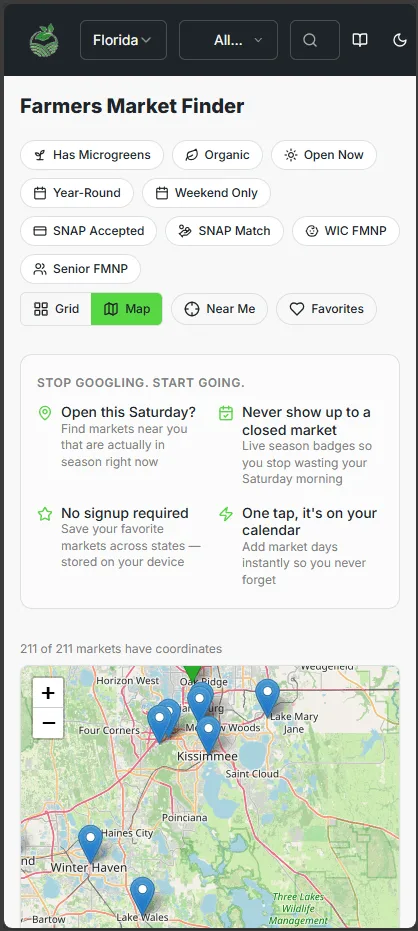
Find the markets near you that take SNAP, and the ones already carrying microgreens. The Market Finder maps them. No signup, no account. Pick one and go.
Find My Local Markets
Is the “40 times more nutrients” claim true? What can you tell a customer about broccoli microgreens? Type the question into the box and Doc Green answers it.
He is the Microgreens World research assistant, an AI trained on the site’s published posts and the peer-reviewed research behind them. He checks what other microgreens sites claim against that research. Every source is linked.
Ask Doc Green about your cropHe can be wrong. The source link is one click away. Educational only, with no diagnoses, doses or medical advice.

