
Microgreens World
CDC and FDA Close the Broccoli Sprout Salmonella Outbreak at 34 Cases in Six States, and Leave the Domestic Seed Supplier Unnamed
The CDC declared the Salmonella Bovismorbificans outbreak over on November 4, 2026. The final count is 34 illnesses across six states: Washington 26, Montana 4, and one each in Idaho, Minnesota, Oregon and Utah. Illness onsets ran from July 7 to September 11. Three people were hospitalized and none died. Patients ranged in age from 2 to 87, with a median of 52. The CDC adds that the true number of cases is likely higher and that the outbreak may have reached beyond these states.
The food link was strong. Of 30 people interviewed, 29 reported eating sprouts or microgreens before they got sick. Twenty-five named broccoli sprouts, and one named a microgreen mix that contained broccoli microgreens. The CDC set that against a national survey in which 8.7 per cent of respondents said they had eaten any sprouts. Whole genome sequencing showed the bacteria from patients and food samples were closely related.
The agencies traced the illnesses to a contaminated broccoli seed lot imported from New Zealand. Broccoli sprouts sold by Evergreen Fresh Sprouts of Moyie Springs, Idaho, and tested by Washington and Montana officials matched the outbreak strain by sequencing, and FDA found the strain in seed samples from the domestic supplier. FDA names lot W4105 as the likely common source. The supplier recalled the lot and notified its customers. In the notices I read, neither agency names that supplier, and the CDC’s final update no longer mentions Evergreen, which its September updates named.
The recalls matter to anyone who buys seed. Evergreen began recalling its broccoli sprouts on September 4, and all of those products are now past their dates. Downstream seed recalls followed. EAK Distribution recalled Home Grown 8-ounce broccoli sprouting seeds sold on Amazon, lot code AUG172026, on October 2. Eden Brothers recalled 1-ounce and 1-pound packets, lots 1022067 and 1022068, on October 7. Gardeners Basics recalled its 1-pound Waltham 29 broccoli sprouting seeds, UPC 848137042889, marked “Packed for 2027,” on October 9. FDA says the seed was sold through company websites, Amazon, Walmart, eBay, Etsy and TikTok Shop.
This is separate from the alfalfa sprout outbreak tied to Everything Sprouts, LLC, which the agencies say does not appear related. The CDC’s page on that one, last updated October 1, listed 76 cases in 16 states, six hospitalizations and an open investigation, with an alfalfa seed lot recalled by two suppliers. I have not seen a later update. My read, and it is only a read: growers should press their own seed suppliers for lot numbers and country of origin now, because the public notices stop short of naming the one company at the center of this outbreak.
FDA · fda.gov · Nov 4, 2026 | CDC · cdc.gov · Nov 4, 2026 | Food Safety News · foodsafetynews.com · Nov 5, 2026 | CDC alfalfa page · cdc.gov · Oct 1, 2026
Fenugreek Microgreens Under Red-White-Blue LEDs Gained 27.9 Per Cent Chlorophyll, While White Light Added Height
A paper in Plant Growth Regulation, published November 2, 2026 by a team centered at the Vellore Institute of Technology in India, grew fenugreek microgreens under three lights: sunlight as the control, white light, and a red-white-blue LED mix. Against the control, white light raised plant height by 25.8 per cent. The red-white-blue LEDs raised total chlorophyll by 27.9 per cent, and LED-grown greens carried 31.5 per cent more soluble protein. Carotenoids stayed roughly level across the treatments.
Several results are softer. Leaf and root size differences were not statistically significant, and the authors say the growth and proximate nutrition trends need further validation. The page does not give the red, white and blue ratio, which is the detail a grower would need to copy the recipe. Because the control was sunlight, the comparison is sun against LEDs, not one LED recipe against another. The version I read is an early-share copy that the journal says may be edited, and the text I could read had no phenolic or antioxidant figures.
Plant Growth Regulation · link.springer.com · Nov 2, 2026
A Review of Microgreen Roots Found Only Six Studies That Measured Root Tissue Directly
The roots left in a harvested tray are a side stream almost nobody has measured, and a narrative review in Horticulturae, published online October 28, 2026, says so plainly. The authors searched Scopus, Web of Science and PubMed on October 10 and got 179 records. After 76 duplicates came out, 103 were screened and 15 full texts assessed. Six measured chemical or biochemical properties of root tissue directly, and only one looked at extractable organic compounds.
That one study found licorice microgreen root extracts held about two-fold less polyphenol and about five-fold lower antiradical activity than leaf extracts. Most other figures in the review come from shoots, which the authors treat as indirect evidence. Radish, broccoli and mustard are the best-supported species. The review floats extracts, biostimulant fractions and composting as uses, and lists the gaps: no data on recoverable biomass, extraction yields, digestion or cost. By the authors’ own description it is a targeted narrative check, not a systematic review.
Horticulturae · mdpi.com · Oct 28, 2026
A New Review of Amaranth, Flax and Buckwheat Microgreens Declines to Rank the Crops on Nutrition
A narrative review in Horticulturae, published online October 30, 2026 by Stevanović and colleagues, looks at amaranth, flax and buckwheat microgreens. Its central position is a cautious one. The authors write that the available literature does not support a single numerical ranking across crops. The paper offers no winner and no league table.
The review keeps direct microgreen evidence apart from findings on seeds, sprouts and mature plants, and it does not carry numbers from one group to another. It also warns that high levels of phenolics or strong results in lab antioxidant tests should not be read as proof of a health effect in people. The paper closes with a list of research priorities. The text I could read gave no search method and no study counts, and the review is not a trial, so growers should treat it as a map of what is still unmeasured. For anyone choosing between these three crops, it gives reasons to test small trays of each rather than trust a ranking.
Horticulturae · mdpi.com · Oct 30, 2026
Every story is read at its source before it is written up. No daily emails and no sales sequences.
Get the Weekly LetterJiffy Plans a Virtual Microgreens Grower Day for December 2, With Speakers From Penn State, Virginia Tech and Johnny’s Selected Seeds
Jiffy is hosting “Microgreens, Macro Impact,” a one-day virtual event on December 2, 2026, at no charge to attend, according to HortiDaily’s November 2 report. The program is a run of short presentations and discussions meant to connect growers, researchers and industry professionals. Confirmed speakers are Kaylee South of Virginia Tech, Dr. Francesco Di Gioia of Penn State, Max Knight of Rooted Robotics, Brenna Chase of Johnny’s Selected Seeds, Sergey Dunayev of Eastside Microfarms, and representatives of Koppert Cress.
Planned topics include commercial production and grower experiences, research and extension, automation, seeds and substrates, food safety and nutrition, and business trends. Kyle Freedman, Jiffy’s CEA segment manager, is quoted as saying there is a lot of knowledge, technology and experience across the microgreens industry, but it can be very fragmented. The organizers describe the day as built around knowledge sharing rather than sales presentations. The article gives no start time or registration link, only Jiffy’s contact details.
HortiDaily · hortidaily.com · Nov 2, 2026
An Ontario Organic Grower Shifted From Microgreens to Salad Greens and Says Microgreens Could Not Be Machine-Packed
Greenbelt Organic Greens of Lynden, Ontario, has moved from microgreens to leafy salad greens, according to a HortiDaily interview published November 4, 2026. The company grew out of Ian Adamson’s late-1990s greenhouse microgreens experiments and was established in 2004. Adamson says microgreens could not be machine-packed because no automated system weighs them accurately, and Canadian labeling rules require a weight on packaged salad. Staff in harvesting and packaging fell from about 30 in 2017 to about seven today.
The growing details are useful. The medium is about 75 to 80 per cent compost the farm makes over four months and does not sterilize, with peat making up the rest. Biofilm clogged irrigation booms and filters, sometimes needing cleaning three times a day, until a monthly microbial treatment stopped the recurring problem. The farm dropped hydrogen peroxide because it harmed the beneficial microbes. The team is also testing worms in the compost, and is still weighing the cost of the collection system that scaling it up would need.
HortiDaily · hortidaily.com · Nov 4, 2026
Farmers Market Advocates Ask USDA to Delay Enforcing a SNAP Stocking Rule That Took Effect November 4
The National Sustainable Agriculture Coalition and other market advocates sent USDA a letter on November 3 asking it to hold off enforcing updated SNAP stocking requirements until markets get clear public guidance. USDA first proposed the changes in September 2025, and the rule took effect November 4, 2026. NSAC says it mainly affects vendors authorized under Criterion A, which face stricter stocking requirements, while markets authorized under Criterion B are unaffected. NSAC says it did not foresee effects on farmers markets when it reviewed the proposal.
The difficulty NSAC describes is the sorting. Many markets do not know which criterion applies to them, because the USDA stocking and sales records used to assign it are internal and often not shared with applicants. NSAC notes many markets are run by unpaid managers or farmers who rely mainly on email with USDA. The release does not spell out the stocking requirements, and I have not read the Federal Register notice. The details of the rule are not verified here.
National Sustainable Agriculture Coalition · sustainableagriculture.net · Nov 3, 2026
Valley City Elementary Students Spend Three Weeks Comparing Microgreens With the Foods They Already Know
Students at Jefferson and Washington Elementary Schools in Valley City, North Dakota, took part in a three-week Farm to School activity built around microgreens. Morgan Cristl of Earth to Jar Botanicals in Fargo grew the microgreens for the schools, delivered them and visited classrooms to explain how they are grown. Students tasted and compared three varieties with familiar foods: sunflower microgreens against sunflower seeds, pea shoots against sugar snap peas, and broccoli microgreens against broccoli florets.
The district’s food service department runs the program. It already serves fresh fruit or vegetable snacks to elementary classrooms three times a week through a USDA Fresh Fruit and Vegetable Program grant, and the stated goals are exposure to new flavors and textures, more willingness to try unfamiliar foods, and healthier eating habits. The report gives no student counts, grant amounts or harvest quantities. VerticalFarmDaily republished the News Dakota report on November 5.
VerticalFarmDaily · verticalfarmdaily.com · Nov 5, 2026
Verdánt Organics Plans a Mankato Microgreens and Mushroom Farm, With a Public Groundbreaking Set for November 10
KEYC reported on October 29, 2026 that VERDÁNT Organics will build its production facility and corporate headquarters in Mankato, Minnesota, on Energy Drive on the city’s east side. The company will grow organic microgreens and blue oyster mushrooms indoors, starting with brassica microgreens such as broccoli and cabbage, for upscale restaurants and food service across the Upper Midwest and beyond. CEO Mike Borman says the site gives direct shipping into Minnesota, Iowa, Wisconsin, the Dakotas and Chicago. KEYC lists more than 17 full-time jobs in the first year, more than 50 production workers at full capacity and 25 corporate roles.
The growing claims are the company’s own. Workers wear protective suits and crops are harvested dry, without washing, and specialized packaging is said to give a 24-day shelf life against five to six days for the industry standard. Spent substrate is composted and pasteurized for reuse. Borman says the company has “amazing unit economics,” but no figures are given, and the article states no investment amount. A public groundbreaking is set for Tuesday, November 10, followed by an open house. The company plans four more regional sites over five years.
KEYC News Now · keyc.com · Oct 29, 2026
A Puerto Rico Town Gives About 15 Merchants Its First Container-Farm Lettuce and Microgreens and Asks for Feedback
Foro Noticioso reported on November 2, 2026 that the mayor of San Lorenzo, Puerto Rico, Jaime Alverio Ramos, announced the first pilot harvest of “San Lorenzo Indoor Farming,” part of the town’s “San Lorenzo Siembra” program. Over the past 30 days the Municipal Agriculture Office set up a wagon with monitoring technology, specialized lighting and nutrients delivered through water. It grew lettuce and microgreens, and about 15 merchants received the produce at no charge, and the town wants feedback on quality and ideas for more crops.
The mayor says the system needs about four hours of monitoring a day and could become an income option for young people and farmers. The stated aim is to prepare students to supply commercial buyers later. A legislative allocation from Representative Ángel Peña Ramírez paid for the project. The article gives no cost, harvest volume, wagon size or participant counts, and the income remark is an official’s view, not a result. No reporter is named, and the text reads as a municipal announcement.
Foro Noticioso · foronoticioso.com · Nov 2, 2026
FDA public meeting on food tracing. Covers tracking food by lot. Enforcement of the rule is set for July 2028.
Planted Detroit sealed bids due. A 37,637-square-foot vertical farm goes to bid.
Microgreens Grower Day. Jiffy’s virtual event, at no charge.
Grow Your Green deadline. Minnesota growers can apply for up to $2,500 in market gear.
USDA SNAP stocking rule. Took effect November 4.
Alfalfa sprout investigation. Open as of CDC’s October 1 update.
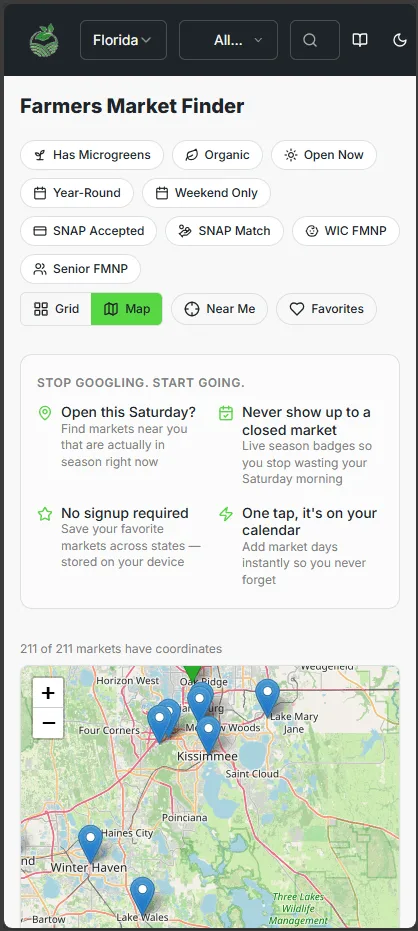
Find the markets near you that take SNAP, and the ones already carrying microgreens. The Market Finder maps them. No signup, no account. Pick one and go.
Find My Local Markets
Is the “40 times more nutrients” claim true? What can you tell a customer about broccoli microgreens? Type the question into the box and Doc Green answers it.
He is the Microgreens World research assistant, an AI trained on the site’s published posts and the peer-reviewed research behind them. He checks what other microgreens sites claim against that research. Every source is linked.
Ask Doc Green about your cropHe can be wrong. The source link is one click away. Educational only, with no diagnoses, doses or medical advice.

