
Microgreens World
Your weekly source for microgreens science, business & growing news
Food Safety
Sprout Outbreak Reaches 55 Cases in 15 States, and Investigators Turn to the Seed
The FDA and CDC are investigating a multistate outbreak of Shiga toxin-producing E. coli and Salmonella infections linked to alfalfa sprouts. As of the August 24 update, 55 people across 15 states have been reported ill. Four have been hospitalised. No deaths. Three STEC serotypes are involved, O26:H11, O103:H25 and O168:H8, alongside one strain of Salmonella Agona. Forty-six people were infected with E. coli, seven with Salmonella, and two with both. Illness onset dates run from May 31 to August 8.
The epidemiology is unusually clean. Of 34 people interviewed, 26 reported eating alfalfa sprouts in the week before they got sick. That is 76 per cent, against a FoodNet population baseline of 8.7 per cent for people who report eating any sprouts at all. Whole genome sequencing showed the bacteria from sick people’s samples are closely related. At least two illness clusters were identified in Minnesota and Wisconsin, with alfalfa sprouts the most commonly reported item in both. Traceback from restaurants and grocery stores in those two states pointed to alfalfa sprouts distributed by Everything Sprouts, LLC of Minneapolis.
FDA opened an inspection and collected samples at Everything Sprouts on August 19. The company initiated a recall on August 22 covering alfalfa sprouts sold under the Calco and Everything Sprouts brands in 5-oz plastic containers, lot numbers 222, 223, 225, 226 and 230. The same sprouts went into Everything Sprouts Crunchy Protein Sprout Mix cups, lots 222, 223, 226 and 230, and Zesty Garlic Mix cups, lots 222, 223, 225, 226 and 230. Distribution ran May 27 to August 21 to wholesale distributors, grocery stores and restaurants in Minnesota and Wisconsin. FDA says it is still working out whether product travelled further.
One line in the FDA advisory is worth reading twice. Investigators are working to determine whether there are additional sources of contaminated sprouts, and whether there is a common seed supplier. That is my read on where this becomes a microgreens story rather than a sprouts story, because a contaminated seed lot does not respect the boundary between the two crops. Separately, CDC reported that Salmonella from nine samples was predicted by sequencing to resist three or more of fosfomycin, streptomycin, sulfisoxazole and tetracycline. The STEC samples showed no predicted resistance, which does not change treatment guidance since antibiotics are not recommended for STEC infections anyway.
Sprouts and microgreens are not the same crop and are not grown the same way, and this publication will keep saying so. But the distinction is ours, not the shopper’s. CDC also notes the real case count is likely higher than 55, because many people recover without testing and it usually takes three to four weeks to link a new illness to an outbreak. Expect the number to move. If you sell at market this weekend, the useful preparation is not a defence of your category. It is knowing your seed lot numbers, your supplier, and the date you sowed the tray in front of you.
U.S. Food and Drug Administration · fda.gov · 24 August 2026 | Centers for Disease Control and Prevention · cdc.gov · 24 August 2026
Food Safety Review
Scoping Review Puts Seed and Water at the Top of the Contamination List
Rizwan and colleagues at Tamil Nadu Agricultural University screened 1,028 papers, de-duplicated to 742, read 130 in full and included 50, following PRISMA-ScR. Irrigation water, nutrient solution, seed and soilless media came out as the most frequently cited entry routes. Their placement of the crop is the part worth reading twice: microgreens sit between sprouts and mature leafy greens, sharing a seed origin and a warm, moist growing stage with sprouts, and like sprouts they carry no recognised kill step before consumption. The review is blunt on three points growers hear otherwise. Absence of soil is not absence of microbes, and different media support different pathogen persistence. Total plate count and coliforms are process indicators that cannot demonstrate the absence of Salmonella, Listeria or pathogenic E. coli. UV-C and oxidative treatments are crop- and dose-specific, and the authors say the evidence is too limited to treat them as kill steps. Their closing line belongs above the bench: claims of clean indoor production should be replaced by evidence of control performance.
Genetics and Molecular Research · geneticsmr.com · Vol. 25, Issue 15s, 2026
Growing Technique
A Pinch of Salt Raised Sunflower Yield 59 Per Cent and Cut the Fat by 70
Bardees Mickky and colleagues at Mansoura University grew sunflower microgreens hydroponically by root dipping for ten days, applying five NaCl concentrations from 0 to 100 mM through bottom irrigation over the final five days. At 25 mM, shoot fresh yield rose 58.7 per cent, shoot dry yield 55.4 per cent and leaf area 81.4 per cent, with no significant change in catalase activity, lipid peroxidation or hydrogen peroxide. That last part is what separates a useful stress from damage. Total antioxidant activity rose 38.1 per cent, ascorbic acid 37.5 per cent, carbohydrates 27.2 per cent and protein 27.6 per cent, with calcium, magnesium, manganese and zinc all up between 12 and 14 per cent. The trade-offs sit in the same abstract and are not small: total fats fell 69.8 per cent, ash 27.3 per cent, iron 15.2 per cent and potassium 12 per cent. At 75 and 100 mM, growth dropped and oxidative markers climbed. Two cautions before anyone reaches for the salt bag. The cultivar was Giza 120, selected for salt tolerance, so the response may not carry over to the seed on your shelf. And a shift in mineral and fat profile that large is a labelling question, not only an agronomy one.
BMC Plant Biology · doi.org · Vol. 26, Article 1483, 2026
Animal Study
Broccoli Microgreens Grown Hot Lost Glucosinolate, and the Mice Responded Differently
Vedran Balta and colleagues at the University of Zagreb grew broccoli sprouts at 23°C (73°F) day and 18°C (64°F) night, and again at 38°C (100°F) day and 33°C (91°F) night, then fed water extracts to 30 healthy Swiss albino mice for 28 days at 300 mg per kg of body weight daily, ten animals per group with sexes evenly split. Heat rewrote the chemistry. Total glucosinolates fell 28 per cent and total phenolic acids fell 40 per cent in the hot-grown sprouts, while total polyphenolics rose 30 per cent. Both extracts lowered mean platelet volume against control and raised myocardial antioxidant capacity. Then the two diverged. The 23°C (73°F) extract raised myocardial nitric oxide; the 38°C (100°F) extract raised total glutathione and also produced significantly higher high-sensitivity cardiac troponin I in heart tissue than either the control group or the 23°C (73°F) group. The authors do not oversell that last result. They state it cannot be read as definitive evidence of myocardial injury without serum troponin, which they did not measure, and they flag that the mice were healthy, the period was short, bioavailability was not determined, and no sex-specific analysis was run.
Food Science & Nutrition · onlinelibrary.wiley.com · Vol. 14, Issue 8, 2026
Nutrient Profiling
Potato Microgreens Measured for Phenolics, Sugars and Antioxidant Capacity
Murat Mutlucan and Sabri Erbaş at Isparta University of Applied Sciences profiled potato microgreen leaves and put numbers to a crop that rarely gets them. Total phenolic content came in at 1.22 mg per gram, total flavonoids at 2.17 mg per gram. Antioxidant capacity measured 5.25 µmol Trolox per gram by CUPRAC, with ferrous ion chelating activity at 9.20 µmol EDTA per gram. The carbohydrate picture is the striking part: total soluble sugars at 124.72 mg per gram against starch of just 0.08 mg per gram. Phenolic content correlated strongly and positively with CUPRAC values. The authors report negative associations between phenolics and the carbohydrate measures, and describe those as suggesting metabolic interactions between primary and secondary metabolites during early development.
Turkish Journal of Agriculture – Food Science and Technology · agrifoodscience.com · 25 August 2026
Consumer Research
Bulgarian Survey Finds Wide Awareness of Microgreens and Narrow Consumption
A questionnaire study of 198 adults in Northeastern Bulgaria set out to measure the distance between knowing about microgreens and actually eating them. Recognition was high. Respondents identified microgreens as edible plants and were broadly aware of their nutritional value, naming vitamins, minerals, antioxidants and fibre. Consumption and home cultivation both stayed limited. Exploratory factor analysis and K-means clustering separated three consumer groups by nutritional awareness and familiarity, and the authors report that those differences strongly influenced how often people ate them. Their conclusion is blunt: microgreens are not yet part of everyday dietary practice, and closing that gap needs better public information, better market availability, and practical guidance on what to do with the things.
Pharmacia · pharmacia.pensoft.net · 19 August 2026
Insolvency
80 Acres Farms Draws a Third Lawsuit, This One for $687,240 in Staffing Invoices
The Job Center LLC, a staffing and recruiting firm based in Symmes Township, Ohio, filed an 18-page complaint on August 7 in Hamilton County Common Pleas Court alleging breach of contract by 80 Acres Farms. It claims the indoor grower owes $687,240 for services provided, plus interest and fees, on invoices dating back to April. 80 Acres announced its closure on August 3 and is now facing a trio of lawsuits. When the Cincinnati Business Courier reported the filing, the case had not yet been assigned, and 80 Acres had 28 days from its summons date to answer. The company did not respond to the Courier’s request for comment. If you supply a larger indoor operation, note the date on those invoices: the arrears predate the August shutdown announcement by roughly four months.
WKRC Local 12 / Cincinnati Business Courier · local12.com · 21 August 2026
Retail
AeroFarms Puts Micro Arugula in Whole Foods and Micro Broccoli in Costco
Announced August 26 from Danville, Virginia. Micro Arugula goes nationwide at Whole Foods Market from late August at a suggested retail price of $4.99 for a two-ounce package. Micro Broccoli arrives in a club-size pack sold exclusively to Costco members in the Northeast and Texas at $7.99 for six ounces. The company says its products now sit in roughly 2,000 retail locations. CEO Gustavo Burger, in the role since the April 2026 acquisition by an affiliate of Palm Ventures, framed the expansion around food safety and an indoor aeroponic system using only purified water. One number deserves a footnote, and the release supplies it: the claim of 34 times more vitamin A, six times more calcium and four times more magnesium than whole crown broccoli is sourced to an in-house October 2025 broccoli analysis, not to published work. Useful to know before a customer asks you to match it.
PR Newswire · prnewswire.com · 26 August 2026
Grower Profile
A Pennsylvania Dairy Couple Run a Microgreens Round on Top of Everything Else
Ashley and Jared Yocum launched Eighty-Four Microgreens in September 2024 at A Little Bit of Heaven Farm, the dairy operation they run in Somerset Township, Washington County. They plant, grow, harvest and deliver, and the delivery costs the customer nothing across the Greater Pittsburgh area. About half a dozen restaurants are on the books. They have worked markets in Washington, Peters Township, Canonsburg, Claysville, Mt. Lebanon, Upper St. Clair, Bridgeville, Coraopolis, Aspinwall, Robinson, Bloomfield and Homestead. The grow room runs lights 18 hours a day, with a separate germination room and refrigeration installed. Ashley is also a full-time pharmacist and home schools two of their four sons. They shut the business down for three weeks early on when it became too much, and now run one delivery driver with a second planned.
Observer-Reporter · observer-reporter.com · 22 August 2026
Fraud Alert
Georgia Warns Vendors Off a Farmers Market Event That Does Not Exist
The Georgia Department of Agriculture issued a consumer alert over a polished social media advertisement for a “2026 GATE Atlanta Vendor & Artisan Market” at the Atlanta State Farmers Market in Forest Park, billed for August 21 to 23. Prospective vendors are pointed to an email address for an application, then asked to pay a fee electronically. CBS News Atlanta emailed the address and received an application and payment instructions within minutes. Agriculture Commissioner Tyler Harper said the event is not affiliated with the state or the market, and that investigators believe the operation may be based outside the United States. A cease-and-desist went to the Facebook account. Similar schemes have surfaced in California, Michigan and Canada. The department says there is exactly one legitimate way to lease stall space at a Georgia state market, and it runs through the department’s own portal.
CBS News Atlanta · cbsnews.com · 21 August 2026
Market Capacity
Bend’s Saturday Market Says It Is Almost Completely Out of Room
The NorthWest Crossing Saturday Farmers Market in Bend, Oregon now hosts more than 180 vendors from across Central Oregon and pulls anywhere from 500 to 3,000 visitors a week. It has run on Northwest Crossing Drive since 2007. “We just keep making our way down the street, and we’re almost completely maxed out,” market director Melissa King told The Bulletin. The structure is worth studying if you are trying to get into a busy market: around 75 per cent of vendors hold a guaranteed spot for the full season, and 20 to 60 drop-in vendors rotate through each week to keep the mix fresh. Growth this year has concentrated in bakery, farm and flower vendors. The last market of the season runs September 26, 10 a.m. to 2 p.m.
The Bulletin · bendbulletin.com · 24 August 2026
Pull Your Seed Lot Records
FDA is checking whether a common seed supplier sits behind the sprout outbreak. Make sure you can name the supplier and lot number behind every tray currently in your grow room, and how long you keep those records.
Write Your Sprouts Answer Now
Somebody at market will ask about the recall this weekend. Have two sentences ready that explain how your crop is grown and harvested, without arguing with the customer or dismissing the outbreak.
Run a Recall Drill
The Everything Sprouts recall named five specific lot numbers across three products. Give yourself an hour and see whether you could identify every buyer of a single sowing date. If you cannot, that is the gap to fix.
Verify Before You Pay
Georgia’s fake vendor market looked professional and answered emails within minutes. Never pay a stall fee from a social media ad. Apply through the market operator’s own portal, every time, even when the ad looks legitimate.
Check What Your Grow Room Ran This Summer
Zagreb researchers measured 28 per cent less total glucosinolate and 40 per cent less phenolic acid in broccoli sprouts grown at 38°C versus 23°C. If your room ran hot in July, the trays you sold may not match the profile you describe on the label.
Note the New Price Anchors
AeroFarms set $4.99 for two ounces at Whole Foods and $7.99 for six ounces at Costco. Those are the numbers a shopper may carry to your table. Decide how you want to talk about the difference before you are asked.
Ongoing
FDA Sprouts Outbreak Investigation · Status listed as ongoing; advisory will be updated as new information arrives.
Ongoing
Common Seed Supplier Traceback · FDA is working to determine whether additional firms or a shared seed source are involved.
Late August
Micro Arugula, Whole Foods Nationwide · AeroFarms two-ounce pack at a suggested $4.99 retail.
Now Open
Micro Broccoli, Costco Northeast and Texas · Club-size six-ounce pack at $7.99, members only.
Now Open
Georgia State Market Stall Applications · The department’s official portal is the only legitimate route to lease vendor space.
Sept 26
NorthWest Crossing Final Market · Last Saturday market of the Bend season, 10 a.m. to 2 p.m.
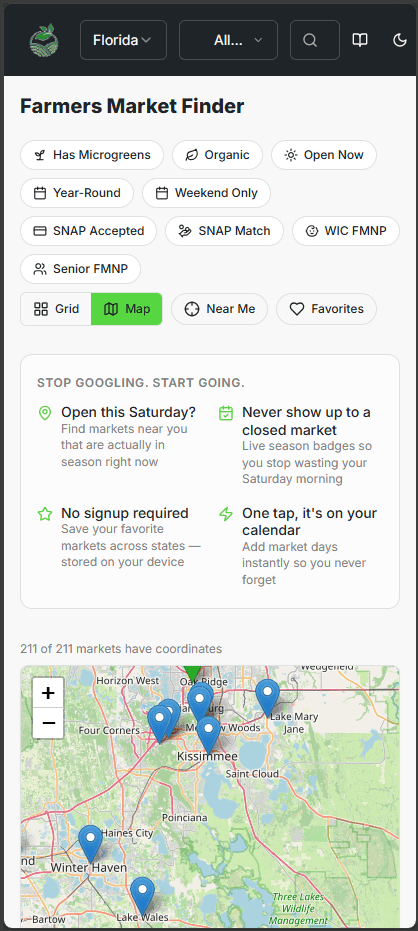
Find yours. The Market Finder maps markets near you and flags the ones carrying microgreens. No signup, no account. Pick one and go.
 Find My Local Markets
Works on your phone
Not on the list yet?
Every week I round up the best microgreens news, growing tips, and research — straight to your inbox. No fluff. Just the good stuff.
Sign Me Up for the Digest
