
Microgreens World
Penn State Lifted Radish Microgreen Iron 345 Percent, and the Paper Also Reports Leaf Spotting
Penn State put out a release on October 22 about three microgreens studies from the lab of Francesco Di Gioia, an associate professor of vegetable crop science. One tests iron fertilizers, one tests red-to-blue LED ratios, and one tests water treated with an electrical discharge. Funding named in the release includes Open Philanthropy, Pennsylvania Department of Agriculture Specialty Crop Block Grants and USDA NIFA. The papers themselves ran earlier: the iron study on September 12 in Biological Trace Element Research, and the light study on September 24 in Horticulturae. I read both at source. I could not open the third, in the Journal of the Science of Food and Agriculture, so what appears about it below is the release’s account and nothing more.
The iron paper, by Rishi Ravichandran and Di Gioia, compared five sources on radish and pea microgreens: two chelates (Fe-EDDHA and Fe-EDTA), ferric and ferrous sulfate, and Fe3O4 nanoparticles. Each went into a half-strength Hoagland solution at 15, 30 or 45 mg per liter, in a greenhouse with sunlight plus LED supplement. Fe-EDTA at 45 mg per liter did best: iron rose about 345 percent in radish and 210 percent in pea against untreated trays. Fe-EDDHA came second and the sulfates third. The nanoparticles did not raise iron significantly in either crop, though the authors note the shallow tray reservoir may have kept the suspension from circulating, so that result may understate the material.
Then the costs, which the paper lists plainly. The overall finding is no significant change in fresh yield against the untreated control. In radish, though, the two 45 mg per liter chelate treatments gave lower fresh yield and higher dry matter, and the Fe-EDTA plants showed necrotic leaf spots that the authors link to possible iron toxicity. The sulfates cut calcium by up to about 43 percent in radish and 62 percent in pea. The chelates added sodium, and in pea they lowered total phenols and antioxidant activity. On a 50 g serving, the paper estimates Fe-EDTA at 45 mg per liter supplies more than 20 percent of an adult man’s iron allowance from pea. Those are tissue-content estimates. Absorption was not measured, and the authors call for in vitro and in vivo work.
The light paper, by Aline Novaski Seffrin and Di Gioia, grew radish and broccoli in a growth chamber at a low daily light integral of 8.23 mol per square meter per day, with six treatments: white, red, blue, and red-to-blue mixes of 50:50, 25:75 and 75:25. Fresh yield did not move, at 3.23 to 3.37 kg per square meter across treatments. Pure blue gave the tallest shoots, 10.2 cm against 8.6 cm for the shortest mixed treatment, and the lowest dry weight, 147.2 g per square meter. It also gave the highest antioxidant activity, about 19.5 percent above pure red in the paper’s results. The release says 16.3 percent across both species. The two documents differ, and I have used the paper. In broccoli only, the 25:75 and 75:25 mixes carried 15 to 20 percent more iron than white, red or blue alone. Radish showed no iron response.
On the third study, the release says pea microgreens grown on plasma-activated water gained yield from fresh water treated 30 to 90 minutes, and that the best result, 60 minutes of treatment plus 72 hours of storage, raised biomass 19.7 percent and water-use efficiency 21.5 percent. A 120-minute treatment cut yield. The release also says the plasma generator came from Plasma Licensing Authority Inc. Every study here is one chamber or one greenhouse, two crops, and a harvest at day 7 to 10, and both papers keep their data behind a request to the author. Questions a grower can put to any of it: does it hold on my mat, my seed and my light, what does a chelate cost per tray, and what does the leaf look like at day 10.
Penn State News · psu.edu · Oct 22, 2026 | Biological Trace Element Research · doi.org · Sep 12, 2026 | Horticulturae · doi.org · Sep 24, 2026
Palak, Broccoli, Fenugreek and Kale Top an Indian Scorecard of Sixteen Microgreen Crops
Researchers at Dr. Rajendra Prasad Central Agricultural University in Pusa, Bihar profiled sixteen vegetable species grown as microgreens in a controlled polyhouse and harvested at the two-true-leaf stage, seven to 21 days after germination. They measured vitamin C, crude fiber, protein, phenolics, two antioxidant assays, calcium, iron, zinc, potassium and oxalate, then folded the results into a Nutrient Quality Score and an Antioxidant Index. Palak, broccoli, fenugreek and kale ranked highest overall, driven mainly by vitamin C, crude fiber and iron.
Radish, kale, broccoli and fenugreek led on vitamin C at 85.77 to 97.88 mg per 100 g fresh weight. Celery, parsley, palak and spinach led on calcium at 320.14 to 410.15 mg per 100 g dry weight. Broccoli (11.95 g) and cabbage (11.48 g) led on fiber. Oxalate ran 15.89 to 55.14 mg per 100 g fresh weight across all species, which the authors read as suggesting safe consumption levels.
The limits are the authors’ design. It is one polyhouse in one region, with three replicates. The two scores are min-max normalized, so they rank crops against each other inside this dataset and do not give absolute values. Vitamin C and minerals sit on different weight bases, so figures should not be compared across nutrients.
Scientific Reports · nature.com · Oct 21, 2026
A Maryland and USDA Paper Reports That a Plant-Based Seed Soak Cut Salmonella on Brassica Microgreens, With Costs in Germination and Daikon Yield
A team from the University of Maryland and USDA’s Agricultural Research Service tested two plant-based seed soaks against Salmonella on five brassica microgreens: daikon radish, broccoli, mustard, red cabbage and red Russian kale. One was a 1 percent benzyl isothiocyanate (BIT) nanoemulsion. The other was Sporan, a botanical fungicide, at 2 percent. Seeds were inoculated in the lab, soaked for 15 minutes and grown 14 days in organic soil. The paper was accepted October 4 and posted online October 5.
BIT cut Salmonella on seeds by up to 2.15 log CFU per gram and Sporan by up to 1.74, against untreated seed. Water alone did not significantly reduce it. On the harvested greens, BIT-treated red Russian kale fell 1.78 log between day 7 and day 14, and red cabbage fell 1.21. Soil counts did not change with either treatment.
The cost shows up in the crop. In a filter-paper test, BIT cut red Russian kale germination to 7.3 percent, against 79.7 for water. In soil, yield held for four species, but BIT-treated daikon fell to 97 grams a tray from 202 for water. The contamination was added in a lab, and the authors frame BIT as one hurdle in a multi-hurdle plan. It is a lead worth watching, not a protocol.
Journal of Agriculture and Food Research · doi.org · Oct 5, 2026
A Survey of 198 Adults in Northeastern Bulgaria Found High Recognition of Microgreens and Limited Eating
A team from the Medical University of Varna surveyed 198 adults in northeastern Bulgaria on awareness, consumption and home growing of microgreens. The paper, in Pharmacia volume 73, was published August 19 and reached the alerts on October 18 through a news write-up. I read the paper’s abstract page, which cuts off mid-sentence, so I have not seen the full results.
The authors used descriptive statistics, exploratory factor analysis and K-means clustering. They report high recognition of microgreens as edible plants and general awareness of their vitamins, minerals, antioxidants and fiber. Actual consumption and home cultivation were relatively limited. The clustering found three consumer groups that differed in nutritional awareness and familiarity with microgreens, and those differences strongly influenced how often people ate them.
The authors conclude that microgreens are not yet part of everyday diets despite that awareness, and they call for better public information, wider market availability and practical guidance. One region, one questionnaire. That is my caution, not theirs: I would read it as a regional snapshot.
Pharmacia · doi.org · Aug 19, 2026
A Mississippi State Thesis Compared Five Growing Media for Microgreens and Found Species and Substrate Interact
Ali Alsughayyir’s master’s thesis in plant and soil sciences at Mississippi State University, posted online October 12, covers two experiments. The first put four kale cultivars in a high tunnel with three commercial biostimulants. The second, on microgreens, compared five substrates, peat and four hydroponic mats, across alternative microgreen species that the abstract does not name.
The abstract reports that the species-by-substrate interaction significantly affected growth, fresh and dry shoot weights and mineral concentrations. In plain terms, the best medium depended on the crop. The abstract gives no numbers, no species list and no mat brands. The full text sits behind a PDF I could not open from here.
So this card carries a finding without its figures. The practical reading is cautious: a substrate result from another farm’s species mix is not a guide to yours, and a trial on your own crop and your own mat is the test that counts.
Mississippi State Scholars Junction · scholarsjunction.msstate.edu · Oct 12, 2026
FDA Drafts Traceability Relief for Mid-Size Retailers and Restaurants and Sets a November 6 Public Meeting
On October 8, FDA issued a draft enforcement discretion policy under the Food Traceability Rule, also called FSMA 204. If it is finalized, FDA would not enforce the rule against retail food establishments and restaurants whose average food sales over the previous three years are above $250,000 and no more than $1 million, adjusted for inflation from a 2020 baseline. Smaller ones are already fully exempt. The notice covers retailers and restaurants only. It does not address farms or suppliers.
FDA will hold a public meeting on November 6 on further flexibilities, including those in a May 27 discussion paper. Registration is required and there is no fee. General registration closes November 5, and anyone who wants to speak must register by October 26. Congress has barred FDA from enforcing the rule before July 20, 2028, for foods on the Food Traceability List.
Whether microgreens are on that list is not settled in what this card could read. FDA’s list names fresh sprouts, fresh leafy greens and fresh herbs. It does not mention microgreens, and neither of the sources below says either way. Before you assume you are outside the rule, ask FDA or a food safety advisor.
Food Safety Magazine · food-safety.com · Oct 8, 2026 | FDA · fda.gov · Oct 8, 2026
Florida Grower Sunswell Greens Puts Butterhead Lettuce in Select Target Stores in Four Southeast States
Sunswell Greens of Lake Worth, Florida, a hydroponic greenhouse grower of specialty lettuces and microgreens, announced on October 20 that its Florida-grown Butterhead lettuce is now in the produce section of select Target stores in Alabama, Georgia, Florida and North Carolina. Availability varies by store. The article does not give a store count.
The launch covers Butterhead only. Microgreens appear in the article just once, in the company description. Sunswell operates two South Florida greenhouses that use natural sunlight and controlled-environment technology, harvests through the hottest months and sells through select retail partners and distributors across the Southeast.
The release frames it as a regional answer to a supply gap: retailers there face seasonal winter and summer shortfalls and often source from the West Coast. John Halle Jr., director of sales and operations, is quoted, and the company says it plans to expand distribution and build relationships with retail and foodservice partners. For a microgreens grower, the item is a datapoint on how a regional greenhouse operation got a national chain to list a product. How it priced the item, and what the greenhouse sells at retail beside lettuce, the article does not say.
Perishable News · perishablenews.com · Oct 20, 2026
UK Startup Home Harvest Opens a Kickstarter for Two Countertop Farms, With First Deliveries Estimated for February 2027
Anyone who has tried to grow microgreens on a kitchen counter knows the hard parts are light, water and airflow. Home Harvest, a UK startup, says its two enclosed appliances automate all three. Harvest One is a single-tray unit for one or two people. Harvest Three has three trays and a 3.5-liter tank for households of three to five. Both use soilless pre-seeded mats, full-spectrum LEDs and a camera, with crop selection in an app. The company claims some crops are ready in as little as eight days.
New Atlas reports Kickstarter pledges from £249 for Harvest One (about US$330) and £299 for Harvest Three (about US$400). The catalog at launch is over 38 crops and eight curated mixes, and users can bring their own seed and media. Manufacturing is scheduled to begin in December and depends on funding for tooling, certifications and volume production, with first deliveries estimated for February 2027. This is the company’s first Kickstarter, and the pre-seeded mats are a recurring cost.
That is a pre-order of equipment that does not yet exist in volume, which is the ordinary condition of a crowdfunded launch. What has not been shown: germination and yield data by crop, the price of a mat, and how the eight-day figure was measured. A grower or a buyer weighing it should ask for those.
New Atlas · newatlas.com · Oct 22, 2026
Make a Login.gov account. USDA says producers with one linked to USDA will see pre-filled Harvest Fuel Relief applications. The sign-up period is not set yet.
Email fuel cost data to USDA. Specialty crop growers are not guaranteed Harvest Fuel payments. USDA asks them to send data to HarvestFuel@usda.gov, and a method comes later.
Match seed lots to FDA notices. As of the Oct 16 issue, two sprout outbreaks were open at the FDA, each tied to a seed lot. Check your lot codes against the notices, not only your supplier’s emails.
Home Harvest manufacturing start. The company says production begins in December if its Kickstarter funds tooling and certifications.
Home Harvest first deliveries. New Atlas reports delivery estimated for February 2027. An estimate, set before manufacturing begins.
Indoor Ag-Con, Las Vegas. Westgate Las Vegas, per the organizer’s call for speakers.

Facebook says overwatering. Reddit swears by peroxide. A YouTube grower says it never happens to him. Doc Green™ (beta) gives you one answer and the study behind it, checked against 2,000+ published studies. It will miss sometimes. Ask your hardest question, then tell us how it did.
Ask Doc Green™Every story is read at its source before it is written up. No daily emails and no sales sequences.
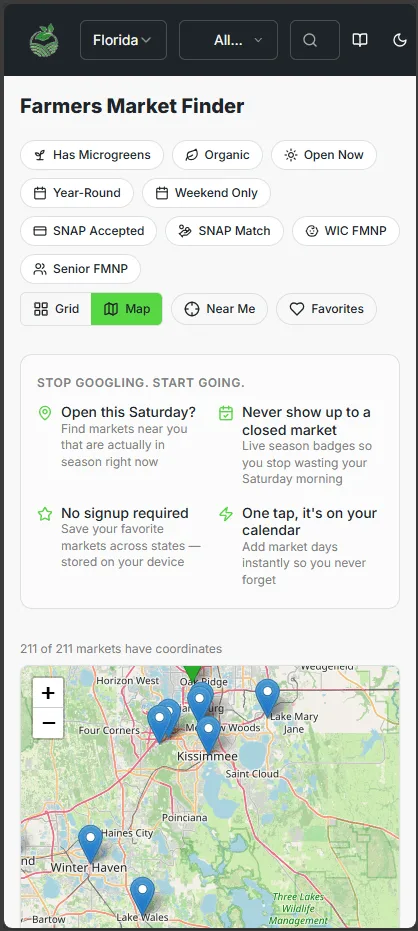
Get the Weekly LetterFind the markets near you that take SNAP, and the ones already carrying microgreens. The Market Finder maps them. No signup, no account. Pick one and go.
 Find My Local Markets

