
Microgreens World
The weekly digest for growers, researchers and entrepreneurs
Industry & Business · Organic Microgreens
City Roots Took No Outside Money, Went Microgreens-Only in 2017, and Is Now Talking to the Retailers 80 Acres Left Behind
City Roots started in 2009 as a community-supported farm in Columbia, South Carolina, founded by Eric McClam and his father Robbie. It grew five vegetables plus microgreens, certified organic through Clemson University, and over the years added mushrooms, cut flowers, agritourism events, hemp, chickens and honeybees. In 2017 it dropped all of that and went microgreens only. Organic Produce Network’s John McCurry reports that it now ranks among the ten largest microgreens producers in the United States, and McClam believes it is the largest certified organic one. That second claim is his, and the article does not test it.
The farm got there on its own money. McClam, his wife and his father own it, with no outside investors and no venture capital. The search for a bigger site began in 2022 and ended on 90 acres, where City Roots built a 75,000 square foot greenhouse with washing and packing facilities. The greenhouse has a retractable roof, grows in living soil that gets reused, and is heated by a geothermal radiant floor running on electric heat pumps. Half a megawatt of solar brings it close to energy parity in summer. It runs seven days a week, all year, with 20 to 25 staff.
The crop list is short: radish, kale, broccoli, arugula, mustard and peas. Between 60 and 70 per cent of sales go to retail and the rest to restaurants, and Sprouts Farmers Market and Trader Joe’s are named as new customers. Distribution stays mostly in the eastern half of the country. McClam ties that footprint to a shelf life of about 14 days, and the farm does not use air freight.
The timing is the part the article states plainly. 80 Acres Farms of Ohio announced in August that it would close after failing to raise capital, and McClam says he is actively talking to some of its retailers. This page has followed the 80 Acres Chapter 7 case and its supplier payments since late August. My read, not the article’s: two companies selling indoor-grown greens to the same kind of buyer, one that needed to keep raising money and one that never took any, and it is the second one having the conversations with the first one’s customers.
The plans come next. Construction on a larger greenhouse is due to start this fall, lifting capacity by 150 per cent, and the farm expects to begin acquiring the property next door this fall as well. McClam is quoted saying they will build another 115,000 square feet in early 2027, which sits awkwardly beside the fall start date, and the article does not reconcile the two. Cilantro comes back, arugula goes up, and a Dutch consultant is advising. What the piece does not carry is a financial figure of any kind: no revenue, no price per clamshell, no cost for the build, and no word on how much of the new capacity is already spoken for.
Organic Produce Network · organicproducenetwork.com · 23 September 2026
Food Safety · Sweden
Some Swedish Indoor Growers Treat the Building Itself as the Food Safety Plan. Training and Certification Made No Measurable Difference to What They Knew.
Researchers at the Swedish University of Agricultural Sciences identified 30 commercial indoor operations growing leafy vegetables, herbs, microgreens and sprouts. Seventeen answered an online survey, a 56.7 per cent response, and representatives of eight were interviewed.
Awareness of the food safety requirements that apply to them was generally limited, and Fisher’s exact tests found no significant link between that awareness and education, certification or previous safety training. With 17 respondents, that is weak evidence either way; my read, not the authors’.
The interviews split two ways. Some operators treated indoor production as inherently low risk. Others named hazards specific to their systems and described routines for seed treatment, water testing, cleaning, employee hygiene, documentation and certification. Testing costs, limited space, language barriers and unclear regulatory communication held implementation back.
The authors are plain about the limit: no observation, audit or microbial sampling, so this measures what growers believe and report, not how safe the product is. Their summary is that indoor production modifies the risk landscape but does not remove it. We read the abstract and introduction; the full text is paywalled.
Wanasinghe et al., Food Control · doi.org · Vol. 193, online 17 September 2026
LED Lighting · Yield
Red LEDs Raised Radish Microgreen Yield 68 Per Cent. Almost All of the Gain Was Water.
Two Nizhny Novgorod universities grew radish microgreens aeroponically for seven days under two 50-watt LED fixtures hung at 40 cm: a two-peak red-blue (450 and 620 nm) and a narrow-band red (650 nm). Seed went through 3 per cent hydrogen peroxide for 10 minutes, then 5 g per Petri dish, three dishes per light.
Fresh yield rose from 9.227 to 15.502 g per gram of seed under red. Dry matter barely moved, 0.766 against 0.794 g, a 4 per cent difference inside the margin of error. Water content went from 92 to 95 per cent. Shoot dry mass, the part most growers sell, came in 16 per cent lower under red, though that gap was not statistically significant; root dry mass rose 42 per cent.
Three cautions. Light output was never measured, no PPFD or DLI, only equal wattage. Each light had its own chamber, so the dishes are not independent replicates, which the authors acknowledge. And their yield counts roots, which they argue are saleable from aeroponics. Their own conclusion is the useful one: judge a light on dry weight, not fresh.
Vetchinnikov, Uromova & Pimanova, Journal of Agriculture and Environment · doi.org · No. 8 (72), 19 August 2026
Biostimulants · Plant Factory
Live Microalgae Kept Broccoli Microgreens Photosynthesising Better Than Dried Powder. Nobody Weighed the Harvest.
Universitas Gadjah Mada in Yogyakarta grew broccoli microgreens on rockwool and treated them with Nannochloropsis, Spirulina or Chlorella, as living suspensions or as commercial dried powder, at 5 and 10 per cent, with and without AB Mix nutrient solution. Treatments were sprayed and flooded daily from day 5, and plants were measured at day 14.
Living treatments held higher photosynthetic efficiency, Fv/Fm 0.791 against 0.663, while SPAD chlorophyll readings barely differed, 47.6 against 45.8. Dead-form Nannochloropsis gave the most suppressed profile. A camera-derived index, PRI, tracked Fv/Fm closely (ρ = 0.83), and that is the paper’s real point: a hyperspectral reading standing in for a clip-on stress test.
The authors list their own limits: one 14-day cycle, 24 treatment units for 24 combinations, and no biomass, yield or nutrient measurements. The results compare living with dead; no comparison against the water or AB Mix controls is reported. My read: living forms were dosed by volume and powders by weight, so form and dose move together.
Ilham et al., IOP Conf. Series: Earth and Environmental Science · doi.org · Vol. 1667, 2026
Research · Italy
Italy’s Energy Agency Puts Its Microgreens System at 1.5 to 2 Kilograms per Square Metre, and Has Run It in Antarctica
Luca Nardi, a researcher at the Agriculture 4.0 Laboratory of ENEA, Italy’s national agency for new technologies, energy and sustainable economic development, told the Adnkronos news agency on 24 September that ENEA has focused on microgreens harvested seven to 15 days after sowing as a way to produce fresh food in extreme environments.
According to figures Nardi supplied, the system yields roughly 1.5 to 2 kilograms of microgreens per square metre with contained water use. It has already been tested at the Concordia base in Antarctica, and he sees uses running from schools to space missions, as well as in cities and homes.
He also said these plants carry four to 40 times the phytonutrient concentration of the adult plant. That is his statement in an interview, and the piece cites no study behind it.
The whole item runs two paragraphs, in Italian. It does not name the crops, the growing medium, the lighting, the water volume, or whether the yield is fresh weight per harvest. The yield is the number a grower could check against their own tray weights, but only once that basis is known.
Adnkronos · adnkronos.com · 24 September 2026
Facilities · Minnesota · Follow-Up
Mankato’s Adviser Says the Indoor Microgreens Farm Does Need a Subsidy, Just Not the $400,000 It Asked For
Last week this page ran a four-sentence report of a $13.6 million indoor farm headed for Mankato and said we had found no other coverage. We missed the Mankato Free Press, whose own archive lists a piece on the plan. On 23 September the paper’s Mark Fischenich filled in most of what was missing.
Old Town Riverfront Properties, tied to Mankato’s APX Construction Group, would build and own a 63,000 square foot facility at 1961 Energy Drive and lease it to Verdánt Organics to grow microgreens and culinary mushrooms for restaurants. The paper puts the cost at $13.5 million. The developer asked for a 15-year tax abatement worth more than $400,000. Stacie Kvilvang of Ehlers, the city’s adviser, found a subsidy was needed but no more than seven years of it: $122,400 over five years or $178,700 over seven.
Two details are worth keeping. The project did not qualify for manufacturing tax increment financing, because growing microgreens and mushrooms is not considered manufacturing. And the application promises more than 70 jobs at an average $47.28 an hour at full operation, with Kvilvang recommending a clawback if jobs or wages fall short. The council was set to decide on Monday 28 September. A separate $300,000 city loan waits until 13 October.
Mankato Free Press · mankatofreepress.com · 23 September 2026
Vertical Farming · Insolvency
Infinite Acres’ Bankruptcy Trustee Has Drawn Up a List of Possible Buyers
The court-appointed trustee for Infinite Acres and Infinite Acres Holding in the Netherlands, declared bankrupt the week before, is exploring a restart, VerticalFarmDaily reported on 18 September. A list of possible buyers for some or all of the business has been drawn up, and an information memorandum is being prepared. The trustee is S. el Hadouchi of Fyrm.Advocaten. No reason for the bankruptcy has been given, and neither the trustee nor management answered the publication’s questions.
The link to a story this page has followed since August is direct. Infinite Acres was founded in 2019 as a joint venture of 80 Acres Farms, Priva and Ocado, and 80 Acres took full ownership in 2021. The Dutch bankruptcy followed the affiliate’s own collapse earlier this summer.
Infinite Acres has run an R&D site in The Hague since 2024 and launched GroLoop, a farm management platform, at GreenTech Amsterdam this year. GroLoop was tested at sites run by 80 Acres, Kalera and Soli Organic. The report does not say whether GroLoop is part of what is on offer.
VerticalFarmDaily · verticalfarmdaily.com · 18 September 2026
Farmers Markets · Policy
A Wisconsin Market’s SNAP Match Brought at Least 20 Per Cent More Visitors. The Farm Bill Now Moving Keeps Last Year’s Cuts.
At the Viroqua Farmers Market in Wisconsin, shoppers on SNAP have had their benefits matched for the past year under a Double Up Food Bucks programme, up to $35. Spend $35 in EBT and you can spend $70 that week. Elena Bird of the Vernon-Crawford Farmers Union told WPR’s Avery Martinez on 22 September that the market has seen at least a 20 per cent rise in visitors since it launched, and a lot of return shoppers.
The worry is what comes next. A farm bill cleared the Senate Agriculture Committee the week before, and the Republican version leaves in place the SNAP cuts passed under the One Big Beautiful Bill Act of 2025. Democrats had called for them to be delayed. New work requirements took effect this year, and WPR reports that from October 2027 the federal government would no longer guarantee full funding.
Bird expects the effect to reach the market, the co-op and other retailers. Vernon County had 2,536 FoodShare recipients in August against a population of about 31,000. The match only works because the market’s farmers can take EBT in the first place.
WPR · wpr.org · 22 September 2026
Trade Shows · Controlled Environment
The First GreenTech North America Opened in Philadelphia With 110 Exhibitors and a Cautious Mood
GreenTech’s first North American show opened at the Pennsylvania Convention Center in Philadelphia with 110 exhibitors, VerticalFarmDaily’s Arlette Sijmonsma reported from the floor on 24 September. Exhibitors and visitors described a cautious investment climate, with fewer large-scale projects than in earlier years.
The split by crop is the useful part. Interest in indoor-grown leafy greens continues, according to the report, while greenhouse tomatoes and other fruiting crops face tougher economics against imports from Mexico and Canada. Pennsylvania Agriculture Secretary Russell Redding and Dutch Ambassador Birgitta Tazelaar spoke at the opening. Paul Sellew of Little Leaf Farms, Abby Prior of Cox Farms and David Einstandig of Mastronardi sat on the state of the industry panel, and Serdar Mizrakci of Element Farms spoke on profitable growth in hydroponic leafy greens.
For a microgreens grower the exhibitor list is the practical part: substrate suppliers Grodan, Berger, Lambert, Pindstrup and Profile Products were all on it. The mood is reported from conversations on the floor, not from a survey.
VerticalFarmDaily · verticalfarmdaily.com · 24 September 2026
City Roots grew on its owners’ money. A plan is how you find out how far yours goes.
You know your crop. You may never have written down what a tray costs you, what a rack of them earns in a month, or how many months of rent you can cover before the next standing order lands. Growing without investors means those numbers are the whole runway.
The Business Plan Builder walks you through it section by section: your crop mix and cycle times, your real cost per tray, channel pricing for restaurants, markets and subscriptions, a twelve-month cash view, and the lender-ready document at the end. You answer questions about your own operation. It does the arithmetic and the formatting.
One payment of $197, yours to keep, with no subscription behind it. Complete it or get your money back.
Educational only. Not financial or business advice. No income is promised.
Measure Your Shelf-Life Radius
City Roots ties its eastern-only footprint to a shelf life of about 14 days and no air freight. Hold back two clamshells from Monday’s harvest, check them daily, and write down the day they stop being sellable. That number sets how far you can deliver.
Write Down One Control
Swedish growers who could name their hazards also had routines: seed treatment, water testing, cleaning, hygiene, records. Pick the one you already do, write the steps and the date on one page, and keep it by the sink. Indoors is not a plan by itself.
Dry a Tray Before You Buy a Light
Red LEDs lifted radish fresh yield 68 per cent and dry matter only 4. Before switching fixtures, cut a sample from each, weigh it, dry it in a low oven until the weight stops falling, and weigh again. Compare the dry numbers.
Ask a Biostimulant Seller for the Scale
The microalgae study measured leaf readings and never weighed a harvest. If a supplier shows you better photosynthesis or greener leaves, ask for grams per tray against a plain-water control on a crop like yours.
Check How Your Town Classifies You
Mankato’s farm missed manufacturing incentives because growing microgreens is not manufacturing there. Before you plan around a local grant or tax break, ask the economic development office how they classify a grower.
Count Your EBT Dollars
Viroqua’s SNAP match lifted visitors at least 20 per cent, and federal funding changes are coming. Tally what share of last month’s market takings came through EBT or match tokens, and ask your manager whether match funds are secured for 2027.
Sept. 28, 2026
Mankato Council Abatement Hearing · Public hearing and vote on a $122,400 to $178,700 tax abatement for the Verdánt Organics indoor farm.
Oct. 13, 2026
Mankato Loan Decision · The city decides on Verdánt’s separate request for a $300,000 low-interest economic development loan.
Oct. 28, 2026
North Country Growers Foreclosure Auction · Berlin, New Hampshire, 11 a.m. An 8-acre hydroponic leafy greens greenhouse with a 2-acre work hall. $100,000 deposit to bid.
Oct. 31, 2026
Hort Americas Young Plant Requests Due · Deadline for Q1 2027 delivery through its indoor propagation partnership with Rooted-in-Tech.
Pending
Infinite Acres Information Memorandum · The Dutch trustee’s sale document for prospective buyers. No date given.
Oct. 2027
SNAP Funding Guarantee Changes · Per WPR, the federal government would no longer guarantee full SNAP funding from this point.
Find the markets near you that take SNAP, and the ones already carrying microgreens. The Market Finder maps them. No signup, no account. Pick one and go.
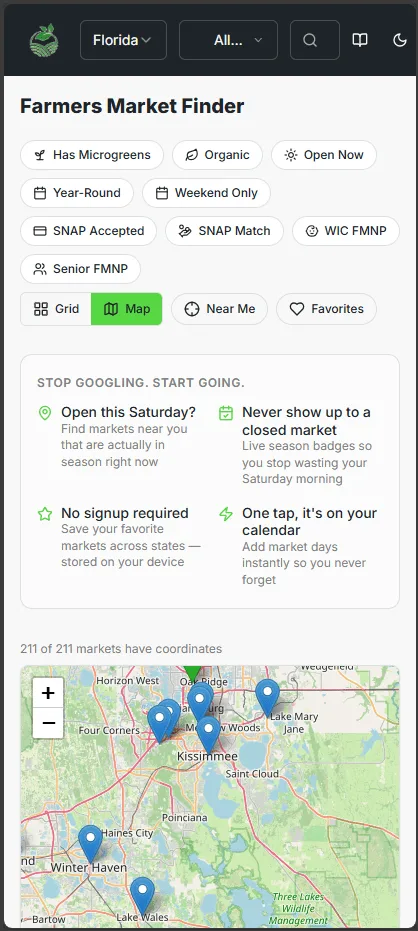
Works on your phone
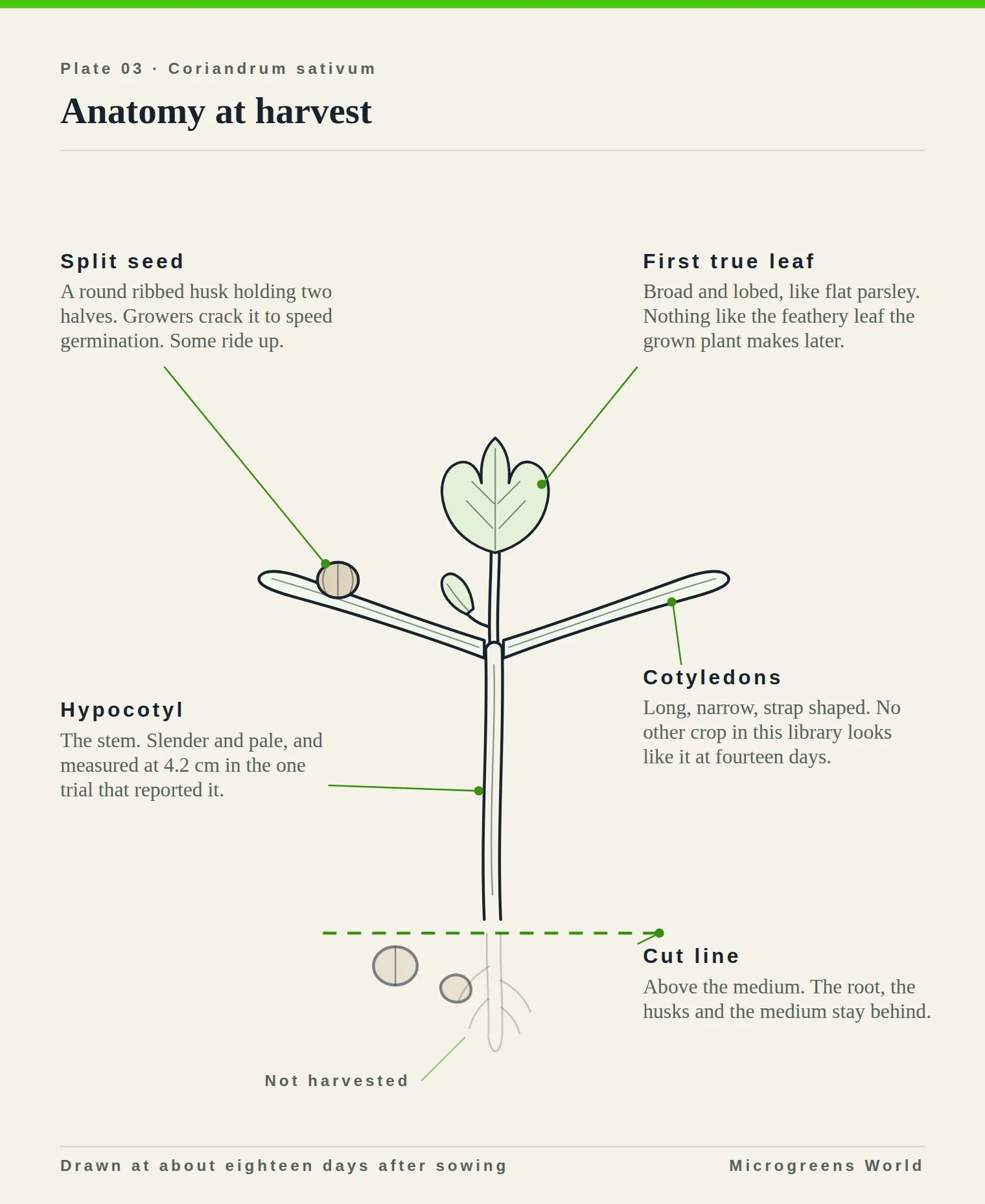
Cilantro, and the panel that put it top of twelve.
Fifty-four tasters rated twelve species side by side. Coriander took the joint highest score. It also finished twenty-first of twenty-five for vitamin C. Saying both halves out loud is what makes a buyer trust the first one.
Guide No. 05 gives you both halves, the six questions a buyer asks at a stall, and three printed sheets carrying your farm name.
Commercial license $47. Personal edition $7. Every figure traced to a table in the source paper, and reissued when the research moves.

