
Microgreens World
Your weekly source for microgreens science, business & growing news
Industry
Thirteen Produce Suppliers Were Paid in Full Days Before 80 Acres Filed. Everyone Else Is Behind $112 Million.
Thirteen produce suppliers were paid in full in the twelve days before 80 Acres Urban Agriculture, Inc. filed for Chapter 7 on Aug. 25. The debtors’ own Global Notes, filed with the schedules two days later, name every one and date every payment. Dynasty Fresh International took $500,000 on Aug. 14. Mister Specialties took $465,000 on Aug. 17. Brodasi, trading as Dosner Organic Farms, took $312,406. Then Salmiana at $200,000, Mountain Spring Organics at $148,000, Vannini Farms at $102,162, Gourmet Xpress at $80,000, Calalu trading as California Specialty Farms at $45,000, Ojai Farms at $36,000, Fresh Grown Farms at $27,172.75, Taylors Herb Gardens at $25,731, Green Harvest Sales at $18,000 and B&W Quality Growers at $7,000. Fresh Grown Farms took a further $38,656.50 across two affiliates on Aug. 24, the day before the petition. The settlements total $2,005,128.25.
What separated those thirteen from everyone else was PACA. The Perishable Agricultural Commodities Act places sellers of fresh produce into a statutory trust over a buyer’s produce inventory, receivables and proceeds, and that trust sits ahead of the secured lenders rather than behind them. The company settled and paid. Its Global Notes state the belief that the settlements “satisfied all PACA Liabilities,” while conceding that to the extent any liabilities were still pending on the petition date, vendors “may assert that they are beneficiaries of a PACA Trust.”
The numbers behind that queue are worth seeing whole. Schedule D lists $112,321,651 in secured claims: Blue Ridge Bank at $72,500,005, Horizon Technology Finance at $22,254,979 on a term loan and $10,000,000 on an asset-based line, and Fifth Third Bank at $7,566,667. Schedule E/F lists $27,034,174.97 in nonpriority unsecured claims, plus priority claims recorded as undetermined. Scheduled assets total $243,002,755.60, of which $4,200,019.55 is real property. Cash on the petition date was $75,200.90. Twelve affiliated debtors are in the filing, Soli Organic, Inc. among them.
Then the case turned. On Sept. 3 trustee George L. Miller filed a notice converting it from no-asset to asset, stating that he had “after due inquiry, discovered assets,” and asked the clerk to fix a bar date. The clerk did so the next morning. Proofs of claim are now due Dec. 7, 2026. The Section 341 meeting of creditors is set for Sept. 21 at 11:00 a.m. by Zoom before Judge Brendan Linehan Shannon’s court. Until Sept. 3 an unpaid vendor had no particular reason to file anything. Now there is a deadline and a reason to meet it.
Here is my read, and it is the practical part. Microgreens are a perishable agricultural commodity. If you sell wholesale to a distributor, a retailer or a restaurant group, the difference between the thirteen names above and the several hundred on the creditor matrix comes down substantially to whether trust rights were preserved, which turns on invoice language and notice timing rather than on how good your relationship with the buyer was. I am not a lawyer and none of this is legal advice. But if you have never checked whether your invoices carry PACA trust language, this filing is the argument for asking someone who is qualified, while nobody owes you anything.
Follow-up: what the PACA trust means for growers selling wholesale
U.S. Bankruptcy Court, District of Delaware · deb.uscourts.gov · In re 80 Acres Urban Agriculture, Inc., Case 26-11324-BLS, Docs 8, 17 and 18
Lighting & Biofortification
Blue LED Wattage and Selenium Dose Pulled Red Cabbage Microgreens in Different Directions
A Diponegoro University team ran red cabbage microgreens through a split-plot trial crossing three blue LED power levels (12, 15 and 18 watts) with four selenium concentrations (0, 20, 40 and 60 µM), three replications, 36 experimental units, grown October to November 2024. The 18-watt blue treatment raised shoot fresh weight and water content. Selenium at 20 µM raised carotenoids. Total anthocyanin peaked somewhere else again, at 18 watts combined with 40 µM selenium. Three outcomes, three different winning settings, which is the useful part: there is no single dial position that maximises everything at once. The abstract reports which treatments were effective but does not give percentage changes, so treat this as a direction to test rather than a number to quote. A note on venue, since readers ask: this is an Indonesian open-access agronomy journal indexed in DOAJ, and the design is a conventional replicated split plot.
Jurnal Agrotek Tropika · doi.org · Vol. 14, No. 3, 2026
Not on the List Yet?
Every Friday, before you open the stall.
Every week I round up the best microgreens news, growing tips, and research, straight to your inbox. No fluff. Just the good stuff.
Systems Design
A Saffron Rig Built Around a Microgreens Companion Crop, With Nothing Grown in It Yet
Four engineers at Thapar Institute in Punjab have published a design for a hydroponic saffron system that runs microgreens alongside the corms. The reasoning is the interesting part. Saffron is regionally confined, labour-intensive to harvest and vulnerable to a failed season, and the corms sit dormant for long stretches, so the chamber earns nothing for much of the year. Their answer was to find a single set of conditions that suits both crops, which they did by reading 90 research articles on nutrient solutions across saffron and microgreens. The shared envelope they landed on is 18 to 22 degrees Celsius (64.4 to 71.6 Fahrenheit), 50 to 70 per cent humidity, and nutrient solution pH between 6.0 and 7.0. The build is deliberately cheap: homemade plastic boxes for the growth chamber and nutrient tank, an Arduino Uno and a NodeMCU ESP8266 logging to Thingspeak, a DHT11 for temperature and humidity, plus pH, turbidity and an ultrasonic height sensor chosen specifically so nothing has to touch the saffron stigmas. Nutrients come from banana peel tea, sprouted mung bean water, seaweed extract and wood ash, with coconut water for pre-germination. Read the tense before you read the results, because there are none. The abstract says sensor integration “will be accomplished” and the nutrient solution “will be chosen.” This is a proposed architecture, not a harvest. It also appeared at a computing conference rather than a horticulture one, and the authors are from a computer science and engineering department, so the agronomy rests on their literature survey rather than on trials of their own. Vertical Farm Daily surfaced it on Sept. 3, which is how it reached this page.
Kaur, Kaur, Kalirao & Garg, ICICC 2026 · doi.org · Lecture Notes in Networks and Systems, Vol. 2052, 2026
Operations
A New Brunswick Vertical Farm Goes Up for Sale, and Demand Was Not the Reason
CBC reported on Aug. 31 that Enogrow, seven years after launching as the future of local agriculture, is up for sale. The owner told CBC that a labour shortage has left staff working 70-hour weeks. That is the whole of what the broadcast piece states, and it is worth not stretching it further. For background, and dating it clearly: a February 2024 VerticalFarmDaily listing described Enogrow as established in 2019, housed in a 24,000-square-foot former school building in Saint-Leolin on the Acadian Peninsula, growing lettuces, fine herbs, shoots, microgreens and edible flowers alongside processed and ready-to-eat products, with a commercial kitchen on site. That same 2024 piece quoted founder Daniel Ratte saying he needed to produce at least 4,100 more heads of lettuce a year to absorb an 8.9 per cent electricity rate rise. Two years on, the constraint being named is people rather than power.
CBC via Yahoo News Canada · ca.news.yahoo.com · 31 August 2026
Grants
Chicago Opens $10,000 Grants to Farmers Market Operators, Closing Sept. 25
Chicago launched the Neighborhood Market Grant Program on Aug. 28, offering one-time awards of up to $10,000 to retail, food and beverage small-business owners and farmers market operators located in what the city calls priority geographies. Allies for Community Business put $450,000 into the pot, funded through the Chicago Road to Recovery Plan. Eligible uses are broad in a way that matters to a small grower: equipment purchases, market operations, marketing and outreach, and improvements aimed at keeping markets open year-round. Applications close Sept. 25 at 5 p.m., with Spanish-language applications opening in early September. The programme follows the abrupt closure of seven Save A Lot grocery stores on the South and West sides in July. If you are outside Chicago, the transferable point is that municipal food-access money is increasingly reaching market operators directly, and those windows are short.
WBEZ Chicago · wbez.org · 31 August 2026
Substrates · Product Announcement
A Poured Gel Substrate Aims at the Uneven Tray. The Evidence Is Still to Come.
Jiffy Gel ships as a concentrated powder, is mixed on site, pours as a liquid and sets solid before seeding. Water and nutrients go in during mixing rather than after filling. Jiffy says the poured surface improves seed-to-substrate contact, leaves less debris so trays reset faster, and that the dried powders and the heat used in mixing reduce pressure from fungus gnats, mould and disease. The mechanism is plausible and tray inconsistency is a real cost, so the idea deserves a look. What does not exist yet is evidence. The piece ran in HortiDaily as supplier material carrying Jiffy’s own images, and every claim describes what the product can support rather than what it did in a trial. No germination rate, no cost per tray, no comparison against peat, coir or hemp mat. That is the ordinary condition of a launch rather than a mark against the product, but it is not enough to switch a production line on. Ask any substrate supplier for the same four things: trial data against your current media on your crops, cost per tray at your volume, what the mixing equipment costs to buy and run, and whether it behaves the same under a fast brassica as a slow one. We will publish those numbers against a named control the day they exist.
HortiDaily · hortidaily.com · 2 September 2026
Grants
A Grand Rapids Grower Won $13,902 to Turn Surplus Microgreens Into Freeze-Dried Spice Blends
Danelle Owens of Grown Hydroponic Farms in Grand Rapids is one of five Michigan recipients in the 2026 NCR-SARE Farmer Rancher Grant Program. Her award of $13,902 funds a no-waste system that converts hydroponically grown microgreens into freeze-dried spice blends, with the stated aims of cutting waste, extending shelf life and opening a new income line for small farms. That is the whole of what MSU Extension published, and the project has not run yet, so there are no yields, no costs and no results to report. The reason it belongs in this issue anyway is that it names the problem most small growers have and few solve: a crop with a seven-day window and no second market for whatever does not sell. Freeze-drying is one answer. The Farmer Rancher programme funds on-farm research across twelve North Central states and is open to growers rather than institutions, which makes it a realistic route for a reader with a question worth testing. NCR-SARE has changed some grant timelines for the coming cycle and is directing applicants to its mailing list for release dates.
MSU Extension · canr.msu.edu · 28 August 2026
International
A 100 Square Foot Room in Coimbatore, and a Profit Figure Worth Reading Twice
Vignesh P grows microgreens on racks inside a ten-by-ten air-conditioned room on his farm in Coimbatore, Tamil Nadu. He completed a BCA in 2013, worked for a gold jewellery company, and in 2015 built a vertical Nutrient Film Technique system that he abandoned when customers would not pay around Rs 70 for a bunch of hydroponic vegetables. He switched to microgreens, fitted 64 trays into the spare room, and produced between 10 and 25 kg a week depending on demand, starting with broccoli and alfalfa and selling direct before moving into supermarkets. Now the numbers, and the care they need. He told 30Stades, whom The Economic Times is quoting, that the room turns roughly Rs 3 lakh in monthly revenue and about Rs 2 lakh in monthly profit. The annual figure of Rs 24 lakh in the headline is arithmetic on top of that, and The Economic Times says so itself, qualifying it as holding only “if that monthly profit is sustained.” These are founder-reported figures with no accounts behind them and no cost breakdown. The transferable part is not the number. It is that a hydroponic leafy-greens business failed on price and the same room succeeded growing a crop customers valued differently.
The Economic Times · economictimes.indiatimes.com · 3 September 2026
Retail
Lidl Is Putting Microgreens Kits in Front of Every Dutch Shopper for Six Weeks
From Aug. 31 to Oct. 11, Lidl Netherlands is running Lidl Tuintjes, or Lidl Mini Farms, a loyalty promotion built entirely around microgreens. Shoppers earn one stamp per ten euros spent and trade a completed card for one of six collectable growing kits: cress, radish, basil, kale, pak choi and beetroot. Each pack carries cartoon characters walking children through growing, harvesting, transport, retail and eating. Chief marketing officer Stephanie Both framed it as making healthy eating “a fun and educational adventure,” and the campaign is carried by national television, radio, outdoor, online and social advertising as well as in-store. Set aside the marketing. A discounter with national reach has decided microgreens are the crop it wants in the hands of a generation of children for six weeks, backed by a full media buy. Nobody selling microgreens has ever had category education at that scale, and it is happening in a market most readers of this page do not sell into. The question for a grower is whether anything similar is available closer to home, at a school or a market association rather than a chain.
Fruitnet · fruitnet.com · 28 August 2026
Stop writing a business plan. Answer nine questions instead.
Could you talk about your buyers and your grow cycles for an hour without notes? Most growers can. Then you open a document called Business Plan and something goes quiet.
The plan was never the problem, and a template is still a blank page with labels on it. What was missing is being asked.
Nine blocks, in buyers-before-trays order. You start with who buys and you finish with what it costs. Set aside an afternoon and walk out ready for the conversations you have been putting off.
One payment of $197, yours to keep, with no subscription behind it. Complete it or get your money back.
Read Your Own Invoice
Thirteen produce vendors were paid in full before 80 Acres filed because they had PACA trust rights. Pull up the invoice template you send wholesale buyers and find out whether it carries the trust language. Ask a lawyer, not us.
Owed Money? Dec. 7
The trustee turned this into an asset case on Sept. 3, so proofs of claim now matter. If you hold an unpaid 80 Acres or Soli Organic invoice, the bar date is Dec. 7 and the creditor meeting is Sept. 21 by Zoom.
Price Your Surplus
A Grand Rapids grower won public money to freeze-dry unsold microgreens into spice blends. Work out what your weekly surplus actually costs you, then whether a shelf-stable second product would earn more than the compost pile.
Count Your Own Hours
Enogrow is selling a farm that has demand, not one that lacks it, because a labour shortage left staff on 70-hour weeks. Put a real hourly figure on your harvest and delivery time this month. If it embarrasses you, that is the constraint, not sales.
Chicago Growers: Apply
The Neighborhood Market Grant closes Sept. 25 at 5 p.m. Up to $10,000, usable for equipment, market operations and marketing. If you sell at a Chicago market in a priority area, this is a short window.
Test One Lighting Change
The red cabbage trial found 18-watt blue LED raised shoot fresh weight and water content. Run one tray at your usual setting and one brighter, weigh both at harvest, and keep the record.
Sept. 21, 2026
80 Acres 341 Meeting · Creditors meet the trustee, 11:00 a.m. by Zoom.
Sept. 25, 2026
Chicago Neighborhood Market Grant · Applications close at 5 p.m. Awards up to $10,000.
Dec. 7, 2026
80 Acres Claims Bar Date · Proofs of claim due. Set after the case converted to asset.
Now In Stores
AeroFarms Micro Arugula · Whole Foods Market nationwide from late August, two-ounce pack.
Now In Stores
AeroFarms Micro Broccoli · Costco club pack, six ounces, members only.
Ongoing
Enogrow Sale · The Saint-Leolin farm is listed while it continues producing.
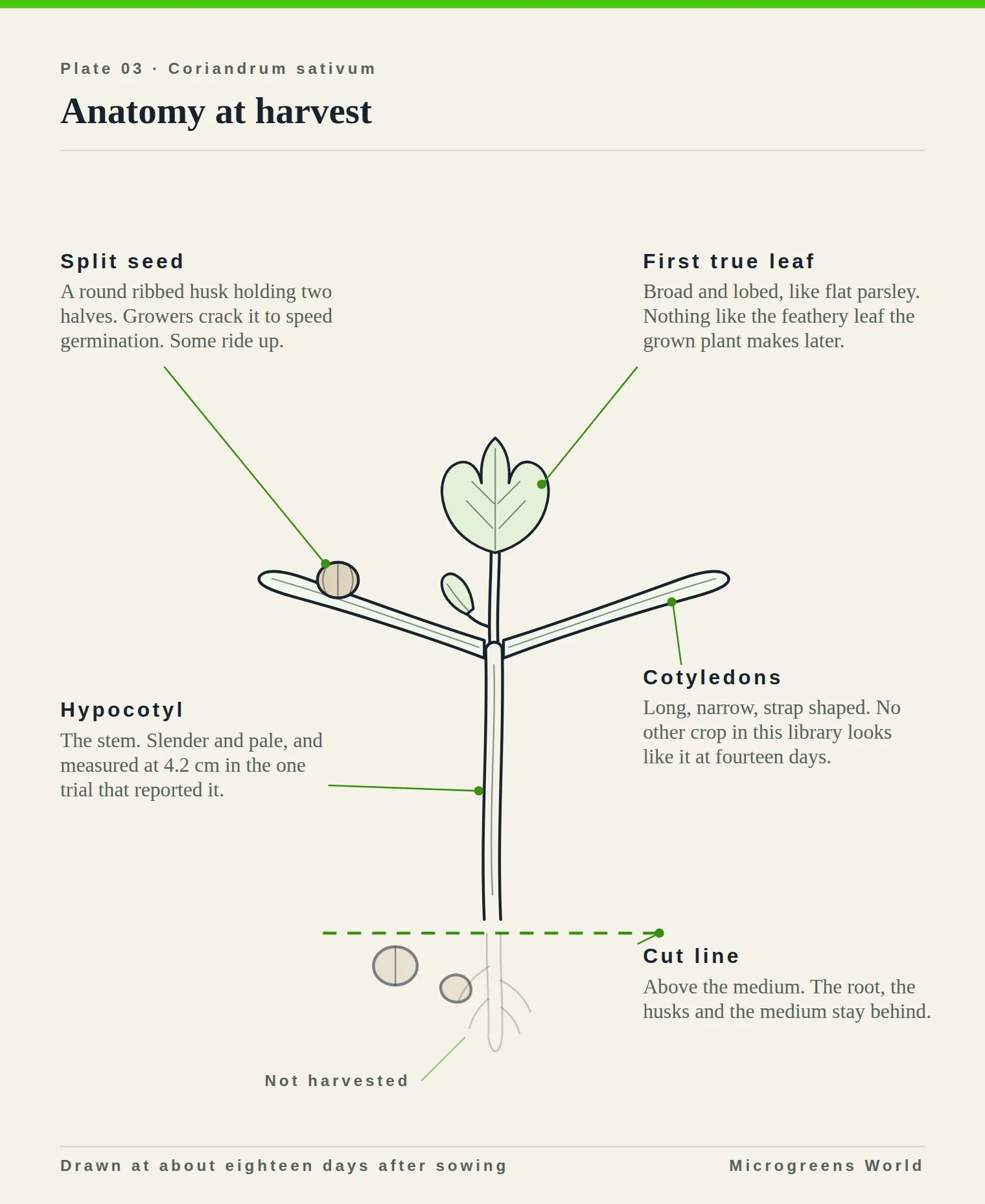
Cilantro won the taste panel. We printed the part it lost.
A customer picks up your punnet, checks the price, and asks what makes it worth seven dollars. You get about three seconds.
Fifty-four tasters rated twelve species side by side. Coriander took the joint highest score and the best looking tray of the lot. It also finished twenty-first of twenty-five for vitamin C. Saying the second half out loud is what makes the first half land.
Guide No. 05 hands you both halves, the six questions a buyer asks at a stall, and three printed sheets carrying your farm name.
Commercial license $47. Personal edition $7. Every figure traced to a table in the source paper, and reissued when the research moves.
Find yours. The Market Finder maps markets near you and flags the ones carrying microgreens. No signup, no account. Pick one and go.
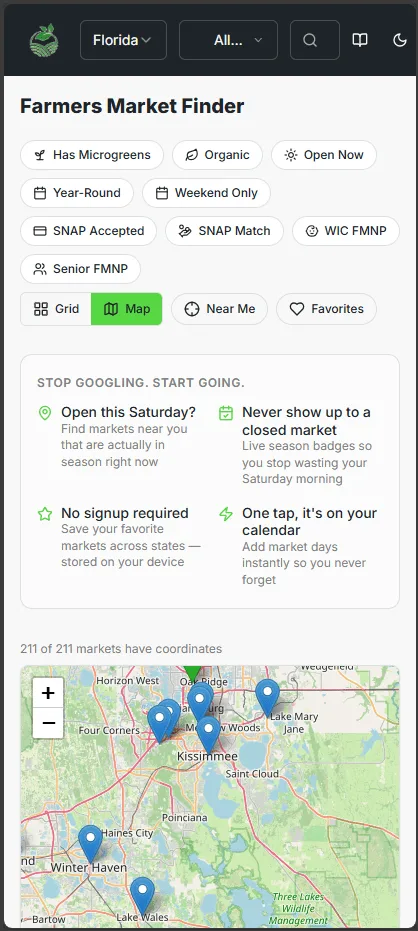
Works on your phone

